You lean over the orchid and notice a young root pushing its glossy green tip out from between the leaves and holding it just beyond the rim of the pot. There is no path laid out in front of it: dry air on one side, damper bark on the other, the outer pot below, a windowpane nearby, and somewhere in the vicinity a human already wondering whether nature might appreciate a little help and everything ought to be pushed back inside.
It ought not.
A root has no eyes, no nose and no map. It cannot hear rain, it does not remember where the watering can stood last time, and it does not even know that such a thing as a flowerpot exists. And yet it can change the direction of its growth in response to differences in water availability — and “differences” is the crucial word here.
It is very easy to say: Phalaenopsis roots grow towards water. Then you look at an orchid with damp bark in the pot while its newest root marches off across the windowsill, and quite reasonably ask:
The water is there. So where on earth is it going?
To answer that, we first need to bake some bread.
In this article Click to expand ↓ Click to collapse ↑
- Let’s bake bread: what a gradient really is
- A root does not walk. It grows into the road ahead
- The experiment in which water got a vote
- Or is it simply gravity?
- Why would an epiphyte need such a trick?
- And then along comes a photograph that ruins everything
- The water is below. The gradient may not be
- So why does a root leave a regularly watered pot?
- The pot exists for us, not for the orchid
- Moisture, light and gravity call a board meeting
- Who actually senses the water? (expandable section)
- And what does the velamen have to say?
- Not every bend is hydrotropism
- Is an aerial root asking to be watered?
- What did this root actually teach us?
- Touching moisture
A glossary for people who thought a root simply got on with growing Click to expand ↓ Click to collapse ↑
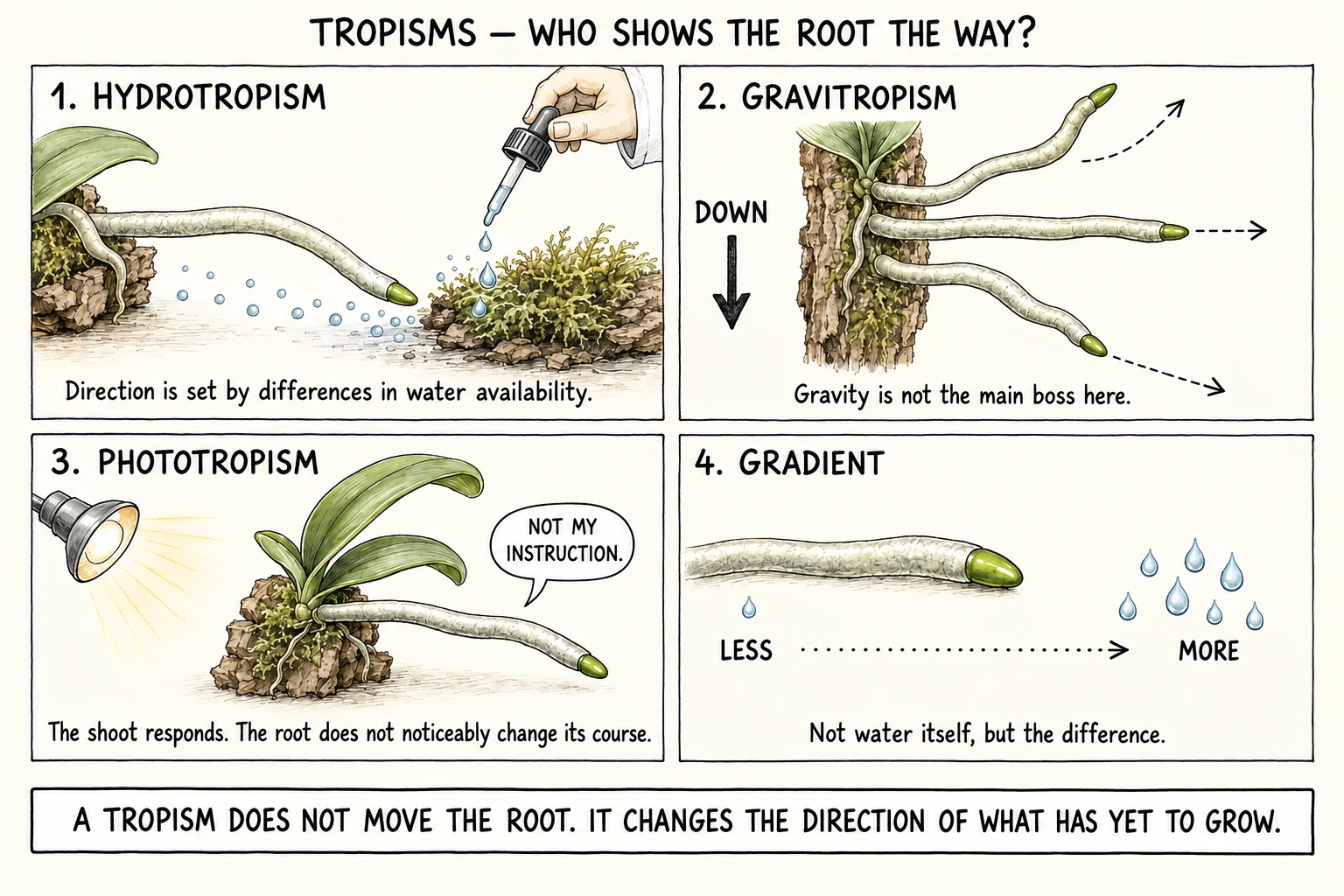
Tropism is a directional growth response of a plant to a stimulus. A plant does not move towards the stimulus as an animal would; it changes the way it grows from that point onwards. It is movement at a pace suitable for someone who is in no hurry, because in any case it will probably outlive most of our resolutions.
Hydrotropism is a directional growth response associated with differences in water availability around a growing organ. It does not mean that a root has radar for detecting the nearest puddle. That distinction will become very important in a moment.
Gradient means a gradual change in some quantity across space. Here, we are interested in differences in conditions related to water availability: less favourable here, more favourable a little farther away. The word sounds as though a calculator ought to appear at any moment, so we shall explain it with a loaf of bread instead.
Gravitropism is a directional growth response to gravity. The roots of many plants show positive gravitropism and grow in the direction in which gravity acts. The aerial roots of the Phalaenopsis aphrodite studied, however, did not seem to consider “down” the only direction worthy of respect.
Phototropism is a directional growth response to light. In experiments with Phalaenopsis aphrodite, light did not determine the direction of aerial-root growth. The lamp may have looked impressive, but in this particular conversation it did not get a vote.
Hydrostimulation means applying a local stimulus related to water availability in such a way that researchers can test whether it influences the direction of root growth.
Let’s bake bread: what a gradient really is
Imagine that someone is baking bread. You walk into the house and already in the hall you catch a faint smell. As you go farther, it becomes stronger. By the kitchen door the situation is obvious, and once you are standing beside the oven you start looking for the butter.
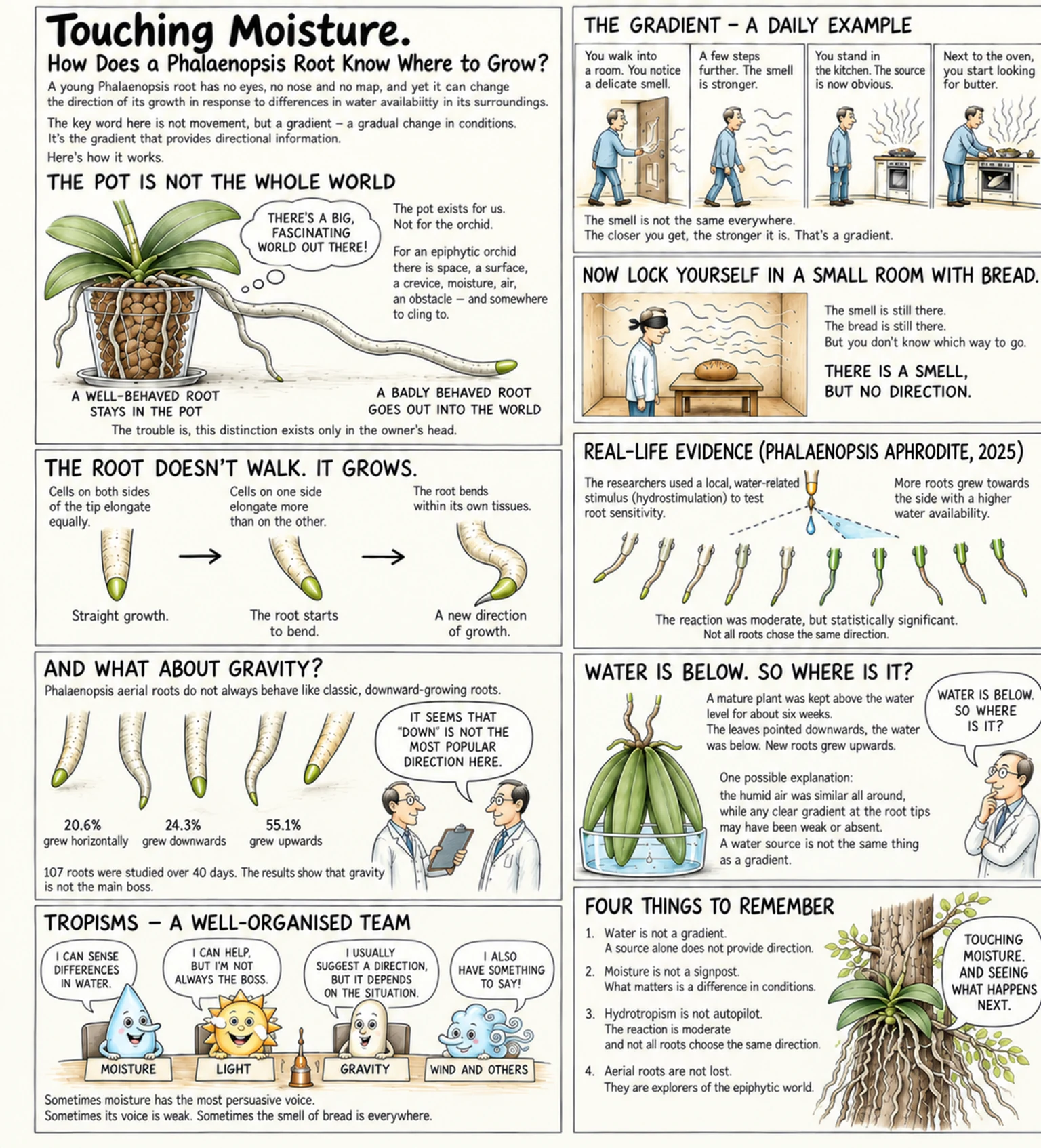
You have not seen the bread and nobody has given you its coordinates, yet you found the kitchen without much difficulty. Why? Because the smell was not equally strong everywhere: weaker in one place, stronger in another, and stronger still as you approached the source. That is the simplest way to picture a gradient — a situation in which there is less of something here, more of it there, and a gradual change between the two.
A root does not, of course, smell water. It has neither a nose nor a secret olfactory laboratory hidden under the velamen. But the bread analogy shows us something fundamental: the mere existence of a source is not enough to indicate direction; there has to be a difference.
A young root is therefore not asking: “Where is the water?” A question much closer to reality would be: “Are conditions related to water availability different on one side of me than on the other?” If they are, directional information becomes available. If they are not, water may be very close indeed and still fail to provide a signpost.
Now let us change the conditions of our bread experiment. Instead of walking through a large house, shut yourself in a small room with a freshly baked loaf. After a while it smells of bread everywhere: to the left, to the right, above your head and behind you. Neither the bread nor its smell has disappeared, but if the intensity is almost the same everywhere, the smell stops being a useful guide. You know that the loaf is somewhere in the room, but the aroma no longer tells you clearly which way to take the next step.
There is a smell, but no direction.
And that is why a great deal of moisture does not automatically mean a strong gradient. We can create a very humid environment around a root without creating a clear difference between one side of its growing tip and the other. The two are not synonymous: moisture describes the conditions; a gradient can provide information about direction.
A root does not walk. It grows into the road ahead
When an animal wants to reach water, it moves its entire body. A root does not have that luxury. The part already formed does not detach itself from the plant and crawl across the windowsill like a thirsty earthworm. Direction is altered mainly by the young, actively growing region.
If growth on one side of the growing zone differs from growth on the other, further development becomes asymmetrical and a bend can form. The root does not turn a steering wheel; it builds the bend out of its own tissues.
This distinction matters, because hydrotropism does not mean that an old silvery section of root suddenly changes its mind and arranges itself towards damp bark. The mature part has other jobs: taking up water, passing it onwards, participating in gas exchange, storing, protecting and helping to anchor the plant to a surface. The decision about the route ahead is written chiefly by the active tip.
The silvery part handles logistics while the green tip negotiates with the future.
The experiment in which water got a vote
In 2025, Hua-Chen Chang and colleagues described the responses of aerial roots in Phalaenopsis aphrodite. It is an especially valuable study for people interested in these orchids because, for once, we are not dressing up Arabidopsis in velamen and pretending that everything must work in exactly the same way. They studied an actual Phalaenopsis.
The researchers wanted to know what might determine the direction in which its aerial roots grow. They began with light. The shoot responded to its position, but the aerial roots did not show the sort of directional response that would allow phototropism to be regarded as the mechanism guiding their growth. Light put on a show; the root apparently declined to buy a ticket.
Next came water. The researchers created a system in which they could alter locally the conditions associated with water availability and compare the behaviour of young roots under control conditions and after hydrostimulation. In the controls, roots grew in different directions. They did not form an orderly queue and march downwards like a military unit.
After a directional water-related stimulus was applied, the proportion of plants in which at least one young root continued growing towards the side with greater water availability increased. When the position of the hydrostimulation was changed, the root response changed as well. It was this repeatable relationship between the position of the stimulus and a change in growth orientation that allowed the authors to speak of hydrotropism.
STOP before the internet turns this into a slogan. The authors described the response as moderate but statistically significant. They did not show that “every Phalaenopsis root always grows towards water”. They showed that in the Phalaenopsis aphrodite studied, a local stimulus associated with water availability significantly altered the probability of a particular growth orientation in young aerial roots.
That explanation is more subtle — and much more interesting.
Or is it simply gravity?
You might shrug and ask whether, if the water was lower down and more roots turned downwards after hydrostimulation, we need hydrotropism at all. Perhaps the root is simply doing what roots are supposed to do and responding to gravity?
Except that the response of Phalaenopsis aphrodite aerial roots to gravity was examined separately. Roots were initially positioned horizontally and observed for 40 days. If they were guided by typical positive gravitropism, we should expect a clear turn downwards.
Instead, of the 107 roots examined, 20.6% continued growing horizontally, 24.3% turned downwards, and no less than:
The direction of their growth therefore did not show the usual dependence on gravity.
That number is worth remembering, because in a moment we shall meet roots growing upwards even though the water is below them. Upward growth in an aerial root of Phalaenopsis aphrodite is not, in itself, behaviour that requires the immediate appointment of a parliamentary inquiry.
Why would an epiphyte need such a trick?
For an orchid growing on a tree, water is not a permanent fixture waiting beneath an even layer of soil. It appears after rain, runs over bark, collects in branch crevices, moss, lichens and decomposing organic matter — and then disappears.
A root able to modify the route of its young growth in response to a local difference in water availability improves its chances of reaching a place that offers water, dissolved mineral nutrients and a surface to cling to. It does not need a map of the entire tree. Information from the immediate surroundings is enough: conditions are less favourable here, slightly better there, so it may be worth building the next millimetre in that direction.
Once the root reaches a suitable surface, it stops being merely an explorer. It can attach itself, while the velamen rapidly absorbs water and helps capture substances dissolved in it. Hydrotropism need not guide a root to a lake. It is enough if it slightly improves the plant’s odds in a world where water availability is extremely uneven in both space and time.
An epiphyte is not a parasite draining the tree. The tree provides mainly a place to live. Water and mineral nutrients are obtained from rainfall, water running over surfaces, dust and organic matter. In such a world, the ability to respond to local differences in water conditions is not botanical eccentricity. It can be very practical equipment indeed.
And then along comes a photograph that ruins everything
Or at least that is how it looks at first glance when we see the result of a home rescue attempt.
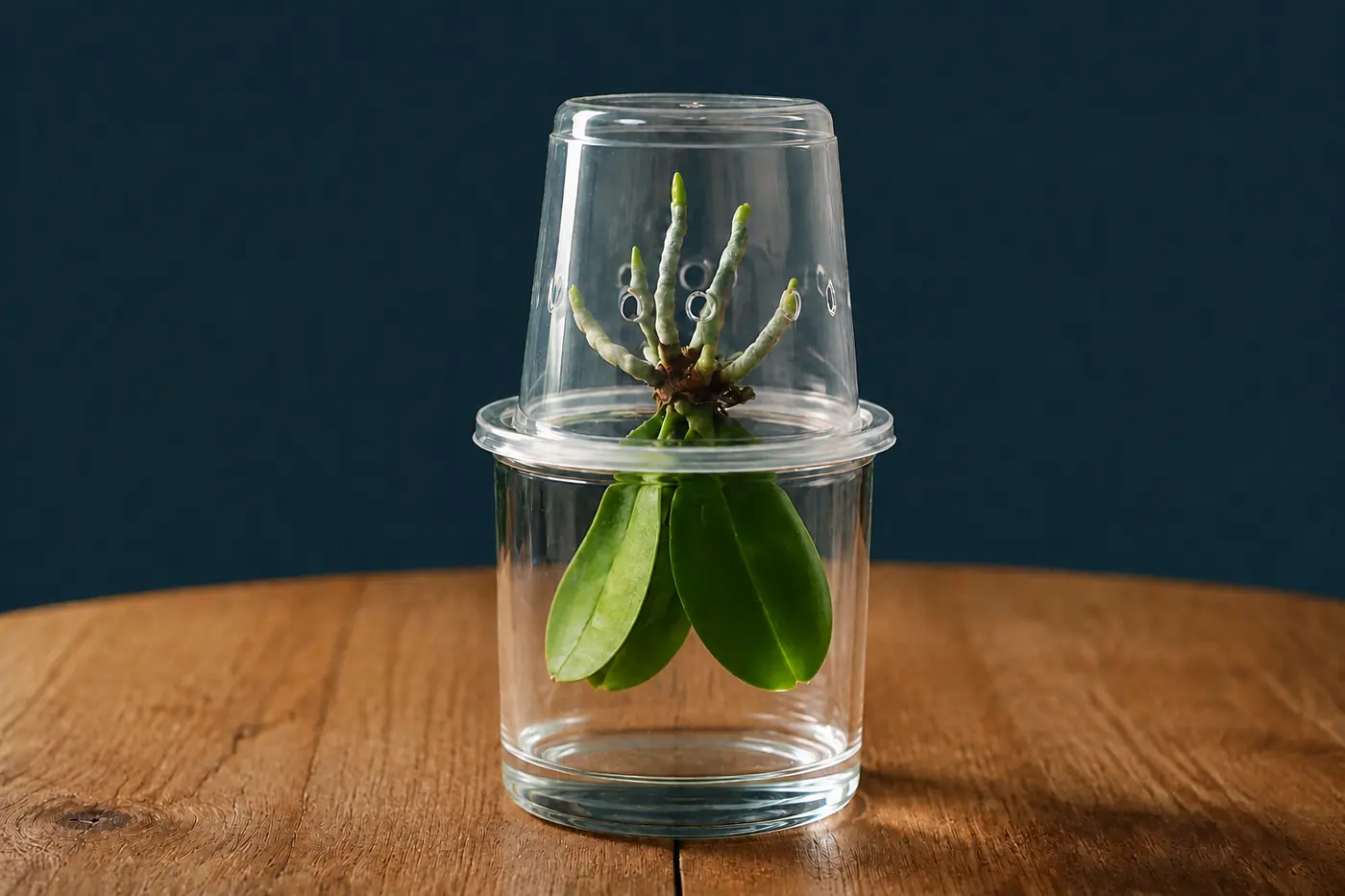
The photograph shows a Phalaenopsis that had lost virtually its entire root system and remained for around six weeks suspended above a vessel containing water. Throughout that time it stayed in the same position: the leaves pointed downwards towards the water, while the stem was above them.
After six weeks, the plant produced new roots that grew upwards.
The water was below. Fine. So where on earth is it going?
If all we remembered from the whole story of hydrotropism was “Phalaenopsis roots grow towards water”, we now have a serious problem. If, however, we understood the gradient, the photograph begins to tell a very different story.
The water is below. The gradient may not be
The fact that a vessel of water stood below the plant tells us where the water source was. It does not tell us how water-related conditions were distributed immediately around the growing root tips. Those are two entirely different pieces of information.
The water was evaporating, and the plant occupied a relatively small space partly enclosed by a plastic cup. It is reasonable to suppose that the air inside was humid. But humidity was not measured at different points in that space, and above all we do not know what difference in conditions existed on opposite sides of the growing root tips.
We therefore cannot say that the roots displayed negative hydrotropism and were “escaping from the water”. Nor can we claim that it was more humid above them and that this was why they grew upwards. We have no data to support either interpretation.
We can, however, offer a possible explanation showing why the photograph does not contradict the controlled experiment. And here our loaf of bread returns.
If we shut a freshly baked loaf in a small room, after a while the whole room may smell of bread. The source is still there, but differences in smell intensity from place to place become small, making the aroma increasingly useless as a signpost. If the humid microenvironment around those roots was similarly even, the directional hydrotropic signal may have been weak. The roots could therefore have continued along their own growth trajectories rather than performing a spectacular U-turn towards the water surface.
This is a hypothesis, not a verdict on that particular case. Without measurements of the gradient at the growing tips, the honest answer is: we do not know what water-related signal actually reached them. And that is precisely what makes the photograph so interesting. It shows how easily two things can be confused: the presence of a water source and the presence of a clear directional gradient at the root.
So why does a root leave a regularly watered pot?
This is the second objection that Phalaenopsis itself raises against an over-simple explanation of hydrotropism. We have a healthy plant. We water it regularly. The pot contains damp bark and plenty of healthy roots. And then the plant produces another root which, rather than entering the potting medium, sets off horizontally across the windowsill.
Once again: the water is there. So where on earth is it going?
The problem is that we can see the whole pot, while the root cannot. Imagine a young tip emerging from the stem several centimetres above the surface of the potting medium. To the left is air. To the right is air. Straight ahead is air as well. The damp bark is below.
Hydrotropism does not mean that the plant calculates the average moisture content of the entire pot, compares it with the humidity of the sitting room and sends the root a set of coordinates: “three centimetres down, slightly to the right”. What matters is the local environment of the actively growing tip. If there is no sufficiently clear difference there to indicate the direction of the bark, wet potting medium may be extremely close and the root may still receive no unambiguous water-related signpost.
Nor is the pot a stable source of one unchanging signal. Immediately after watering, the medium is wet, then very damp, then merely damp, later almost dry, until eventually a human reappears with the watering can. The gradient therefore changes not only in space but also over time.
Our bakery simply has exceptionally irritating opening hours. In the morning it bakes furiously and perfumes half the street; in the afternoon it switches the oven off; in the evening it opens every window; the next day it does not bake at all. Navigation by smell alone is suddenly rather less straightforward.
For an epiphyte, however, none of this is chaos. A surface soaked by rain on a branch may be only slightly damp a few hours later and completely dry after that. Water appears, moves and disappears. That is precisely the sort of changeable world in which the root operates.
The pot exists for us, not for the orchid
This is probably the simplest explanation for many arguments about aerial roots. Phalaenopsis did not evolve in a transparent size-12 plastic pot. It knows nothing of the biological categories “well-behaved root staying inside” and “disobedient root that has escaped”.
For an epiphyte, there is space, a surface, a crevice, moisture, air, an obstacle and somewhere to cling to. A root growing outside the pot is therefore neither a defective pot root nor automatic evidence that the plant is dehydrated. It is a perfectly normal epiphytic root exploring its surroundings.
Hydrotropism can influence its route if a suitable local gradient appears, but it is not a safety system designed to keep every root inside a plastic container. A well-behaved root stays in the pot and a badly behaved root goes out into the world — except that this distinction exists only in the owner’s head.
Moisture, light and gravity call a board meeting
A root never receives only one signal. At the same time it experiences humidity, temperature, light, gravity, surface contact, obstacles, salts and changes in its surroundings. These signals need not all act with equal strength, and not every one of them will provide useful directional information at any particular moment.
In the aerial roots of Phalaenopsis aphrodite, experiments did not reveal a typical gravitropic response or show light directing root growth. A local water-related stimulus, on the other hand, was capable of changing orientation to a statistically significant degree. Even that, however, is not a remote control with a single button.
Tropisms are more like a board meeting in which every participant has arrived with a presentation. Sometimes moisture has the most persuasive slides. Sometimes its voice is weak. And sometimes the whole room smells of bread and the navigation department has nothing useful to add.
Who actually senses the water? Click to expand ↓ Click to collapse ↑
Here the story becomes more complicated — and therefore much more interesting. In studies of hydrotropism in various plants, an important role has been attributed, among other things, to the root cap, which may detect differences in water availability and transmit a signal to the growing zone. It has become clear, however, that there is no single mechanism shared by all plants.
In the model plant Arabidopsis thaliana, hydrotropism involves, among other factors, the MIZ1 protein, abscisic-acid-dependent signalling and changes in the growth of cortex cells. We also know that hydrotropism and gravitropism need not use identical control mechanisms. A root may therefore process the messages “that way is down” and “water conditions are better that way” differently.
It would be wonderfully convenient to write that Phalaenopsis aphrodite works in exactly the same way. It would also be premature.
The authors of the 2025 study measured four compounds involved in plant signalling: the auxin IAA, abscisic acid ABA, salicylic acid SA and jasmonic acid JA. They compared the side of the root facing the water with the side facing the air and found no significant differences in the levels of these compounds between the two sides.
This does not prove that hormones are unimportant. It tells us only that the expected asymmetry was not detected, and that the mechanism by which a Phalaenopsis aphrodite root receives directional information about water and translates it into altered growth is still not fully understood.
We know, then, that the root received the message. We do not yet know who handed it the envelope or what alphabet was used to write the address.
Science, unlike the self-appointed expert speaking from a forty-second reel, is capable of saying: “we do not know yet”. Which is one of the reasons it is much more interesting.
And what does the velamen have to say?
Velamen is the multilayered covering on the roots of many epiphytic orchids. Its mature cells are dead, but their walls remain and form a porous structure. When this layer comes into contact with water, it rapidly absorbs it, contributes to water and mineral relations, and helps protect the living tissues of the root.
It is not, however, a nose capable of smelling a droplet at the far end of the windowsill. It is easy to confuse these two phenomena because both involve water. Hydrotropism primarily answers the question: “where should the next section of root be built?” Velamen becomes especially relevant when we ask: “what should we do with the water once it reaches the root?”
Navigation and warehousing may belong to the same company, but they are not the same department.
Not every bend is hydrotropism
In home cultivation, what we see is the final result of many overlapping events. One young root encounters damper bark and grows into the pot. Another runs along the wall. A third emerges through a drainage hole. A fourth heads horizontally across the windowsill, openly disregarding the owner’s ideas about composition.
We cannot point at the first and announce: “Aha! Hydrotropism!”, because demonstrating a tropism requires controlled conditions, a defined directional stimulus and a repeatable response. One photograph of a root bending towards wet bark is not yet a paper in Nature, even if it collected four hundred hearts.
The same rule works in the opposite direction: a root growing away from a vessel of water does not disprove hydrotropism either.
So two things are worth remembering: not every root that bends towards water proves hydrotropism, and not every root that fails to bend towards it proves its absence.
Is an aerial root asking to be watered?
Not necessarily. The presence of aerial roots in itself does not indicate dehydration. Phalaenopsis may produce them even when perfectly well hydrated, because its roots have not read the manual explaining that an elegant plant ought to keep everything inside the pot.
The need for watering is better judged from several signs together: the condition of the roots in the potting medium, the weight of the pot, how dry the bark has become, the appearance of the velamen and the condition of the plant as a whole. A root hanging over the windowsill is not a banner reading “WATER!”.
Nor should a permanently full vessel be placed beneath its tip in the hope that the orchid will install its own private plumbing. A response to a local difference in water availability and keeping a root continuously in water are two entirely different physiological issues.
What did this root actually teach us?
Not that Phalaenopsis always grows towards water, that it can detect a glass standing ten centimetres away, or that every aerial root is searching for moisture. Nor did we learn that a root which failed to turn towards water is somehow “not working properly”.
The study of Phalaenopsis aphrodite showed something subtler: young aerial roots of this species were able to alter their growth orientation in response to an appropriately created local stimulus associated with water availability. The response was moderate but statistically significant, not all roots chose the same direction, and the mechanism by which they read this information is still not fully understood.
Water is not a gradient, moisture is not a signpost, hydrotropism is not an autopilot, and an aerial root is not a root that has lost its way.
Touching moisture
A root cannot see water, hear it or smell rain. It does not know that a vessel stands five centimetres away or that damp bark lies below it. It reads its own immediate surroundings.
If conditions related to water availability on one side of the growing tip differ sufficiently from those on the other, that difference can become information. Growth on the two sides begins to proceed differently, the green tip alters its route, and every subsequent millimetre builds a bend towards a place that may offer water, support and the possibility of continuing life.
And sometimes the difference is too small to become a clear signpost. The whole room smells of bread. Moisture is present, but direction ceases to be obvious. The root is then neither running “towards water” nor “away from water”. It simply continues building its route from the information that actually reaches it.
And perhaps that is the most important lesson a Phalaenopsis root can teach us: in biology, “the water is there” does not necessarily mean “therefore the root will go there”.
Bibliography and scientific sources Click to expand ↓ Click to collapse ↑
- Chang H.-C., Chen I.-C., Chen J.-C., Hou Y.-J., Fang S.-C. (2025). Water as a Compass: Hydrostimulation-Triggered Aerial Root Growth in Phalaenopsis aphrodite. Physiologia Plantarum 177(5): e70505. https://doi.org/10.1111/ppl.70505
- Chen J.-C., Lin H.-Y., Novák O., Strnad M., Lee Y.-I., Fang S.-C. (2024). Diverse geotropic responses in the orchid family. Plant, Cell & Environment 47(10): 3828–3845. https://doi.org/10.1111/pce.14975
- Dietrich D. et al. (2017). Root hydrotropism is controlled via a cortex-specific growth mechanism. Nature Plants 3: 17057. https://doi.org/10.1038/nplants.2017.57
- Dietrich D. (2018). Hydrotropism: how roots search for water. Journal of Experimental Botany 69(11): 2759–2771. https://doi.org/10.1093/jxb/ery034
- Miyazawa Y., Takahashi H. (2020). Molecular mechanisms mediating root hydrotropism: what we have observed since the rediscovery of hydrotropism. Journal of Plant Research 133: 3–14. https://doi.org/10.1007/s10265-019-01153-3
- Iwata S., Miyazawa Y., Fujii N., Takahashi H. (2013). MIZ1-regulated hydrotropism functions in the growth and survival of Arabidopsis thaliana under natural conditions. Annals of Botany 112(1): 103–114. https://doi.org/10.1093/aob/mct098
- Zotz G., Winkler U. (2013). Aerial roots of epiphytic orchids: the velamen radicum and its role in water and nutrient uptake. Oecologia 171: 733–741. https://doi.org/10.1007/s00442-012-2575-6
- Idris N.A., Collings D.A. (2021). The orchid velamen: a model system for studying patterned secondary cell wall development. Plants 10(7): 1358. https://doi.org/10.3390/plants10071358
The Root Trilogy
← Part I: The Pharmacy at the Tip of the Root
Part II: Touching Moisture. How Does a Root Know Where Water Is Waiting? (you are here)
Part III: The Secret Garden
Copyright Marzenna Kielan, all rights reserved