Aerial roots of Phalaenopsis have a particular talent for causing anxiety. They climb out of the pot, creep across the windowsill, lean against the glass, catch on the curtain and sometimes head towards the neighbouring plant with the air of someone who has just decided to move house.
The owner watches this for a while with growing suspicion, until the inevitable question appears, as unavoidable as the electricity bill: can I cut it off?
Of course you can. You can also remove the fridge from the kitchen because it clashes with the cupboards, but before making the decision it is worth checking exactly what you are about to remove. Because that unassuming green tip, currently trying to disappear behind the pot, leads a far more interesting life than its appearance suggests. Or at least, in one thoroughly studied Phalaenopsis hybrid, the green tip turns out to have an even more interesting life than we might have imagined.
In this article
Click to expand ↓
Click to collapse ↑
- Where the root begins
- Alkaloid: a word with a bad reputation
- Not all pyrrolizidine alkaloids are the same
- How a plant builds a chemical compound
- The first station on the production line
- Where does the factory operate?
- How the root was caught in the act
- The pharmacy also delivers
- And then they discovered a branch office
- Production has stopped, but the goods are still there
- Where did HSS come from in the first place?
- Why there?
- One plant is not an entire genus
- When the green tip disappears
- So: cut it or leave it?
- An unassuming edge of a very large world
A glossary for those who came to the pharmacy and found themselves in a laboratory
Click to expand ↓
Click to collapse ↑
Meristem is a region made up of young cells capable of rapid division. Thanks to them, the root produces new tissues and continues to grow.
Velamen is the multilayered covering found on the older parts of the roots of many epiphytic orchids. It is what gives dry roots their characteristic silvery appearance.
Alkaloids are a huge group of naturally occurring nitrogen-containing organic compounds. They include substances as different as caffeine, nicotine, quinine and morphine. The word “alkaloid” does not therefore mean “poison”.
PA stands for pyrrolizidine alkaloids, one group within the alkaloids. In the Phalaenopsis plants studied, these included 1,2-saturated compounds of the phalaenopsine type.
Biosynthesis is the production of a chemical compound by a living organism from other, simpler substances.
Biosynthetic pathway means a series of consecutive chemical reactions leading to a particular product.
Enzyme is a biological tool, usually a protein, that enables a particular chemical reaction to take place.
HSS is homospermidine synthase, the first enzyme specific to the pathway leading to pyrrolizidine alkaloid biosynthesis.
Precursor is a compound used as the starting material for further chemical transformations.
Idioblast is a specialised cell that differs clearly from the surrounding cells in a tissue.
Raphides are slender, needle-like crystals of calcium oxalate stored in specialised idioblasts.
DHS is deoxyhypusine synthase, an enzyme of primary metabolism. HSS evolved from a duplicated DHS gene.
Where the root begins
From our point of view, the green tip is the end of the root. From the plant’s point of view, it is exactly the opposite: this is where the root begins.
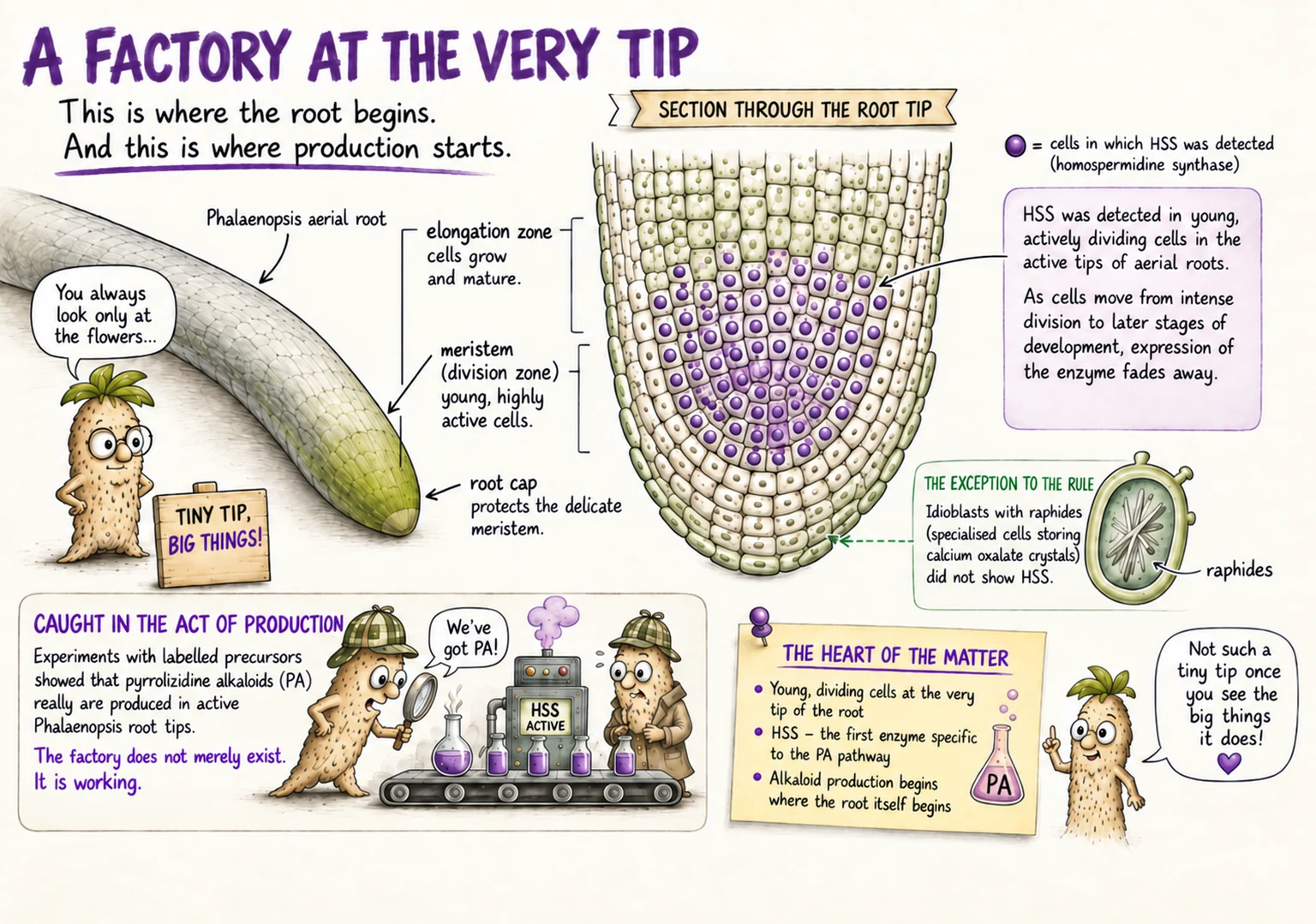
Near its tip lies the meristem, a region made up of young cells capable of rapid division. These cells allow the root to produce new tissues and continue growing. The easiest way to picture the meristem is as a building site that keeps moving forwards: new cells are produced at the front, while a little farther back they elongate, mature and take on increasingly specialised jobs.
That is why an actively growing tip looks different from the older part of the root. It is smooth, firm, usually green or greenish, and has not yet developed the mature velamen, the multilayered root covering that gives older sections their characteristic silvery appearance.
You might think that building a new root was already a sufficiently responsible occupation. Phalaenopsis apparently disagrees. Some rather interesting chemistry is going on in the same tiny region as well.
And this is where our pharmacy opens for business.
Alkaloid: a word with a bad reputation
Before we inspect the pharmacy, let us first look at what it sells.
One group of compounds produced by plants is the alkaloids. The name sounds slightly sinister, and not entirely without reason: alkaloids include nicotine, morphine and strychnine, but also caffeine and quinine.
The word “alkaloid” does not therefore mean “poison”. It describes an enormous family of nitrogen-containing organic compounds with very different properties. Plants use them, among other things, in their interactions with herbivores, insects and microorganisms, although the functions of many alkaloids are still being investigated.
Phalaenopsis can produce alkaloids too. In the studies that interest us here, these were pyrrolizidine alkaloids, abbreviated in the scientific literature to PA. The hybrids studied contained, among other compounds, substances known as phalaenopsines.
Let us stop for a moment and see what that actually means.
Not all pyrrolizidine alkaloids are the same
Some PAs found in other plants really are toxic. Of particular importance is the presence of a certain double bond in their molecules, which allows them to be converted in an animal’s body into highly reactive compounds.
The phalaenopsine-type alkaloids studied in Phalaenopsis, however, are 1,2-saturated. Chemically, they differ from the much better studied toxic 1,2-unsaturated PAs. So no: the Phalaenopsis on your windowsill is not turning the sitting room into a poison laboratory.
A much more interesting question is: why does the plant make these compounds at all?
The concentration of alkaloids in young and particularly valuable tissues suggests that they may form part of the plant’s chemical defence system. That is a perfectly reasonable ecological interpretation, but it should not be promoted to a fact that the experiments themselves did not demonstrate. We still do not know the full role of these compounds in Phalaenopsis.
The pharmacy exists, then, but we cannot yet decipher every prescription.
How a plant builds a chemical compound
An alkaloid does not appear with a single wave of a magic wand, and Ollivanders does not supply our pharmacy. The plant therefore has to manage on its own. It starts with simpler compounds and transforms them step by step into others. A whole sequence of such reactions is called a biosynthetic pathway.
Biosynthesis sounds impressive, but it simply means that a living organism makes a particular compound from other, simpler ingredients.
For these reactions to proceed efficiently, the cell needs the right tools. These are enzymes, proteins that enable particular chemical reactions to take place. If a biosynthetic pathway is a production line, enzymes are the successive workstations along it.
Let us meet one of them.
The first station on the production line
One of the most important tools near the beginning of the pathway we are interested in has a rather imposing name: homospermidine synthase, or HSS. You do not need to remember the name. What is far more interesting is why scientists were so keen to find out where HSS occurs.
HSS is the first enzyme specific to the pathway leading to pyrrolizidine alkaloid (PA) biosynthesis. Here, “specific” means that the appearance of this enzyme is already associated with this particular production line, rather than merely with the cell’s general housekeeping.
We can therefore think of HSS as a distinctive workstation near the beginning of the factory conveyor belt. The enzyme does not make the entire finished product, because further reactions are still required, but its presence reveals that the pathway leading to PAs has been switched on at this site.
Which makes the next question rather interesting: where exactly is HSS?
Where does the factory operate?
To locate it, scientists used antibodies, molecules capable of recognising particular proteins with great precision. Antibodies that recognised HSS were prepared and used to examine different Phalaenopsis tissues. Wherever the characteristic signal appeared, the enzyme could be shown to be present.
And that was when it turned out that the orchid had placed this part of its chemical factory somewhere rather peculiar: at the very tip of the root.
HSS was detected in young, actively dividing cells in the growing tips of aerial roots. As the cells moved from intense division into later stages of development, HSS expression faded away.
Our chemical factory therefore occupies a very particular site: the youngest, actively growing part of the root. And even here there is a division of labour. HSS was not detected, for example, in idioblasts containing raphides. An idioblast is a specialised cell that differs from the cells around it, while raphides are slender, needle-like crystals of calcium oxalate stored inside such cells.
Some cells divide, some store crystals, in still others the enzyme that interests us is active, and all of this is happening at the very tip of the root, in a region to which we usually pay almost no attention at all.
How the root was caught in the act
Finding HSS was a very strong clue, but the researchers had another way to test whether roots really were sites of alkaloid biosynthesis. They used labelled precursors.
A precursor is a compound that serves as the starting material for later transformations. “Labelled” means that it has been prepared in such a way that its fate can subsequently be traced.
Imagine a sack of flour in which every grain can be detected by a special instrument. Simply finding flour in a bakery does not prove that bread is being baked from it. But if the same label later turns up in a loaf, things become considerably more interesting.
Experiments using labelled precursors showed that the aerial roots of Phalaenopsis are sites of alkaloid biosynthesis. Later studies of HSS localisation indicated that the first pathway-specific step takes place in mitotically active cells at their tips.
The factory was therefore betrayed not merely by the presence of one enzyme. It was caught in the act.
The pharmacy also delivers
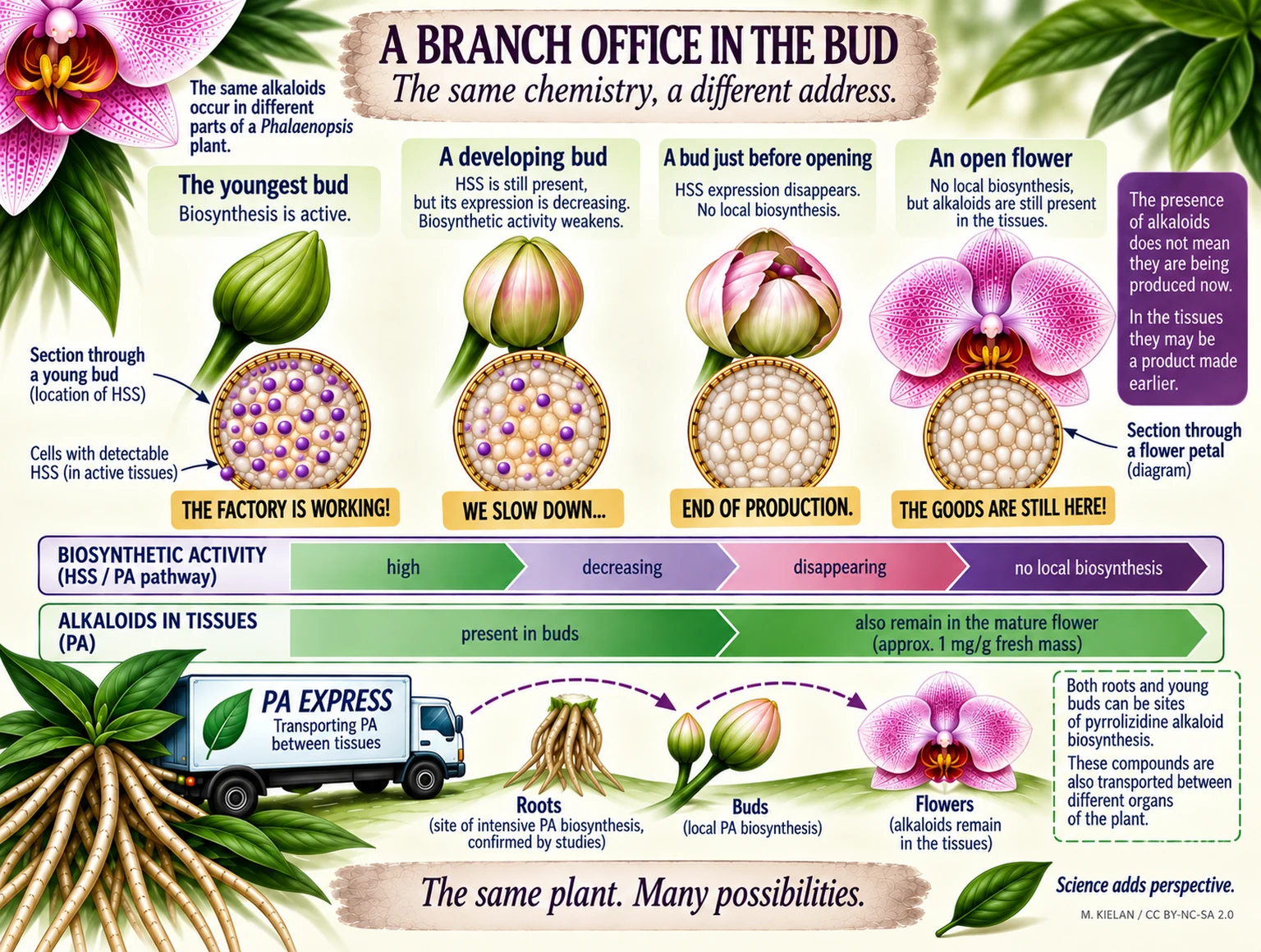
Alkaloids were also found in other parts of the plant, even though the same local production was not demonstrated there. The studies also showed that alkaloids produced in the roots are transported to other parts of the plant, where they can accumulate.
No one, of course, observed individual molecules marching through the orchid carrying suitcases. Researchers could, however, trace labelled compounds and establish that the products of our pharmacy do not remain solely at the place where they are made.
The pharmacy at the tip of the root also offers delivery.
And then they discovered a branch office
The story could have ended neatly there: the root makes the compounds, sends them elsewhere, and everyone goes home. Except that Phalaenopsis had one more surprise.
HSS was also found in the youngest flower buds. The mere presence of the enzyme was not enough to declare the bud an active biosynthetic site, so further experiments using labelled precursors were carried out. Once again, alkaloid production was demonstrated.
The pharmacy had a branch office, although only a temporary one.
The youngest buds showed the greatest biosynthetic capacity. As they grew, that capacity declined and then disappeared before the flower opened. So by the time we are admiring the fully open flower, its local production line has already shut down.
That does not mean the warehouse is empty.
Production has stopped, but the goods are still there
In the youngest buds, alkaloid concentrations reached approximately 6.3 mg per gram of fresh mass. As the bud enlarged, the concentration decreased, yet the open flower still contained around 1 mg per gram of fresh mass. Particularly high amounts were detected in structures directly involved in reproduction, namely the column and pollinia.
This illustrates very neatly the difference between showing that a compound is being produced in a particular place and showing that the compound is present there. Production may have ended earlier while its products remain in the tissues.
The factory had closed, but the warehouse was still stocked.
Where did HSS come from in the first place?
Click to expand ↓
Click to collapse ↑
This part is for the more inquisitive reader, but it is well worth opening.
HSS evolved from a gene encoding another enzyme, deoxyhypusine synthase (DHS), which performs a basic and entirely different function in cells.
The evolutionary origin of HSS involved a duplication of the DHS gene: one copy retained the original function, while the other was free to change gradually and eventually be recruited for a new task, participation in pyrrolizidine alkaloid biosynthesis.
It is one of evolution’s more elegant mechanisms. There is no need to invent a solution from scratch: copy something that already works, then gradually adapt the copy to a completely different job.
More intriguingly still, a similar story occurred independently in several evolutionary lineages of flowering plants. HSS was therefore not inherited by all these plants from a single ancestor that already possessed it. Instead, evolution arrived at a similar solution several times, repeatedly starting from the same point: DHS.
Why there?
One question remains: why does some of this chemical work take place specifically at the root tip?
We do not have one certain answer. The active tip is a region of intense cell division and vigorous metabolism, while at the same time being a delicate structure, because damage to the meristem can stop further growth of that root.
In an epiphyte, the tip is also the first part to enter new territory. It touches bark, moss and lichens, encounters water and obstacles, and comes into contact with microorganisms and tiny animals. It is therefore both a building site and a scouting party. Locating part of the plant’s chemical resources there makes good biological sense.
But let us stress that this is an interpretation. The studies showed where biosynthesis occurs; nobody interrogated the root about its reasons for choosing the premises.
One plant is not an entire genus
And here we need to pull the scientific handbrake once again.
The detailed HSS studies were carried out on a particular interspecific hybrid: Phalaenopsis equestris × (Phalaenopsis aphrodite × Phalaenopsis mannii). We cannot therefore automatically assume that every species, every hybrid and every supermarket Phalaenopsis produces exactly the same set of compounds, in exactly the same place and in exactly the same amount.
What we do know is that the phenomenon is not a literary invention dreamed up after staring at a green root tip. It has been demonstrated experimentally.
We simply should not turn one well-studied case into a constitution binding the entire genus.
When the green tip disappears
Let us return to the windowsill.
Yesterday the root had a beautiful, glossy tip and was clearly growing. Today the tip looks duller, darker or as though it has closed down. That does not necessarily mean disease.
Root growth can change with the condition of the plant and its environment. Growth may slow or stop, and after some time a new branch may take over.
Mechanical damage is a different matter. The active tip is delicate and easily crushed, broken or scraped while moving the pot or trying to persuade the root that it really ought to return politely to the outer pot.
Once you know how much is happening in this tiny region, it becomes rather difficult to look at it in quite the same way.
So: cut it or leave it?
We have returned to the question from the beginning. A healthy aerial root should not be removed merely because it has ruined the symmetry of the plant, escaped from the pot or embraced the ceramic frog standing next to it.
That does not mean that cutting off a single root somehow “disarms” the orchid chemically; the studies showed nothing of the sort. The argument is much simpler: it is a living, functioning organ.
It takes up water, participates in mineral nutrition and gas exchange, may carry out photosynthesis, responds to its surroundings, and its active tip is both a site of growth and a place of unusually interesting metabolic activity.
Roots that are genuinely dead, hollow or rotting can be removed when necessary. Healthy ones are best left alone, even when their ideas about spatial planning clearly conflict with ours.
An unassuming edge of a very large world
Phalaenopsis flowers take all the attention, while roots usually interest us only when something begins to look suspicious. Yet the silvery tangle emerging from the pot is not a piece of plumbing that ought to be hidden as discreetly as possible.
A root absorbs water and mineral nutrients, participates in gas exchange, may photosynthesise and responds to its environment. Its active tip builds new parts of the organ, explores new surfaces and, at least in one well-studied hybrid, also carries out specialised chemical work.
The green tip now resting against the window and looking as though it simply ran out of better ideas is therefore a building site, a scout and a small laboratory all at once. Any one of those jobs would be responsibility enough, but the root apparently sees no reason to restrict itself to just one.
So the next time it crosses half the windowsill and stops exactly where it is most inconvenient, you might put the scissors down and look at that green end once more.
It carries its own pharmacy.
Bibliography and scientific sources
Click to expand ↓
Click to collapse ↑
- Frölich C., Hartmann T., Ober D. (2006). Tissue distribution and biosynthesis of 1,2-saturated pyrrolizidine alkaloids in Phalaenopsis hybrids (Orchidaceae). Phytochemistry 67(14): 1493–1502. DOI: 10.1016/j.phytochem.2006.05.031
- Anke S., Gondé D., Kaltenegger E., Hänsch R., Theuring C., Ober D. (2008). Pyrrolizidine Alkaloid Biosynthesis in Phalaenopsis Orchids: Developmental Expression of Alkaloid-Specific Homospermidine Synthase in Root Tips and Young Flower Buds. Plant Physiology 148(2): 751–760. DOI: 10.1104/pp.108.124859
- Nurhayati N., Gondé D., Ober D. (2009). Evolution of pyrrolizidine alkaloids in Phalaenopsis orchids and other monocotyledons: Identification of deoxyhypusine synthase, homospermidine synthase and related pseudogenes. Phytochemistry 70(4): 508–516. DOI: 10.1016/j.phytochem.2009.01.019
The Root Trilogy
Part I: The Pharmacy at the Tip of the Root (you are here)
Part II: Touching Moisture. How Does a Root Know Where Water Is Waiting? →
Part III: The Secret Garden (in preparation)
Copyright Marzenna Kielan, all rights reserved