What happens inside a Phalaenopsis leaf when we switch off the lights?
Evening settles over the house. The lights go out, the day’s small duties are done, and you plump up a pillow, leaving your orchid to its own devices. Watered, inspected from every angle and perhaps even congratulated on a new root, the moth orchid (Phalaenopsis) sits quietly on the windowsill. It looks ready to turn in, too.
Inside its leaves, the night shift is just getting started.
There are no sirens, no floodlights and nobody clocking in at the gate. Instead, the stomata open: microscopic pores linking the inside of the leaf to the surrounding air. Carbon dioxide begins to drift in, and the factory that spent much of the day behind closed doors switches to its overnight routine.
Phalaenopsis uses a form of photosynthesis called CAM, short for crassulacean acid metabolism. The name comes from the stonecrop family, Crassulaceae, in which the characteristic daily rise and fall in tissue acidity was described early on. The same mechanism is also found in many cacti, bromeliads and orchids.
CAM does not allow the plant to carry out the whole of photosynthesis in the dark. Its secret lies in the scheduling: much of the carbon dioxide is taken in at night, then used in the Calvin cycle during the day.
In this article — click to expand ↓— click to collapse ↑
A night-shift glossary — click to expand ↓— click to collapse ↑
| CAM | A way of organising photosynthesis in which much of the CO₂ uptake and its use in the Calvin cycle occur at different times: uptake mainly at night, the Calvin cycle mainly during the day. |
|---|---|
| Stomata | Microscopic pores in the leaf surface through which gases are exchanged and water vapour escapes. |
| PEPC | Phosphoenolpyruvate carboxylase, the enzyme that captures the overnight carbon supply in CAM plants. |
| PEP | Phosphoenolpyruvate, the compound to which PEPC adds the carbon taken up at night. |
| Malate and malic acid | Related chemical forms in which carbon can be stored in the vacuole overnight. |
| Vacuole | A large compartment inside a plant cell that stores water and a variety of other substances. |
| Rubisco | The enzyme that incorporates carbon from CO₂ into the Calvin cycle during the day. It can also react with oxygen, which causes complications. |
| Calvin cycle | A series of reactions that incorporates carbon from CO₂ into organic compounds. |
| Photorespiration | A process triggered when Rubisco reacts with oxygen instead of CO₂. It uses energy and releases some previously fixed carbon. |
| CAM idling | An emergency response to severe drought: the stomata remain closed and CO₂ produced by respiration is captured and reused within the leaf. |
A factory in the treetops
To see why Phalaenopsis runs a two-shift operation, we need to leave the windowsill for a moment and step into a tropical forest. Most species in the genus are epiphytes. They grow on trees without feeding on them, using trunks and branches as supports that bring them closer to the light.
It is a useful address, but nobody has laid water pipes up there. The roots have no reservoir of soil to draw on. Rain drenches them; then they begin to dry. The next soaking might come tomorrow, next week or whenever the weather finally obliges.
The leaf has to make its water last. It also needs carbon dioxide to build sugars and other organic compounds. Opening the stomata lets CO₂ in, but gives water vapour a way out. For most plants, that is part of the cost of doing business. Phalaenopsis has a way of keeping the bill down.
At night, the air is usually cooler and its relative humidity higher. The difference in water vapour concentration between the inside of the leaf and the surrounding air is smaller, so an open pore loses less water. This is a good time to take delivery of carbon dioxide.
There is one snag. Without light, the plant cannot carry out all the reactions needed for photosynthesis. The overnight delivery has to be put into storage.
Deliveries after dark
Carbon dioxide entering the leaf at night does not go straight to Rubisco. That enzyme is a key member of the day shift: it brings carbon from CO₂ into the sequence of reactions known as the Calvin cycle, where organic compounds are made.
The night shift has a different enzyme on duty: phosphoenolpyruvate carboxylase. Mercifully, even biochemists allow us to call it PEPC.
PEPC adds the incoming carbon to a compound called phosphoenolpyruvate, or PEP. The result is oxaloacetate, which is rapidly converted into malate.
The names may sound like the opening questions in a biochemistry exam, but the job itself is straightforward. Carbon from the air is packed into a chemical form that can be kept until morning.
PEP needs raw materials of its own. Phalaenopsis is among the CAM plants that store reserve carbohydrates mainly as starch. During the night, some of that starch is broken down to supply the ingredients for PEP. Carbon gathered earlier helps the plant capture the next delivery.
Malate moves into the vacuole, a large compartment occupying much of the leaf cell, where it is stored mainly as malic acid. Those thick, fleshy leaves provide generous storage space: large cells with roomy vacuoles can accommodate the carbon collected overnight.
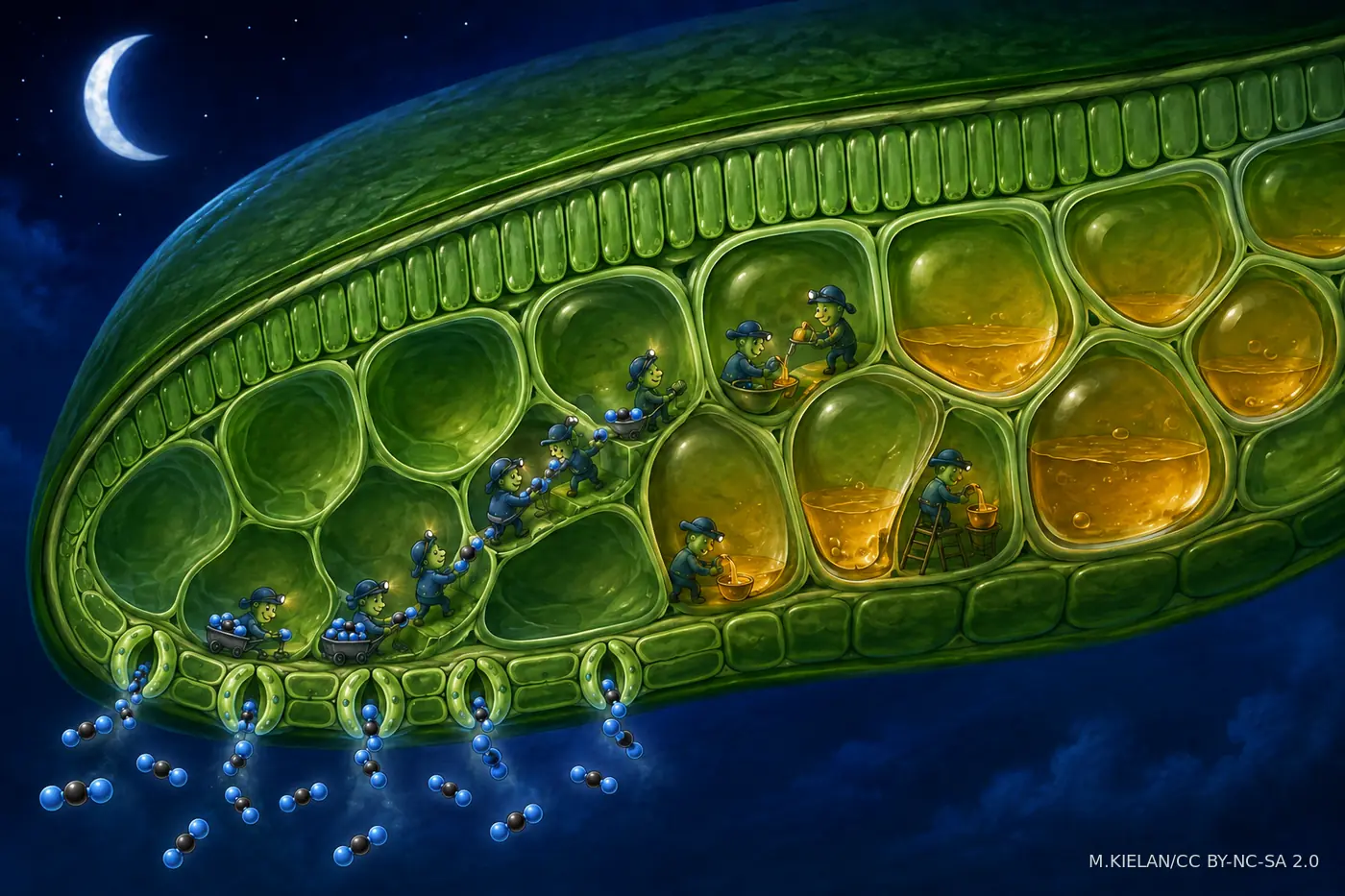
Storage space is finite, of course. As malic acid accumulates, the leaf becomes progressively more acidic. Its malic acid content usually reaches a peak towards dawn, when the night shift is finishing up and the warehouse manager is beginning to eye the last empty shelf.
From the outside, nothing gives the game away. At dawn the leaf looks much as it did the evening before. Inside, malic acid has built up in the vacuoles, acidity has risen, and the carbon collected overnight is ready for the day shift.
The morning handover
With the arrival of light, the next stage begins. The stomata gradually close, reducing water loss during the day. Malic acid leaves the vacuoles, and carbon from it is released again as CO₂.
Rubisco now takes over, incorporating that CO₂ into the Calvin cycle. The carbon becomes part of organic compounds, using energy supplied by the light reactions of photosynthesis.
Rubisco has an awkward habit, though. It can react with oxygen as well as carbon dioxide. This sets off photorespiration, a process that uses energy and releases some carbon the plant has already fixed.
Releasing CO₂ from malic acid behind closed stomata raises its concentration inside the leaf. That makes Rubisco more likely to react with carbon dioxide rather than oxygen.
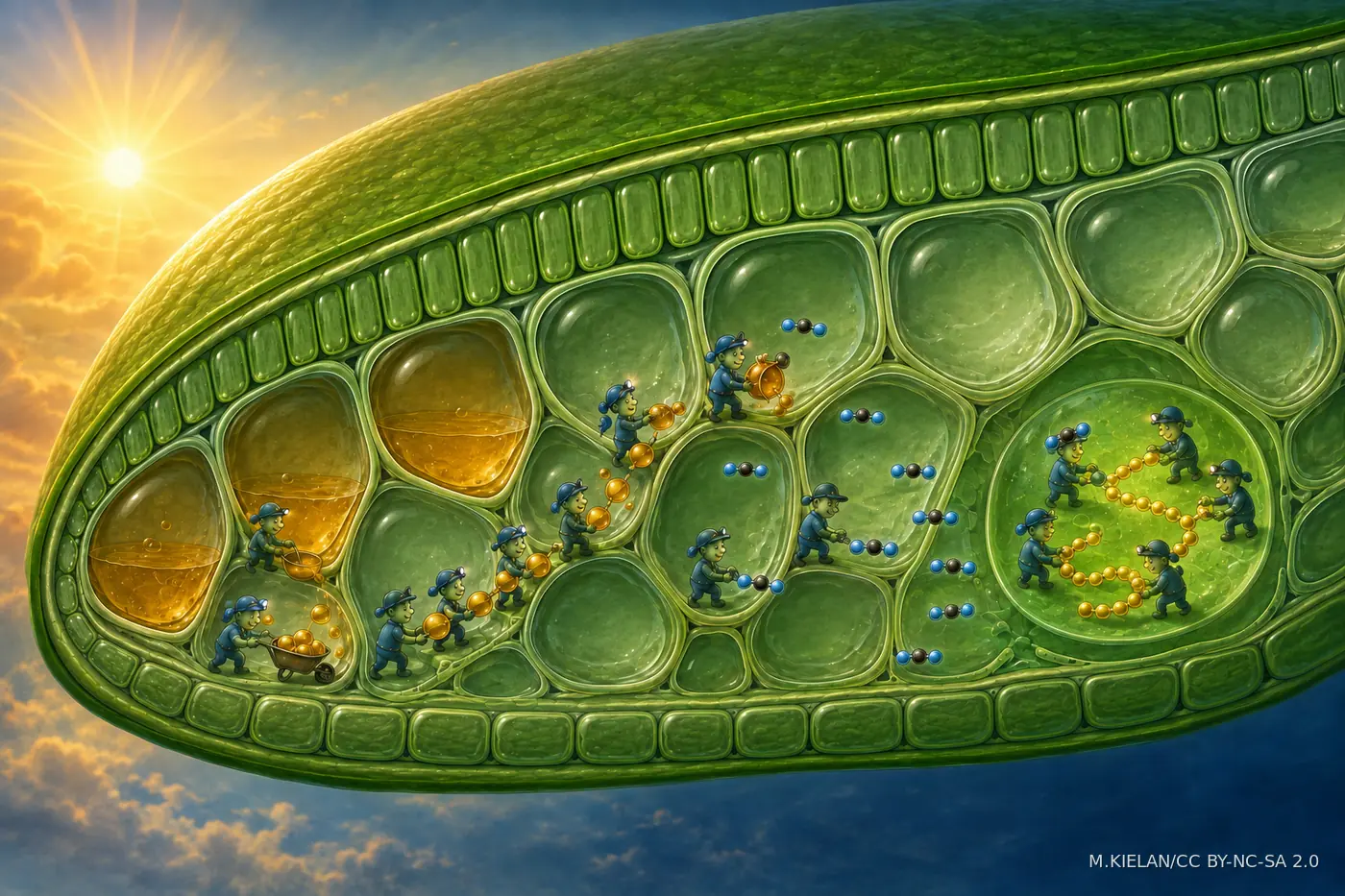
The day shift can therefore work behind closed doors, drawing on supplies laid in overnight. Phalaenopsis keeps photosynthesising without having to leave its stomata open through the warmest part of the day, while Rubisco receives a concentrated supply of CO₂.
The arrangement works both ways. The night shift needs PEP made from stored carbohydrates; the day shift must use the captured carbon and replenish the reserves needed for the next round.
If a Phalaenopsis gets too little light, the consequences do not disappear at sunset. A poor day’s work limits what the leaf can do the following night. Studies of cultivated Phalaenopsis have shown that daytime light supply can alter subsequent nocturnal CO₂ uptake. In this firm, unfinished business is duly passed to the next shift. In triplicate, presumably, with the manager’s signature.
More than night and day
The simplest account of CAM is satisfyingly neat: stomata open at night and close during the day. Biology has a few amendments to make.
The classic CAM cycle has four phases. The first falls at night. The stomata are open, PEPC fixes incoming carbon and malic acid accumulates in the vacuoles. Around dawn comes a brief transition. Light has arrived, the stomata are still open, and the balance of carbon fixation gradually shifts from PEPC towards Rubisco.
The third phase occupies much of the day. The stomata remain closed while malic acid is broken down and the released CO₂ is used in the Calvin cycle. Late in the afternoon, if the stored supply has run out and conditions are favourable, the stomata may reopen. For a while, the plant can take CO₂ directly from the air again.
That is the model, but the boundaries between phases can move. Light, temperature, water supply, humidity, day length and the plant’s condition all influence the pattern. In experiments with the hybrid ‘Sacramento’, a sixteen-hour light period brought PEPC back into a more prominent role towards the end of the day, although the classic model assigns that period chiefly to Rubisco.
The plant’s internal clock also has a say. As night approaches, cellular mechanisms prepare PEPC for carbon fixation. The leaf is following a daily rhythm, adjusted by its surroundings, rather than simply reacting whenever someone turns out a light.
So saying that Phalaenopsis takes up CO₂ only at night is too sweeping. Much of its uptake does happen in darkness, but gas exchange can also occur around dawn and late in the afternoon.
The pattern changes as the plant develops, too. In some studies, younger leaves and younger plants took up a greater proportion of their CO₂ during the day than mature leaves and older plants. The size of these differences depended on the plants studied and the experimental conditions. Separate work on seedlings showed a gradual development of the CAM rhythm as the first leaves formed, with the earliest stages relying more heavily on daytime CO₂ uptake. That does not mean every new leaf on an adult Phalaenopsis repeats the seedling’s journey. A young leaf and a young plant are different things.
Even within a single orchid, the departments need not all keep exactly the same hours.
The cost of saving water
CAM reduces water loss and can suppress photorespiration, but the extra machinery has to be paid for. Fixing carbon at night, moving malate into the vacuole and retrieving it later all carry energy costs. Storage is limited by the size of the cells and their vacuoles, and making PEP draws on carbohydrate reserves.
In favourable conditions, a plant using the simpler C₃ pathway can take up CO₂ for much of the day and put on new leaves, roots and shoots relatively quickly. Phalaenopsis trades some of that potential speed for a more economical use of water. It gathers carbon without leaving the taps running through the heat of the day.
That is one reason moth orchids are unlikely to give a giant pumpkin much competition in a growing contest.
Emergency measures
CAM makes careful use of water. It does not give us permission to leave an orchid thirsty indefinitely. A Phalaenopsis cannot conjure up water from its reputation for toughness, any more than it can build new tissue through sheer determination.
During prolonged drought, nocturnal CO₂ uptake declines. If the water shortage becomes severe, the stomata may stay closed around the clock. The plant stops taking in fresh carbon dioxide from the atmosphere and enters an emergency state known as CAM idling.
Its metabolism has not stopped. The cells still respire, consuming oxygen and producing CO₂. Closed stomata greatly reduce the escape of that carbon dioxide, allowing some of it to be used again. At night it is refixed and stored as malic acid; by day it is released and reused in the Calvin cycle. Carbon circulates within the leaf in an almost closed loop.
This brings in no new carbon and cannot support normal growth. It does, however, limit further loss of water and conserve carbon that would otherwise escape. The plant is surviving on what it already has.
The factory is still running, but it has stopped accepting deliveries. It is repacking the stock left inside.
In an experiment with Phalaenopsis ‘Edessa’, net CO₂ uptake had ceased after six weeks without watering. That was a response to serious water shortage, not a demonstration that orchids flourish without a drink.
Being able to conserve water does not make a plant immune to running out of it.
The bedroom orchid and the night-time oxygen myth
At this point, someone usually mentions the orchid that produces oxygen at night and therefore belongs in the bedroom, quietly improving our sleep. It is an appealing story, with a grain of truth and enough scientific vocabulary to sound convincing. CAM, however, does not provide a way of making photosynthetic oxygen in the dark.
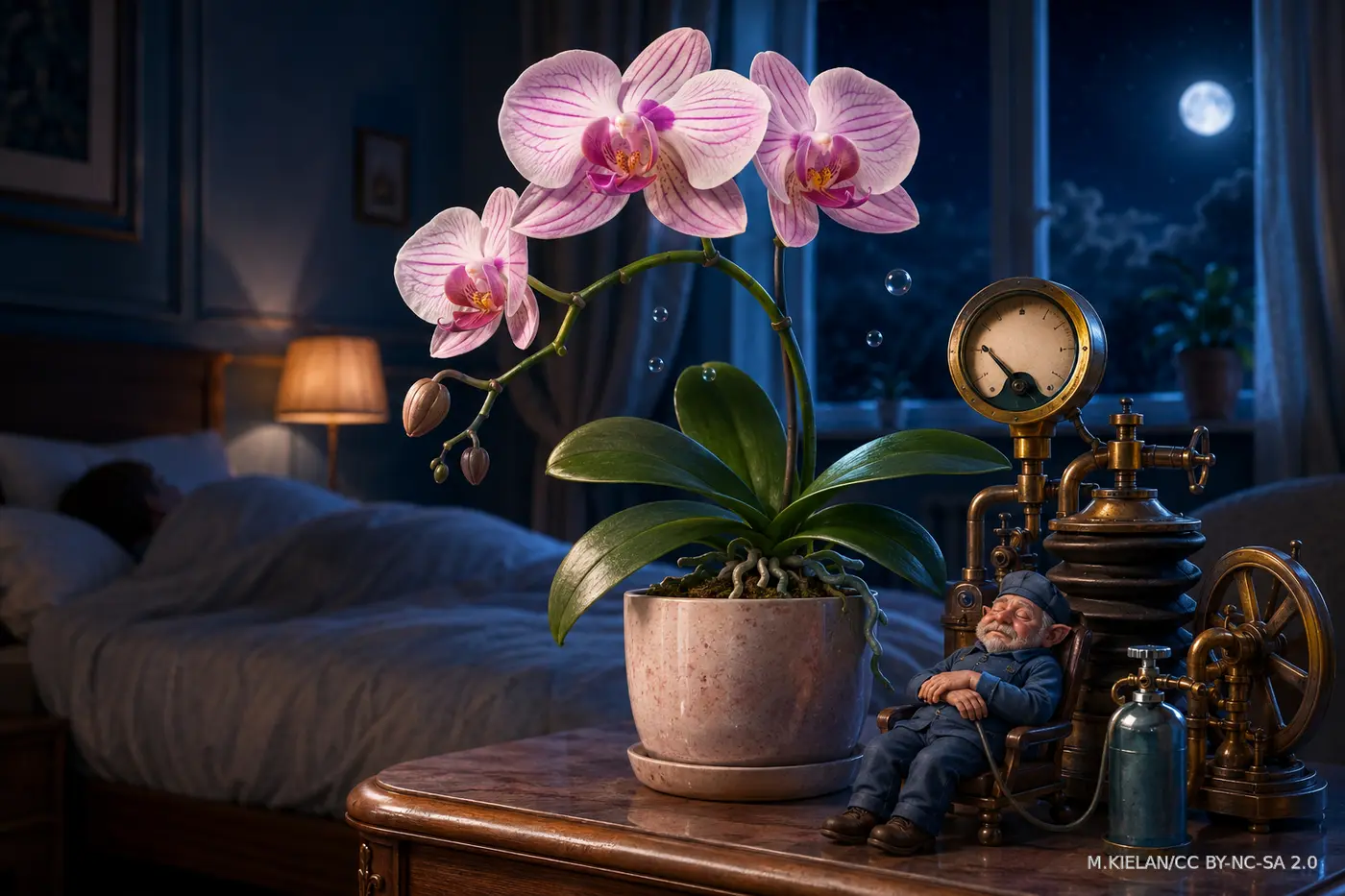
The oxygen released in photosynthesis comes from the splitting of water molecules in photosystem II. This complex of proteins and pigments, found in chloroplasts, captures light energy. Without light, the photosynthetic splitting of water that produces oxygen cannot take place.
At night, an orchid respires like other plants. It uses oxygen and produces CO₂, although some of that carbon dioxide may be refixed straight away. An open stoma is a route for gas exchange, not a miniature oxygen generator.
Phalaenopsis takes up much of its carbon dioxide at night. Photosynthetic oxygen production requires light and normally takes place during the day.
There is no need to banish the orchid from the bedroom. In an ordinary, ventilated room, a single plant’s gas exchange is tiny beside human respiration and the exchange of air with the surroundings. Put it wherever the growing conditions suit it and you enjoy seeing it. If sleeping among moth orchids makes you feel more at ease, all well and good. Photosystem II just cannot take the credit.
When the house falls asleep
A Phalaenopsis leaf looks simple enough: green, fleshy and still. It gives little hint of the careful timing, controlled gas exchange, shifting metabolic pathways and transport between cell compartments that keep it working.
At night, it opens its pores, captures carbon dioxide and stores the carbon in a chemical form. As morning advances, it closes the doors. Through the day it unpacks those reserves and carries on with photosynthesis, losing far less water than it would if it had to collect CO₂ in the full heat and light of midday.
This intricate, energy-demanding compromise serves the plant well in a world where roots clinging to a branch cannot count on a daily soaking. It offers neither freedom from thirst nor a supply of oxygen in the dark.
Next time you glance at the moth orchid on your windowsill before bed, you can switch off the light with a clear conscience. Inside those quiet leaves, work is about to begin.
References and scientific sources — click to expand ↓— click to collapse ↑
- Cushman J.C. (2001). Crassulacean acid metabolism. A plastic photosynthetic adaptation to arid environments. Plant Physiology 127(4): 1439–1448. DOI: 10.1104/pp.127.4.1439
- Dodd A.N., Borland A.M., Haslam R.P., Griffiths H., Maxwell K. (2002). Crassulacean acid metabolism: plastic, fantastic. Journal of Experimental Botany 53(369): 569–580. DOI: 10.1093/jexbot/53.369.569
- Ota K., Morioka K., Yamamoto Y. (1991). Effects of leaf age, inflorescence, temperature, light intensity and moisture conditions on CAM photosynthesis in Phalaenopsis. Journal of the Japanese Society for Horticultural Science 60(1): 125–132. DOI: 10.2503/jjshs.60.125
- Guo W.J., Lee N. (2006). Effect of leaf and plant age, and day/night temperature on net CO₂ uptake in Phalaenopsis amabilis var. formosa. Journal of the American Society for Horticultural Science 131(3): 320–326. DOI: 10.21273/JASHS.131.3.320
- Ping C.-Y., Chen F.-C., Cheng T.-C., Lin H.-L., Lin T.-S., Yang W.-J., Lee Y.-I. (2018). Expression profiles of phosphoenolpyruvate carboxylase and phosphoenolpyruvate carboxylase kinase genes in Phalaenopsis, implications for regulating the performance of Crassulacean Acid Metabolism. Frontiers in Plant Science 9: 1587. DOI: 10.3389/fpls.2018.01587
- Ceusters N., Valcke R., Frans M., Claes J.E., Van den Ende W., Ceusters J. (2019). Performance index and PSII connectivity under drought and contrasting light regimes in the CAM orchid Phalaenopsis. Frontiers in Plant Science 10: 1012. DOI: 10.3389/fpls.2019.01012
- Hogewoning S.W., van den Boogaart S.A.J., van Tongerlo E., Trouwborst G. (2021). CAM-physiology and carbon gain of the orchid Phalaenopsis in response to light intensity, light integral and CO₂. Plant, Cell & Environment 44(3): 762–774. DOI: 10.1111/pce.13960
- Ceusters N., Frans M., Van den Ende W., Ceusters J. (2019). Maltose Processing and Not β-Amylase Activity Curtails Hydrolytic Starch Degradation in the CAM Orchid Phalaenopsis. Frontiers in Plant Science 10: 1386. DOI: 10.3389/fpls.2019.01386
The Secret Life of a Leaf
- The Night Shift — you are here
- A Reserve for Lean Times — coming soon
- I’m Staying Put — coming soon
Further reading: stories from the roots
Copyright © Marzenna Kielan. All rights reserved.