Invisible Army. Part III: War Under Cover
Thrips, mealybugs and scale insects hide in flowers and crevices, beneath layers of wax and under shields of their own making. An army of predators and parasitoids can be deployed against them, but each unit has a different task, its own requirements and limits to what it can achieve.
The flower that should have been empty
The flower looked flawless. Its petals were firm, its lip fresh and its colours clear. Only on closer inspection did something begin to seem amiss. A pale streak had appeared on one petal and tiny brown specks on another. The neighbouring bud had stopped halfway and apparently lost all interest in opening any further.
Dry air might be to blame, or a drop of water left overnight, damage sustained while the bud was opening, or a sudden change in temperature. A flower does not give evidence or identify the culprit.
Yet gently part the petals and a thin, dark dash emerges from within. Barely more than a millimetre long, it moves with the irritating confidence of someone who knows every emergency exit. A moment later it vanishes between the petals. It is a thrips.
It is not there by accident. The flower provides food, shelter and a place difficult to reach with either a fingertip or a droplet of spray. Eggs may be concealed inside plant tissue. Feeding larvae occupy flowers and buds, young leaves and narrow recesses. Mobile adults can move to the next plant before we have realised that the first one is under attack. In many important species, some developmental stages also descend towards the growing medium. This is not an opponent obliging enough to remain in one place.
The war against thrips is therefore fought on several floors at once: inside tissues where eggs have been hidden, in flowers occupied by larvae and adults, on leaves and, at times, in the growing medium where non-feeding developmental stages lie low.
Sending a single predator after them is rather like guarding the front door of a house that also has windows, a cellar and a way out through the garage.
An entire army is required because its units hunt in different ways. Some catch only the youngest larvae; others follow thrips into flowers and tackle even adult prey; still others wait below, where the pest disappears from the surface of the plant.
Each guards a different passage, and a thrips has plenty of them.
An enemy on several floors
If a thrips spent its entire life sitting on one petal, the matter would be almost courteously simple. We could find it, remove it and declare the investigation closed. But a thrips changes not only its address. It changes its form as well.
In many species, the female does not leave her eggs on the plant surface. Using a saw-like ovipositor, she cuts into the tissue of a leaf, petal or bud and slips an egg inside. She does not leave her offspring on the doorstep. She installs them in the house at once.
A larva emerges from the egg. It is tiny, pale and wingless, but already feeding. Unlike an aphid or mealybug, it does not draw sap from the plant’s vascular system. It damages cells in the surface tissues and then consumes their contents. The emptied cells leave pale or silvery streaks, minute scars and brown specks. On a leaf these may seem inconspicuous. On a flower, even slight damage is immediately visible.
The first two larval stages feed and grow. The insect then becomes a prepupa and afterwards a pupa. It stops feeding while preparing for its final transformation. In many of the most important glasshouse species, it descends from the plant at this point and hides in the growing medium, plant debris or crevices. This is not, however, an iron rule observed by every thrips.
At last the adult appears: slender, mobile and equipped with two pairs of exceptionally narrow wings fringed with long hairs. Those fringes gave the order its scientific name, Thysanoptera, literally ‘fringe-winged’.
Such delicate wings hardly look impressive, but a thrips has no need to put on an air show. It need only reach the neighbouring flower, another plant or the clothing of a person who has just inspected the collection. Its small size allows it to vanish into a crack before the grower can put down the hand lens and say something unsuitable for publication on an orchid website.
The entire cycle can proceed quickly, particularly in warmth. A single plant may simultaneously carry eggs hidden in its tissues, feeding larvae, inactive transitional stages and adults ready to move house. Removing what we can see today does not mean that another generation will not emerge tomorrow.
Nor is ‘thrips’ the name of one culprit. It covers a vast group of insects, and orchids have hosted, among others, western flower thrips, greenhouse thrips, onion thrips and species particularly associated with orchids. They differ in feeding site, behaviour and details of their life cycle. Without an exact identification, we do not always know which one has moved in.
We nevertheless know enough to understand the central difficulty. The egg sits inside the plant. The young larva feeds on its surface or in a flower. An older larva becomes a more difficult opponent. A transitional stage may descend into the growing medium. The adult moves between plants.
There is no single place in which to set a trap for the whole life of a thrips. Every floor has to be covered.
The patrol that hunts the children
The first unit is almost invisible. The predatory mite Neoseiulus cucumeris is roughly half a millimetre long. Smaller than an adult thrips, wingless and hardly the sort of creature one would instinctively entrust with the defence of a collection, it nevertheless travels efficiently over leaves and flowers, investigates tiny irregularities in their surfaces and searches for prey within its weight class.
It is chiefly interested in the youngest thrips larvae, which it grasps with its chelicerae, pierces and drains.
Predatory mites are arachnids. After meeting one, a thrips larva does not proceed to the next floor.
Neoseiulus cucumeris is not, however, the scourge of everything with fringed wings. A newly hatched larva makes a suitable meal. An older one is larger, stronger and more difficult to subdue. Eggs remain hidden in plant tissue, transitional stages may be in the growing medium, and an adult thrips is outside this predator’s weight category.
Our enforcer therefore works at the nursery entrance. It will not stop the parents, search the cellar or prise eggs out of the walls. It guards the moment when young thrips first appear on the plant surface.
That is why Neoseiulus cucumeris is best suited to preventive patrols or very early intervention. If numerous older larvae and adults are already feeding on the plants, predatory mites cannot turn back the clock. They may reduce the arrival of the next generation, but they will not remove all the earlier stages.
They are sold, among other forms, in sachets hung on plants. Each contains a small breeding colony together with food and material in which the mites can reproduce. Successive individuals gradually leave through an opening and begin their patrol. A sachet is not a bag of dormant troops released in a single day. It is more like a miniature barracks supplying reinforcements over a period of time.
That is, of course, provided the occupants approve of the climate. Eggs and young stages are sensitive to air that is too dry, while their rate of development depends on temperature. Hanging sachets above a blazing radiator and informing the army that it must now fend for itself will not do.
Amblyseius swirskii is employed for similar duties. It too is a small predator that chiefly attacks young thrips larvae. It prefers warmer conditions and can supplement live prey with pollen. That does not make it self-sufficient on every moth orchid.
The two species are sometimes presented as interchangeable sachets ‘for thrips’. They are not identical. They differ in temperature requirements, developmental rate and ability to maintain a population when prey is scarce. The choice should reflect conditions in the collection and the directions supplied with the particular product.
They do not win wars with a spectacular assault. They patrol the plant and intercept the enemy while it is still small, wingless and comparatively defenceless. They are not commandos blowing up the flower. They are the patrol that may prevent the enemy from ever growing up.
The minute pirate bug enters the flower
Predatory mites intercept thrips early in life. Once a larva has grown larger, or the insect has reached adulthood, somebody bigger is needed: Orius.
Members of this genus are known in English as minute pirate bugs. The name has considerably more menace than its charming Polish counterpart, dziubałeczek, but neither quite prepares us for what the insect does to its prey.
This small predatory true bug is usually only two or three millimetres long. It has a flattened body, agile legs and piercing-sucking mouthparts. These are not used to draw sap from the orchid. Instead, the bug drives them into a thrips, immobilises its victim and sucks out the contents, leaving little more than an emptied shell.
Both nymphs and adults hunt. Orius can attack larvae of various sizes as well as adult thrips. It roams over leaves, peers into buds and squeezes between petals: precisely where thrips feel safest. A flower that is an ornament to us becomes hunting ground to both sides.
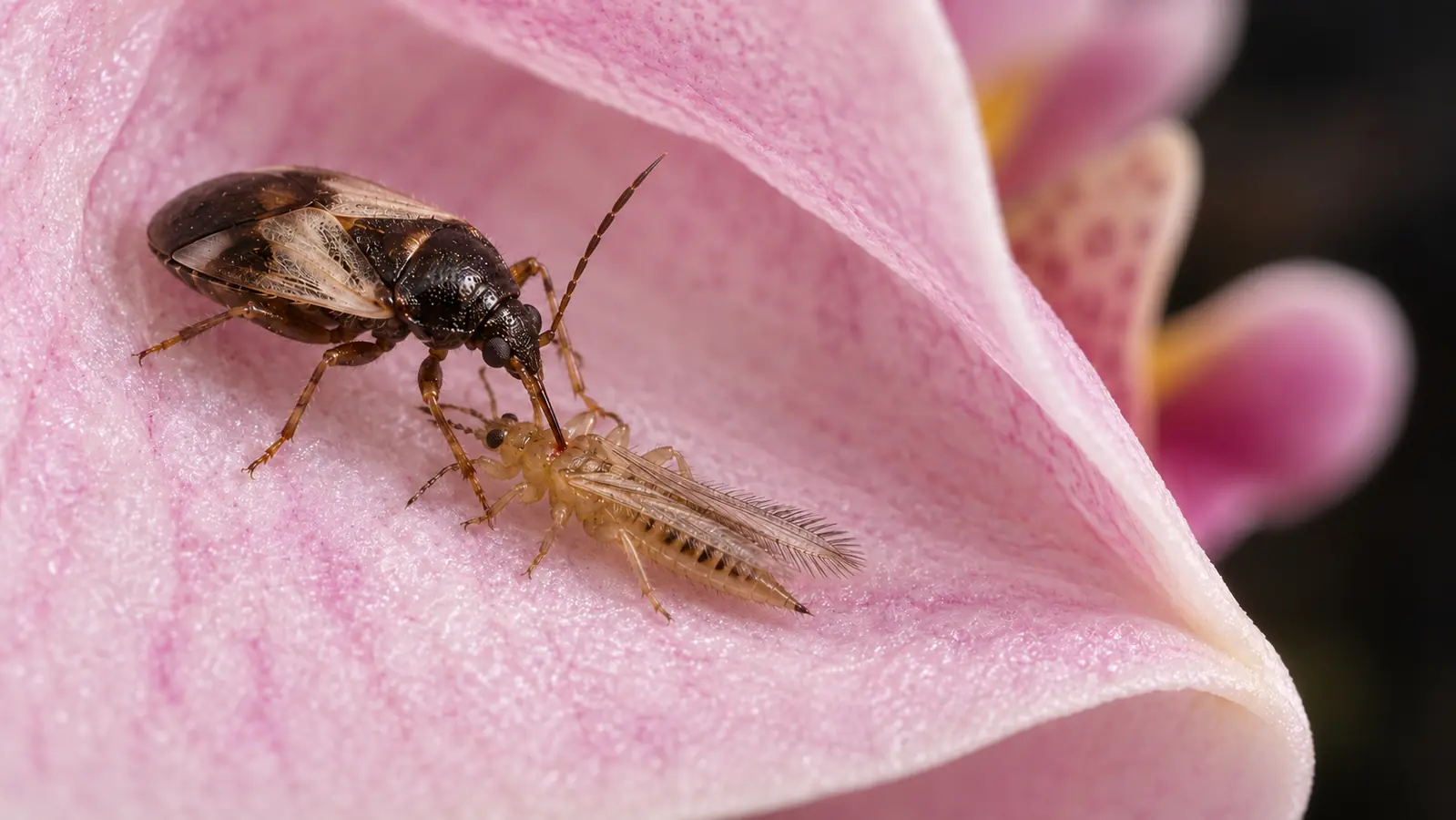
The minute pirate bug is a generalist. Besides thrips, it may hunt aphids, whiteflies, small mites, and the eggs and young stages of other insects. It can supplement its diet with pollen and a little plant sap, which may help it survive when prey numbers fall. ‘May’ does not mean that it will remain on one moth orchid until retirement.
In glasshouses, these bugs are released into extensive crops offering many plants, flowers and potential refuges. Food is distributed unevenly in a home. A predator released onto one plant receives no instruction to remain there. It has wings and plans of its own.
Temperature matters. Orius laevigatus, frequently used in Europe, performs best in warmth. Suppliers recommend releasing it in groups so that individuals can meet and reproduce. Minute pirate bugs may occasionally probe human skin as well. They do not feed on blood and are not dangerous, but the resulting nip can be surprisingly painful.
They can therefore be used at home, particularly in a growing tent, conservatory or larger isolated collection with a confirmed infestation. In an ordinary room, however, fifty flying enforcers with a tendency to nip may prove rather less discreet than a sachet of predatory mites.
The mites guard the enemy’s nursery. The minute pirate bug follows the parents into the flower.
The unit stationed in the growing medium
A thrips leaving the flower does not always choose another plant. In many important glasshouse species, an older larva stops feeding, drops or climbs down and seeks a sheltered place in which to complete the next stages of development. The chase continues above while, in the pot, the enemy locks the door, turns out the light and waits for wings.
One soldier stationed there is Stratiolaelaps scimitus, a predatory mite living in the upper layer of the growing medium. For years it was sold under the name Hypoaspis miles. Rather than patrolling leaves and searching flowers, it moves between particles of substrate and hunts other small organisms that also spend part of their lives there.
It is used chiefly against fungus gnat larvae, but it can also attack thrips stages concealed in the growing medium. It does not catch eggs inside plant tissue, pursue larvae over petals or stop adult insects. It guards the cellar.
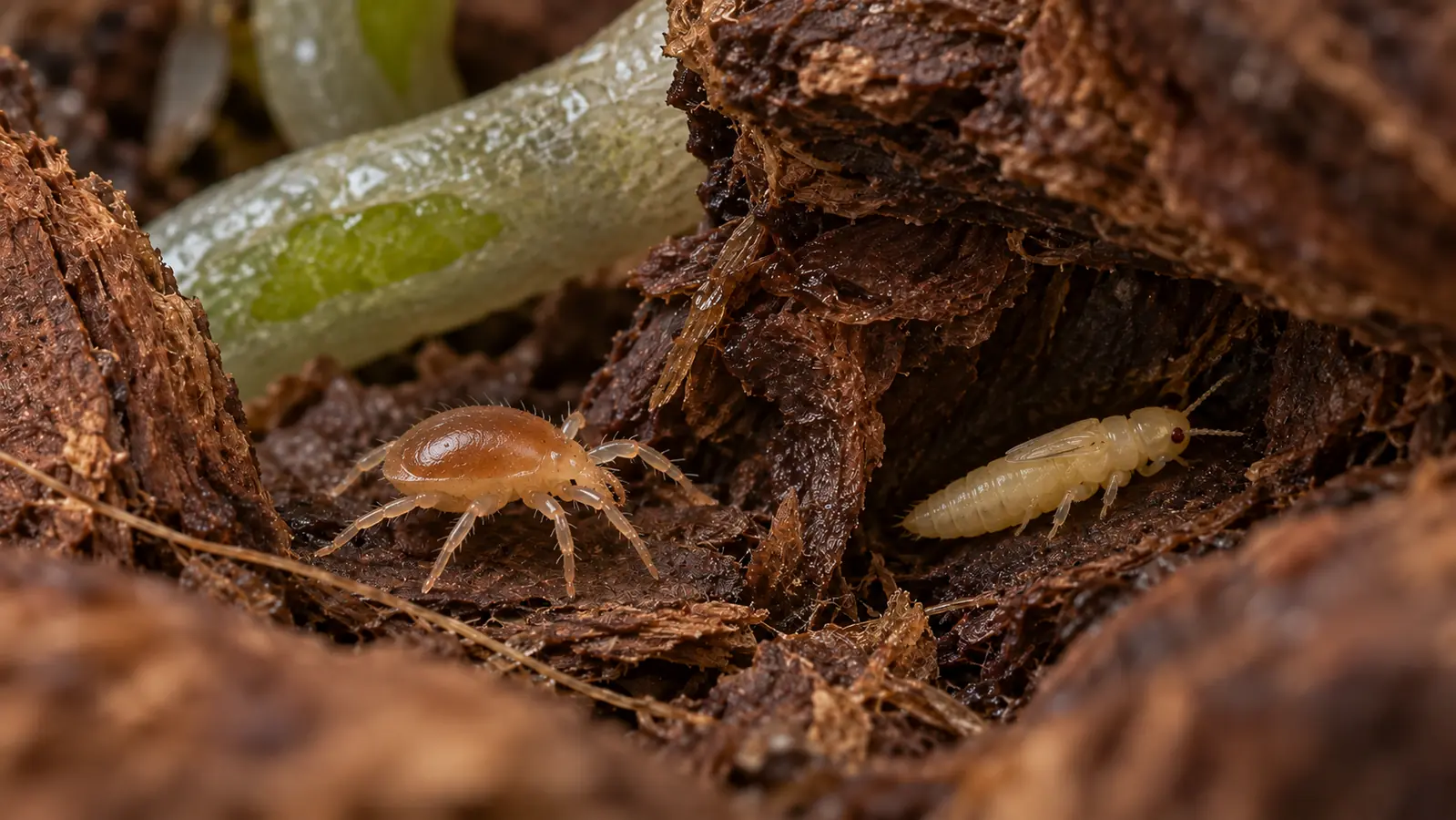
Another ally is Steinernema feltiae, an entomopathogenic nematode so small that an individual cannot be seen without magnification. Its infective juveniles search for a host and enter through natural openings. They carry symbiotic bacteria of the genus Xenorhabdus, which multiply inside the insect. The host dies, and the nematodes acquire both accommodation and food. It sounds like biological warfare because that is precisely what it is.
Steinernema feltiae acts against suitably small insect stages, not against the plant. It does, however, require a moist environment, because it travels in the thin film of water surrounding particles in the growing medium. Drying and unsuitable temperatures restrict its activity.
Most recommendations were developed for crops in peat, coir or mats that retain moisture for a long time. Phalaenopsis usually grows in loose, coarse bark. There are large air spaces between the pieces, water drains away and the surface dries. Moth orchid roots appreciate this arrangement; a nematode may be less enthusiastic.
Beneficial organisms may find suitable conditions in the damper parts of a pot, but we cannot assume that they will intercept every thrips stage. Keeping bark permanently wet simply to please the unit below would be a peculiar method of protecting an orchid by first creating a root problem.
Stratiolaelaps and Steinernema are therefore supporting forces, not a complete solution. Not every pot will make a suitable post for them. It is nevertheless useful to know that a thrips may find somebody already waiting in the cellar.
The white scrap of fluff that moved
At first glance it does not look like an insect. A scrap of white fluff appears in the angle between a leaf and the stem of a moth orchid. It might be a fibre from the growing medium, a fragment of cobweb or a speck of dust that has selected a particularly awkward place to be cleaned. Only when touched with a cocktail stick or paintbrush does the fluff reveal that it has legs and no intention whatever of awaiting further developments.
Mealybugs belong to the scale insect group. The females retain a flattened oval body and the ability to move, although they much prefer to find a safe recess, insert their mouthparts into plant tissue and surround themselves with a protective layer of wax. This wax gives them their flour-dusted appearance.
Depending on the species, it may form a fine coating, short projections or longer white filaments. It protects the insect from water loss, makes its surface difficult to wet and offers partial shelter from contact treatments. It is not invincible armour, but it can cause a droplet to run harmlessly past.
A female may produce a cottony egg sac containing dozens, sometimes hundreds, of eggs. Tiny mobile nymphs emerge from it. They are responsible for the colony’s expansion. The adult female may appear indolent; her children set off to conquer the neighbouring crevices.
On Phalaenopsis, mealybugs occupy leaf axils, hollows around the stem, the undersides of leaves, flower spikes and spaces beneath dry bracts. They may hide under the pot rim or between its wall and the growing medium. Some species feed on roots, allowing a plant to decline for a long time before any white deposit appears in view.
An infested moth orchid loses vigour. Sticky honeydew appears on the leaves and sooty mould may grow upon it. The first sign of mealybugs can therefore be a sticky surface or blackish deposit some distance from the culprit’s refuge.
In a warm home, eggs, nymphs and adult females may all occupy one plant at the same time. A cotton bud moistened with alcohol reaches what we have found. It does not reach an egg in a crevice or the nymph that has walked beneath the neighbouring pot.
Nor is every white tuft on an orchid a mealybug. The waxy secretions of other scale insects can look similar, particularly clusters of male Boisduval scale. We must first establish who is sheltering beneath the white covering. Only then can we release somebody who looks remarkably like it.
A wolf in sheep’s clothing
A mealybug is sitting on the leaf. It is white, covered in waxy filaments and distinctly larger than the others. It also moves with surprising speed. It looks like a pest thriving rather too well in our collection. Except that it is not a mealybug.
It is a larva of Cryptolaemus montrouzieri, the mealybug destroyer. Long white waxy projections cover its body, making it resemble its own prey. The likeness can be so convincing that a person armed with a cotton bud and the best of intentions may remove the finest member of staff from the plant.
The larva is generally larger than an adult mealybug, more elongated and more mobile. It ranges over the plant, enters colonies and devours eggs, young nymphs and adults. White filaments are no evidence of helplessness. They are work clothes.
An adult Cryptolaemus looks like a ladybird, though not like a red bead with black spots. It is a small dark beetle with a paler head and rear end. The female lays her eggs near the pest’s egg sacs, ensuring that her offspring begin life beside a laid table.
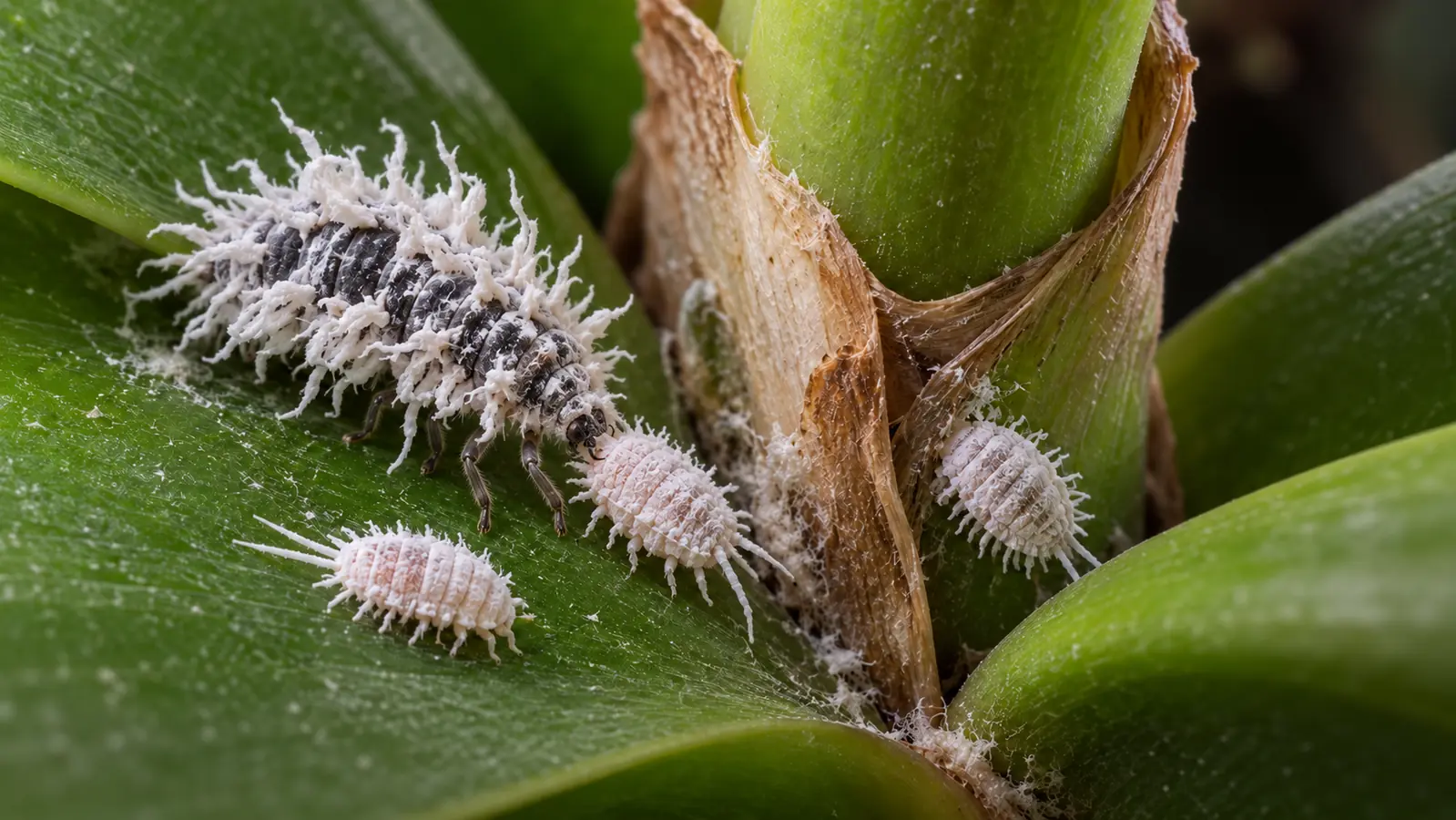
The predator neither removes the wax nor attempts to persuade the mealybug to leave its refuge. It walks through the white threads and eats their owner.
The mealybug destroyer is not, however, a just-in-case patrol. It needs an adequate supply of prey. If we have found one female on a single moth orchid, ordering an entire unit may be rather like summoning armed police to remove a visitor who refuses to take off his shoes.
When prey is scarce, the adult beetles begin searching elsewhere. They can fly. Temperature matters too, since Cryptolaemus comes from a warm climate. In a larger, warm, isolated growing area with a confirmed colony, it can be an excellent intervention force. On a windowsill holding a handful of plants, careful physical removal, quarantine and regular inspection may be more sensible.
The wolf has not merely put on sheep’s clothing. It has walked straight into the fold wearing it.
A child raised inside the enemy
The mealybug destroyer leaves no doubt about its intentions. It enters the colony and begins eating. Leptomastix dactylopii is more subtle.
It is a minute parasitoid wasp. It has neither powerful jaws nor protective armour. Antennae and an ovipositor are enough, because the enemy’s body will provide both food and shelter for its offspring.
The female walks over the plant in search of a host. On encountering a mealybug, she examines it with her antennae. Not every candidate is accepted. Species, size and developmental stage all matter, as does the possibility that another wasp’s offspring may already be inside.
If the candidate meets her requirements, she inserts her ovipositor into its body and lays an egg. For the moment, the mealybug remains alive.
The larva develops inside the host and consumes its tissues. It cannot kill at once, because it would lose both fresh food and protection. Eventually the host stops moving. Its body hardens, changes colour and becomes a mummy. The adult wasp chews a round exit hole and emerges.
Leptomastix is not an ordinary parasite. A parasite exploits its host, but its development need not end in the victim’s death. Here death is part of the plan. An organism with this way of life is called a parasitoid. The distinction may sound like a linguistic nicety; to the mealybug it is fundamental.
The best documented host of Leptomastix dactylopii is the citrus mealybug, Planococcus citri. The wasp chiefly selects larger nymphal stages and young females. That does not mean it will make equally efficient use of every mealybug found on a houseplant.
A packet may say ‘for mealybugs’, but to a parasitoid that category is much too broad. A wasp adapted to one host may inspect another with its antennae and leave without laying an egg. It will not make a mistake merely to oblige us.
Professional biological control identifies the pest first and selects the parasitoid afterwards. Buying one for an unidentified white tuft is like hiring a brilliant burglar without checking whether this is the lock he knows how to open.
The wasp impresses neither by size nor strength. Its weapon is a precise fit. It does not break through the enemy’s covering. It places its own offspring beneath it.
A fortress made from its own body
A small bump appears on a leaf. It does not flee when touched, and no legs or antennae are visible. It resembles a dried droplet, a scar or a scrap of something stuck to the plant. One may overlook it for a long time without realising that an insect is sitting beneath the motionless cover.
Armoured scales, soft scales and mealybugs all belong to the scale insect group. They share piercing-sucking mouthparts and the adult females’ remarkable ability to look like something other than an insect. The differences between them, however, determine how they should be controlled.
A mealybug retains its legs and covers itself in wax. A soft scale becomes progressively less mobile with age, and the domed covering on its back remains part of its body. An armoured scale builds a separate roof from waxy secretions and cast larval skins. The shield can be gently lifted, revealing the soft insect beneath.
Mealybugs and soft scales excrete sticky honeydew on which sooty moulds grow. Armoured scales do not produce honeydew. A plant may yellow, weaken and develop patches without its surface ever becoming sticky.
One of the most serious species on orchids is Boisduval scale, Diaspis boisduvalii. It can colonise leaves and their bases, stems, pseudobulbs and places beneath dry sheaths. Its feeding damages plant cells, and even individual females may be surrounded by extensive yellowish or necrotic areas.
The adult female hides beneath a round pale shield. The male looks quite different. His covering is white, elongated and marked with longitudinal ridges. Large numbers of males form clusters resembling a cottony deposit. One colony may therefore appear to contain two entirely different problems.
The female lays eggs beneath her shield. Tiny yellowish first-stage nymphs, known as crawlers, emerge from it. They have legs and search for a feeding site. This is the only stage in the female armoured scale’s life when she genuinely sets out on a journey.
The nymph later inserts its mouthparts into the plant, settles and begins to build. The fortress does not appear at once, so its future owner spends a brief period walking over the leaf without a roof above her head. She is almost invisible but, at this moment, most accessible to natural enemies.
The adult female sits beneath her shield, with the eggs deeper still. The mobile young, however, must emerge onto the surface. If the fortress cannot be taken, it may be wiser to wait until the gate opens.
Waiting at the gate
The shield separates an armoured scale from the outside world, reduces water loss and obstructs contact treatments. One day, however, the young emerge from beneath it. They do not yet possess shields of their own. They roam over the plant and can reach the next orchid. This is a particularly dangerous moment for both the collection and the scale insect.
Crawlers can be rinsed or wiped away, or intercepted before they settle. Predators also take them without needing to prise up a completed shield. They have only to wait by the exit. Some can reach residents already in hiding as well.
One such hunter is Rhyzobius lophanthae, a small predatory ladybird native to Australia. Both larvae and adult beetles feed on scale insects, especially armoured scales. They can get beneath the edge of a shield and eat the insect underneath. A roof that stops a droplet of spray will not necessarily stop a hungry ladybird.
Rhyzobius hunts various armoured scales and is also used against Boisduval scale. It is not a universal tin-opener for every shield. Success depends on the scale species, the size of the colony, temperature and the predator’s ability to find its prey. Adult beetles have wings and may leave the plant.
Parasitoid wasps work more subtly still. A female explores the shield with her antennae, assesses the host and then inserts her ovipositor through the covering or beneath its edge. Depending on the species, she lays an egg on or inside the scale insect’s body. The larva gradually consumes the host while remaining beneath the very shield intended to protect it. The covering changes ownership without being consulted.
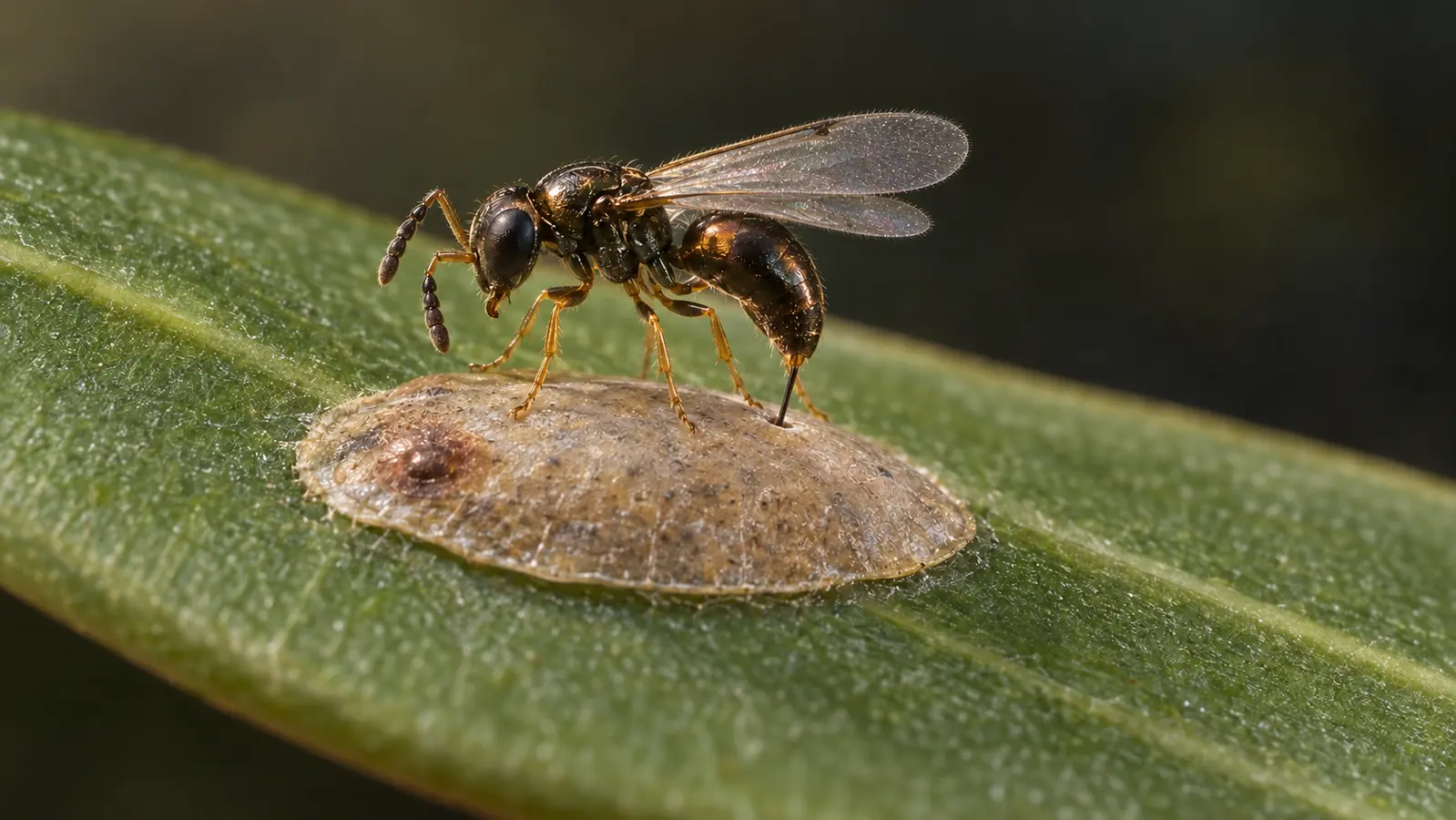
Wasps of the genus Aphytis are used against armoured scales, while certain soft scales are targeted by members of the genus Metaphycus. They are not interchangeable. Individual species select particular hosts and host stages. Natural parasitism by wasps of the genus Coccidencyrtus has been recorded in Boisduval scale. Its shield is therefore not impregnable, but this does not mean that any product labelled ‘parasitoid wasp’ will do.
The more specialised the ally, the more precisely the enemy must be known. With a few armoured scales on one plant, isolating the moth orchid, physically removing the covers and repeatedly checking for crawlers may be quicker. A biological unit may make more sense in a large, warm collection.
Not every fortress has to be stormed. Sometimes guarding the gate is enough.
A war no single hero can win
The invisible army does not march in orderly ranks. Each unit takes up a different position.
Some soldiers patrol the leaves and intercept the youngest thrips larvae; others follow adult prey into flowers; another unit waits in the growing medium, where the pest attempts to vanish while it transforms.
The mealybug destroyer dresses as its own prey and begins feasting in the heart of the colony. A minute wasp does not try to overpower a mealybug. It lays an egg inside it and leaves the work to its offspring.
An armoured scale builds a shelter over itself, but even that offers no complete safety. A predatory beetle gets beneath the edge. A parasitoid uses the host’s body. And when the young emerge from beneath the shield, the fortress briefly opens its own gate.
Each ally works differently and each has limits. A predatory mite will not overcome an adult thrips. A minute pirate bug will not guard the growing medium. A ladybird may fly away when the mealybugs run out. A wasp will pass over the wrong host. A nematode will not cross dry bark merely because victory matters terribly to us.
Biological control is not about finding one organism capable of solving every problem. It is about identifying the enemy, understanding its life cycle and choosing the moment when it is most exposed.
A natural enemy is neither a decorative extra nor the living equivalent of something in a bottle. It has its own requirements, prey range and mode of attack. Released in the wrong place, it may die, fly away or simply take no interest in the pest.
The army therefore needs more than soldiers. It needs reconnaissance, supplies, suitable conditions and a commander who knows when to send out a patrol and when to stage an intervention. It needs boundaries too, because not every organism suitable for a glasshouse belongs on a bedroom windowsill.
Across the first three parts, we have met the enemies and their natural foes. In Part IV, we shall turn that knowledge into a system for protecting a home collection: a living shield, not another miracle cure.
Series: Invisible Army
- Part I: Who Guards the Orchids?
- Part II: Hunters on the Web
- Part III: War Under Cover — you are here
- Part IV: The Living Shield — in preparation
Text: Marzenna Kielan, phalaenopsis.pl
Show sources and methodological notesHide sources and methodological notes
-
University of Massachusetts Amherst. Western Flower Thrips, Management and Tospoviruses. https://www.umass.edu/agriculture-food-environment/greenhouse-floriculture/fact-sheets/western-flower-thrips-management-tospoviruses
-
Koppert. Thripex Plus: Neoseiulus cucumeris, mode of action and environmental requirements. https://www.koppert.com/thripex-plus/
-
Calvo F.J., Knapp M., van Houten Y.M., Hoogerbrugge H., Belda J.E. 2015. Amblyseius swirskii: what made this predatory mite such a successful biocontrol agent? Experimental and Applied Acarology 65:419–433. https://pubmed.ncbi.nlm.nih.gov/25444470/
-
Cornell Integrated Pest Management. Minute Pirate Bug and Insidious Flower Bug Biocontrol Agent Factsheet. https://cals.cornell.edu/integrated-pest-management/outreach-education/fact-sheets/minute-pirate-bug-and-insidious-flower-bug-biocontrol-agent-factsheet
-
Lattin J.D. 1999. Bionomics of the Anthocoridae. Annual Review of Entomology 44:207–231. https://doi.org/10.1146/annurev.ento.44.1.207
-
VKM. 2023. Assessment of Stratiolaelaps scimitus for biological control. https://vkm.no/english/riskassessments/allpublications/stratiolaelapsscimitusforbiologicalcontrol.4.1cbe1a1c1868b3ea4ab463c7.html
-
Buitenhuis R., Shipp J.L. 2005. Efficacy of the entomopathogenic nematode Steinernema feltiae as influenced by Frankliniella occidentalis developmental stage and host plant stage. Journal of Economic Entomology 98:1480–1485. https://pubmed.ncbi.nlm.nih.gov/16334313/
-
University of Connecticut Integrated Pest Management. Biological Control of Mealybugs. https://ipm.cahnr.uconn.edu/biological-control-of-mealybugs/
-
Al-Shami S., Qureshi J.A. 2024. Leptomastix dactylopii Howard, parasitoid of mealybugs. University of Florida IFAS Extension, EENY-807. https://doi.org/10.32473/edis-IN1420-2024
-
García Morales M. et al. 2016. ScaleNet: a literature-based model of scale insect biology and systematics; entry for Diaspis boisduvalii. https://scalenet.info/catalogue/diaspis%20boisduvalii/
-
Liu H. et al. 2025. Boisduval scale, Diaspis boisduvalii, in southern Florida: herbivory on wild orchids and nativity status. Florida Entomologist. https://doi.org/10.1515/flaent-2024-0065
-
Stathas G.J. 2000. Rhyzobius lophanthae prey consumption and fecundity. Phytoparasitica 28:203–211. https://doi.org/10.1007/BF02981798
-
Panis A., Pinet C. 2001. Coccidencyrtus malloi as a parasitoid of diaspidid scales under glass in France. Entomologica 33:199–209. https://ojs.uniba.it/index.php/entomol/article/viewFile/868/698
-
European Commission. Invertebrate biological control agents against plant pests. https://food.ec.europa.eu/plants/plant-health-and-biosecurity/invertebrate-biological-control-agents-ibcas-against-plant-pests_en
-
EPPO. PM 6 Standards on the safe use of biological control. https://www.eppo.int/RESOURCES/eppo_standards/pm6_biocontrol
Most studies of the beneficial organisms described here were conducted in laboratories and glasshouses, on plants other than Phalaenopsis. This article distinguishes well-established species biology from cautious extrapolation to conditions in the home. Product names, application rates and availability may change; before use, consult the label of the particular product, current regulations and information on its compatibility with any plant protection products previously applied.