When you look at the silvery root of a Phalaenopsis, what you see is… calm. The surface is dry, pale, almost clean. After watering, it turns green within seconds, then slowly fades back to silver. It is easy to imagine that you are looking at a simple covering: a botanical sponge that catches water, passes it on to living tissues and otherwise leads a fairly uneventful social life.
A little magnification would be enough to put an end to that peace.
We do not yet have a complete census of every tenant living on every Phalaenopsis root. Research on various orchids does, however, allow us to open the door to this world — and shows that an apparently quiet root can be a very busy address indeed. Bacteria, fungi and photosynthetic organisms have all been found on the roots of different Orchidaceae; microorganisms may occupy the root surface and spaces within the velamen, while some also enter living tissues. This is therefore not a finished portrait of the microbiome of a household Phalaenopsis, but a picture assembled from research on different orchids and from the general biology of microbial communities.
A root is not an empty pipe. It is a landscape.
And in any landscape like this, sooner or later someone opens a garden, a market, a laboratory or a slightly dodgy establishment that operates after dark. There is no point pretending otherwise — it is a splendid place to colonise.
The root surface is not inhabited by “good” and “bad” microbes. It is inhabited by organisms making use of the conditions available to them. Humans supplied the morality, usually after noticing a stain.
In this article
Click to expand ↓
Click to collapse ↑
- Velamen – dead tissue, very lively address
- Biofilm – a city built from glue
- Bacteria – tenants, chemists and opportunists
- Microalgae and cyanobacteria – the green quarter of the velamen
- Fungi – from passer-by to partner
- Surface, interior and three different conversations
- Who designs the garden: the orchid, the environment or chance?
- Microbial products – an invitation with no guarantee of residency
- Do roots need sterilising?
- How do you care for a garden you cannot see? — expandable section
- A garden without a gardener
A glossary for people who peer at the neighbours through a microscope
Click to expand ↓
Click to collapse ↑
Microbiota – the community of microorganisms living in a particular environment, for example bacteria, archaea and fungi. A list of tenants, although many of the names are still written illegibly.
Microbiome – a term used in several ways; most often it includes the microorganisms, their genes, functions and relationships within a given habitat. Not just the list of tenants, but also their occupations, business dealings and correspondence.
Rhizoplane – the surface of the root together with the organisms directly associated with it. The orchid promenade, only considerably stickier.
Endosphere – the interior of plant tissues inhabited by microorganisms that have managed to cross the border without triggering immediate eviction.
Biofilm – an organised community of microorganisms attached to a surface and surrounded by a matrix they produce themselves. A microscopic gated estate, except that the house rules are written by bacteria.
Endophyte – a microorganism that lives inside a plant for at least part of its life cycle without causing visible symptoms of disease. The absence of damage does not necessarily mean friendship; sometimes it merely means civil relations between neighbours.
Orchid mycorrhiza – a specialised association between an orchid and a fungus, whose hyphae form characteristic coils known as pelotons inside cells of the root cortex. This is not a coating on the velamen, but a meeting taking place beyond the threshold.
Velamen – dead tissue, very lively address
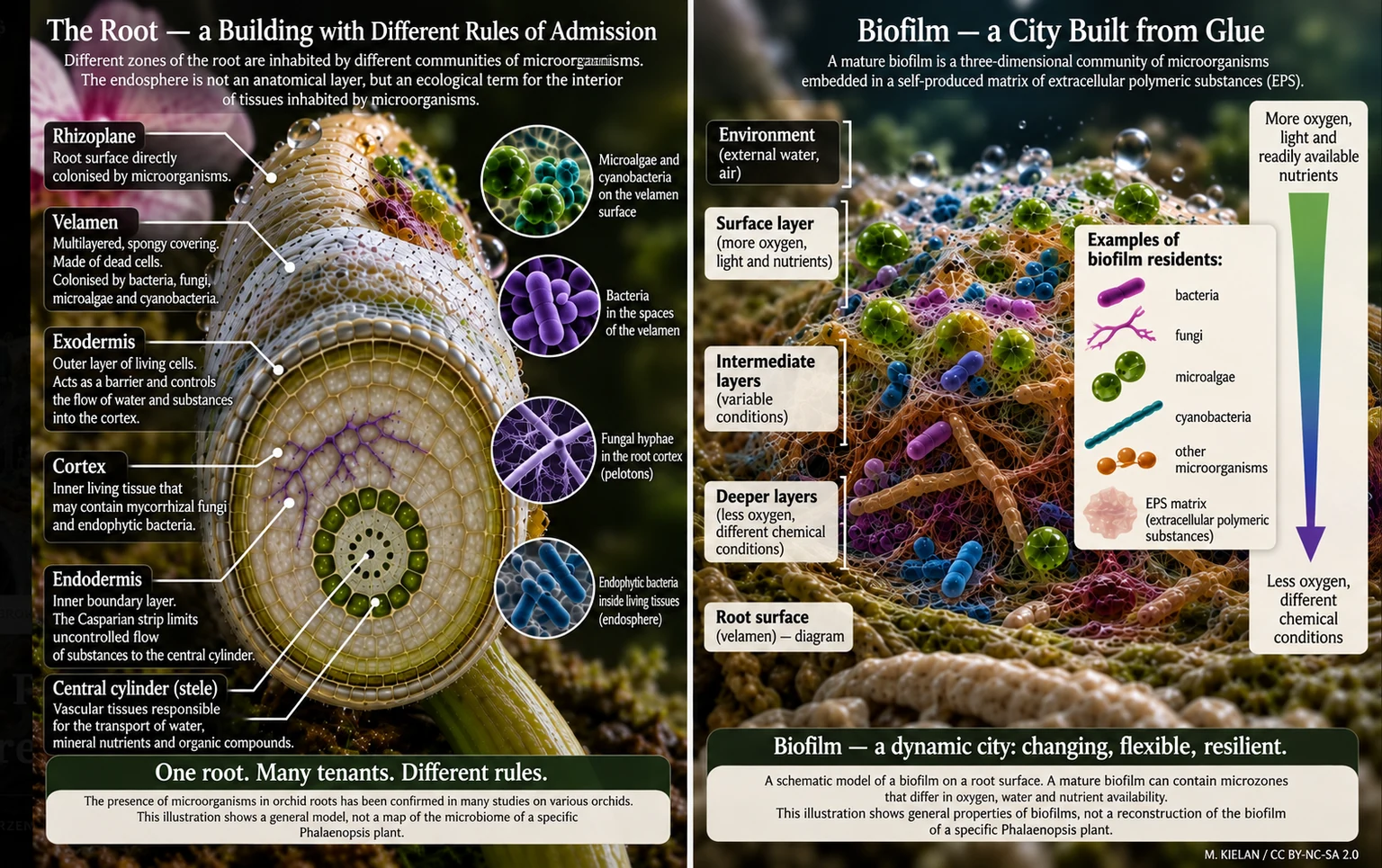
The velamen consists of one or more layers of cells — in many epiphytic Phalaenopsis there are several — which are dead and empty at maturity. What remains are intricately structured cell walls forming a light, porous coat around the living parts of the root. This structure absorbs water quickly and participates in the root’s water economy, helping to capture water and the substances dissolved in it.
Dead does not, however, mean sterile. Quite the opposite: empty cells, fissures, irregularities and intermittently available water create countless microscopic hideaways. After rain or watering, moisture appears. Along with it come tiny particles of bark, dust, mineral compounds, organic debris and microorganisms.
For bacteria, a surface as smooth as glass is harder to colonise than a porous structure full of places sheltered from drying out and being washed away. The velamen was not “designed” as a hotel for microorganisms, but from a tenant’s point of view the location is extremely tempting.
Aerial roots and roots growing in potting media do not offer identical conditions either. They differ in access to light and water, temperature, contact with organic matter and the length of time for which they remain wet. It is hardly surprising that they may host different communities.
Biofilm – a city built from glue
A single bacterium sitting on an exposed root is easy to dry out, wash away or eat. In a group, its chances improve. Microorganisms can attach themselves to a surface and produce a matrix made up, among other things, of polysaccharides, proteins and extracellular DNA.
The matrix helps retain water and nutrients, stabilises the community and alters the movement of chemical compounds. Mature biofilms may contain microzones that differ in oxygen, water and nutrient availability. Two organisms separated by a fraction of a millimetre may therefore be living in different worlds. This is a general property of biofilms, not the result of a measurement taken on Phalaenopsis velamen.
A biofilm is not automatically beneficial. It may be a neutral component of the microbiome, support favourable interactions or protect populations that the grower would rather not protect. Stickiness alone does not provide a moral certificate.
If a thin, stable layer of microorganisms develops on the root surface, that does not yet mean disease. But if the root remains wet for too long, oxygen is scarce, tissues are damaged and the biofilm begins to be dominated by organisms capable of exploiting a weakened plant, the garden may change its line of business rather quickly.
Bacteria – tenants, chemists and opportunists
Numerous surface-dwelling and endophytic bacteria have been isolated from orchid roots. Research on the epiphytic orchids Acampe papillosa and Dendrobium moschatum found abundant bacterial populations, and in A. papillosa aerial roots harboured considerably more bacteria than roots growing in the substrate.
Under laboratory conditions, some isolates can produce auxins, solubilise poorly available phosphorus compounds, fix nitrogen or inhibit the growth of other microorganisms. It sounds like an ideal shortlist of candidates for jobs in the garden. But the fact that a strain grown on culture medium can perform a particular function is not proof that it performs the same service on the root, nor that the effect matters to the plant as a whole.
A microbiome is not the sum of the claims printed on advertising labels. A bacterium producing a small amount of indole-3-acetic acid may support root development in one system, have no measurable effect in another, and disrupt the balance in a third. The strain matters. So do the dose, the host, the neighbours and the conditions.
Even the name of the genus tells us very little by itself. The same group may contain neutral, beneficial and pathogenic strains. Judging a bacterium purely by its surname would be about as sensible as hiring someone because their cousin is said to be excellent at repairing roofs.
Microalgae and cyanobacteria – the green quarter of the velamen
Microalgae and cyanobacteria have also been found on the aerial roots of some orchids. Research, particularly on leafless epiphytic orchids, has revealed a surprising diversity of photosynthetic organisms associated with roots. Some live not only on the outer surface but also in fissures and deeper spaces within the velamen.
Cyanobacteria capable of fixing atmospheric nitrogen make especially tempting protagonists. In a nutrient-poor environment, the possibility of introducing biologically available nitrogen compounds into the local cycle may matter. Simply finding cyanobacteria, however, does not tell us how much nitrogen actually reaches the orchid. Still less does it mean that every greenish film on a root at home is a self-fertilising factory that must immediately be placed under conservation protection.
A conspicuous growth of algae more often tells the grower that light, water and nutrients are available. In a transparent pot, this is commonplace. A light film is usually no reason to panic; a thick, slippery layer, on the other hand, may restrict gas exchange at the surface of the growing medium, make the roots harder to assess and indicate that moisture is being retained for too long.
Green does not always mean healthy. Sometimes it simply means: light plus wet plus lunch.
Fungi – from passer-by to partner
Orchid roots may be colonised by many fungi. Some live on the surface, some as endophytes inside tissues, some remain saprotrophs feeding on dead matter, while others may become pathogenic under favourable circumstances.
Mycorrhizal fungi deserve a section of their own. Orchid seeds are extraordinarily small and contain almost no reserves. Under natural conditions, orchid seed germination is closely linked to colonisation by suitable mycorrhizal fungi, which provide the developing embryo with compounds needed for the growth of the protocorm. It is one of the most extraordinary beginnings of life in the plant world: the child arrives with such a tiny suitcase that its first meals have to be obtained through somebody else’s hyphae.
Inside the roots, the hyphae of mycorrhizal fungi form pelotons — tightly coiled masses of fungal threads — within cells of the cortex, separated from the host cytoplasm by a plant-derived membrane. In time, the pelotons break down. This is a dynamic system of colonisation, exchange and digestion, not a peaceful little fungus sitting on the outer silver skin.
In adult, photosynthetic orchids, dependence on the fungus is usually different from that seen in seeds and young protocorms. Many mature plants continue to maintain mycorrhizal associations, but their importance depends on the species, the environment and the plant’s nutritional strategy. The fact that every orchid requires a fungus for natural germination does not justify the conclusion that every adult hybrid on a windowsill will die without a bottle labelled “universal mycorrhiza”.
Surface, interior and three different conversations
When talking about the root microbiome, it is easy to throw all its inhabitants into one bag. Yet an organism attached to the outer surface of the velamen, a bacterium living between cells and a fungus forming pelotons in the living cortex occupy different niches and have very different relationships with the plant.
The velamen is the first point of contact and a physical filter. Beyond it lies the exodermis, the outer layer of the living cortex, with a small number of passage cells that facilitate the movement of water and dissolved substances. Beneath that lies the cortex proper. Moving further inside means crossing anatomical and chemical barriers, and admission is not granted to everyone who happens to arrive in a raindrop.
The plant is not a passive block of flats either. Living tissues recognise microbial signals, activate immune responses and modify the chemical environment. At the same time, drought, injury, oxygen deprivation or the accumulation of dead matter can weaken these boundaries and turn a previously neutral neighbour into an opportunist.
Who designs the garden: the orchid, the environment or chance?
The composition of the microbiome depends on the species and genotype of the plant, the age of the root, where it is growing, the substrate, water, temperature, fertilisation and which microorganisms happen to be available in the surroundings. In a study of Dendrobium denneanum growing on a living tree, on rock and in pots, the different cultivation modes were associated with differences in the composition of bacterial and fungal communities. That is an important clue, though not a universal verdict for all orchids in all growing conditions.
There is therefore no single “correct orchid microbiome” that can be sealed in a sachet. An aerial root in a tropical forest, a root attached to bark and the root of a hybrid buried in pine bark on a windowsill are not hosting the same parties.
Chance supplies the first arrivals. The environment decides who gets water, light and food. The plant imposes its own filters. Then the tenants begin influencing one another.
Microbial products – an invitation with no guarantee of residency
Adding bacteria or fungi to a potting medium does not automatically create a stable, beneficial microbiome. The microorganism has to be alive, encounter suitable conditions, attach itself or colonise the right niche, survive competition and perform the function for which it was applied.
The specific strain matters, not merely the species name. The effectiveness of an inoculant also depends on its viability, formulation and storage, the dose, method of application, ability to colonise and compatibility with both the host and the microbiome already present. A result obtained with one strain or one plant is therefore not automatically a promise of the same effect in a Phalaenopsis at home.
A microbial product may be a useful tool. It is not, however, an act of biblical creation. Pouring the contents of a bottle over a root does not guarantee that the advertised residents will move into the penthouse suites and spend the rest of their lives working off the rent.
Do roots need sterilising?
A healthy orchid is not sterile and should not be treated as though every microscopic life form were the beginning of an epidemic. Routine use of disinfectants can damage tissues and alter the microbial community already present, so there is no reason to treat a healthy root as a surface that must be sterilised.
That does not mean hygiene is unnecessary. Tools are worth disinfecting, diseased plants should be isolated, decomposing potting medium replaced, and treatments aimed at a specific pathogen used when there is a reason to do so. A targeted intervention is one thing; repeatedly bombarding a healthy root because the internet suggested that bacteria sound suspicious is quite another.
Sterility in a pot is, in any case, a short-lived promise. Open the bag, water the plant, touch it, allow the first movement of air — and recolonisation begins. Nature abhors vacant property; the residents’ association can only try to set the terms of the tenancy.
How do you care for a garden you cannot see?
Click to expand ↓
Click to collapse ↑
We do not need to know the names of every resident in order to avoid creating perfect conditions for disaster.
- Provide air. A loose, durable potting mix and good air movement reduce prolonged oxygen deprivation, which harms roots and alters microbial communities.
- Do not deprive roots of air. The roots of epiphytic Phalaenopsis also need access to air and should not remain permanently in sodden, oxygen-poor media. Warm mush is still not desirable real estate.
- Remove decomposing potting media. Old, crumbling bark retains more water, loses air spaces and supplies organic matter to saprotrophic organisms.
- Fertilise sensibly. Excess salts damage tissues, but an oversupply of readily available nutrients can also rearrange the microbial buffet.
- Do not pour homemade soup over the roots. Sugar, milk, banana, rice water and other kitchen potions feed the entire community, not just the tenants favoured by the person who made the video.
- Treat the cause, not the mere presence of microbes. A soft, foul-smelling root requires a different response from a thin green film on the wall of a pot.
- Use inoculants as tools, not articles of faith. Check the ingredients, strains, storage requirements and evidence that they work.
A garden without a gardener
The root surface is not a scene of harmony from an eco-lifestyle catalogue. There is competition for space, water and nutrients. There is cooperation, exchange of metabolites and chemical deterrence between neighbours. There are transient organisms, permanent residents, partners, parasites and opportunists waiting for the conditions to change.
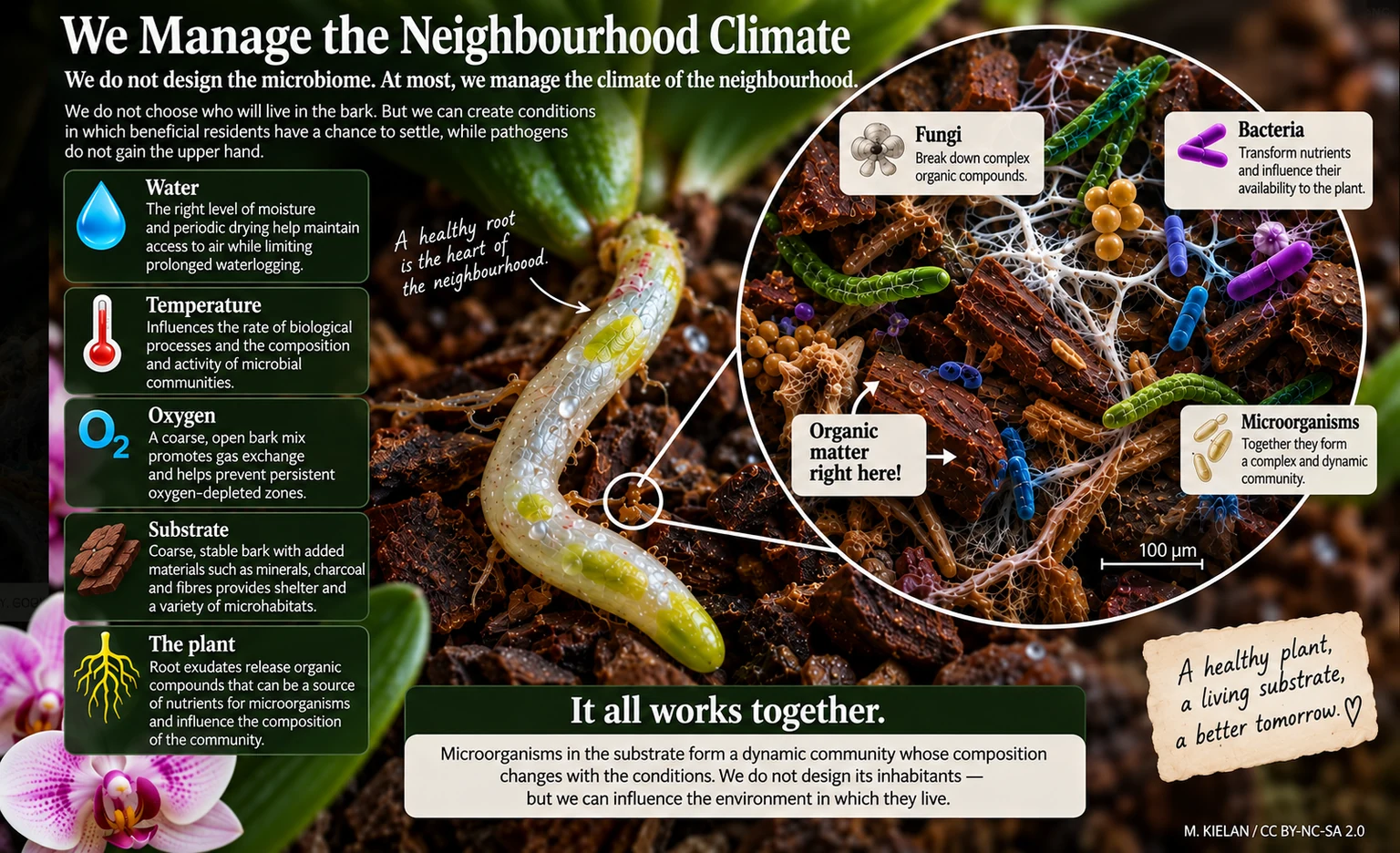
The orchid does not consciously choose every tenant, but its anatomy, metabolism and immune system form a filter. We influence this world too: through the potting medium, water, fertiliser, air movement, temperature and every product poured into the pot.
But we are not the designers of the microbiome. At best, we manage the climate of the neighbourhood.
The next time you look at a silver root, you will see more than a covering. You will see a porous landscape that wakes briefly after rain, fills with water and sets thousands of microscopic processes in motion.
The garden will remain invisible.
But never empty.
Bibliography and scientific sources
Click to expand ↓
Click to collapse ↑
- Zotz G., Winkler U. (2013). Aerial roots of epiphytic orchids: the velamen radicum and its role in water and nutrient uptake. Oecologia 171: 733–741. https://doi.org/10.1007/s00442-012-2575-6
- Idris N.A., Collings D.A. (2021). The orchid velamen: a model system for studying patterned secondary cell wall development. Plants 10: 1358. https://doi.org/10.3390/plants10071358
- Tsavkelova E.A., Cherdyntseva T.A., Netrusov A.I. (2004). Bacteria associated with the roots of epiphytic orchids. Microbiology 73: 710–715. https://doi.org/10.1007/s11021-005-0013-z
- Kaur J., Sharma J. (2021). Orchid root associated bacteria: linchpins or accessories? Frontiers in Plant Science 12: 661966. https://doi.org/10.3389/fpls.2021.661966
- Li T., Yang W., Wu S. et al. (2021). Progress and prospects of mycorrhizal fungal diversity in orchids. Frontiers in Plant Science 12: 646325. https://doi.org/10.3389/fpls.2021.646325
- Tsavkelova E.A. et al. (2022). Cyanobacterial root associations of leafless epiphytic orchids. Microorganisms 10: 1006. https://doi.org/10.3390/microorganisms10051006
- Chen L. et al. (2023). Cultivation modes impacting root microbiomes and metabolites in medicinal orchid Dendrobium denneanum. Frontiers in Microbiomes 2: 1287336. https://doi.org/10.3389/frmbi.2023.1287336
- Deepthi A.S., Ray J.G. (2020). Algal associates and the evidence of cyanobacterial nitrogen fixation in the velamen roots of epiphytic orchids. Global Ecology and Conservation 22: e00946. https://doi.org/10.1016/j.gecco.2020.e00946
- Flemming H.-C., Wingender J. (2010). The biofilm matrix. Nature Reviews Microbiology 8: 623–633. https://doi.org/10.1038/nrmicro2415
- Berg G., Kusstatscher P., Abdelfattah A., Cernava T., Smalla K. (2021). Microbiome Modulation—Toward a Better Understanding of Plant Microbiome Response to Microbial Inoculants. Frontiers in Microbiology 12: 650610. https://doi.org/10.3389/fmicb.2021.650610
- Pepe O. (2020). Effectiveness of Plant Beneficial Microbes: Overview of the Methodological Approaches for the Assessment of Root Colonization and Persistence. Frontiers in Plant Science 11: 6. https://doi.org/10.3389/fpls.2020.00006
← Part I: The Pharmacy at the Tip of the Root
← Part II: Touching Moisture. How Does a Root Know Where Water Is Waiting?
Part III: The Secret Garden — you are here
Copyright Marzenna Kielan – all rights reserved