In 2011, Destario Metusala saw a photograph of an orchid collected in western Kalimantan. The plant belonged to a private collection and was labelled Phalaenopsis gigantea “yellow”. It looked familiar, but not quite. The flowers were smaller, the perianth segments narrower, and the whole thing gave off that irritating feeling familiar to anyone who has spent long enough with one group of organisms: something is not right, but you cannot yet say what.
Hello, is Jolka in?
In the Polish cult film Sexmission (Seksmisja), Maks reaches the surface and asks: “Hello, is Jolka in?”. The question is absurdly ordinary in view of the situation in which the character has just found himself. Something similar happened in the story of Phalaenopsis kapuasensis. Nobody hacked through an unknown valley with a machete, and nobody pulled an orchid from a rocky crevice no human had ever reached before. The plant was simply already there.
Metusala asked the owner, Muhammad Gunawan, for floral material. In mid-2011 he received flowers preserved in alcohol. At first, it really was reasonable to suspect that this might be an unusual form of Phalaenopsis gigantea. But the proportions of the flowers did not fit the familiar picture of that well-known species. The material was intriguing, yet still too limited to settle the matter.
Six years passed.
In 2017, similar plants appeared for sale at a local orchid show in Jakarta. That same year, Dr Ingrid Hilman, an orchid enthusiast who owned such a specimen, provided Metusala with fresh flowers for study. We do not know whether her plant was one of those offered at the show, and there is no reason to assume that it was. What we do know is that the researchers finally had material that could be examined not merely as a curiosity, but as a potentially distinct species.
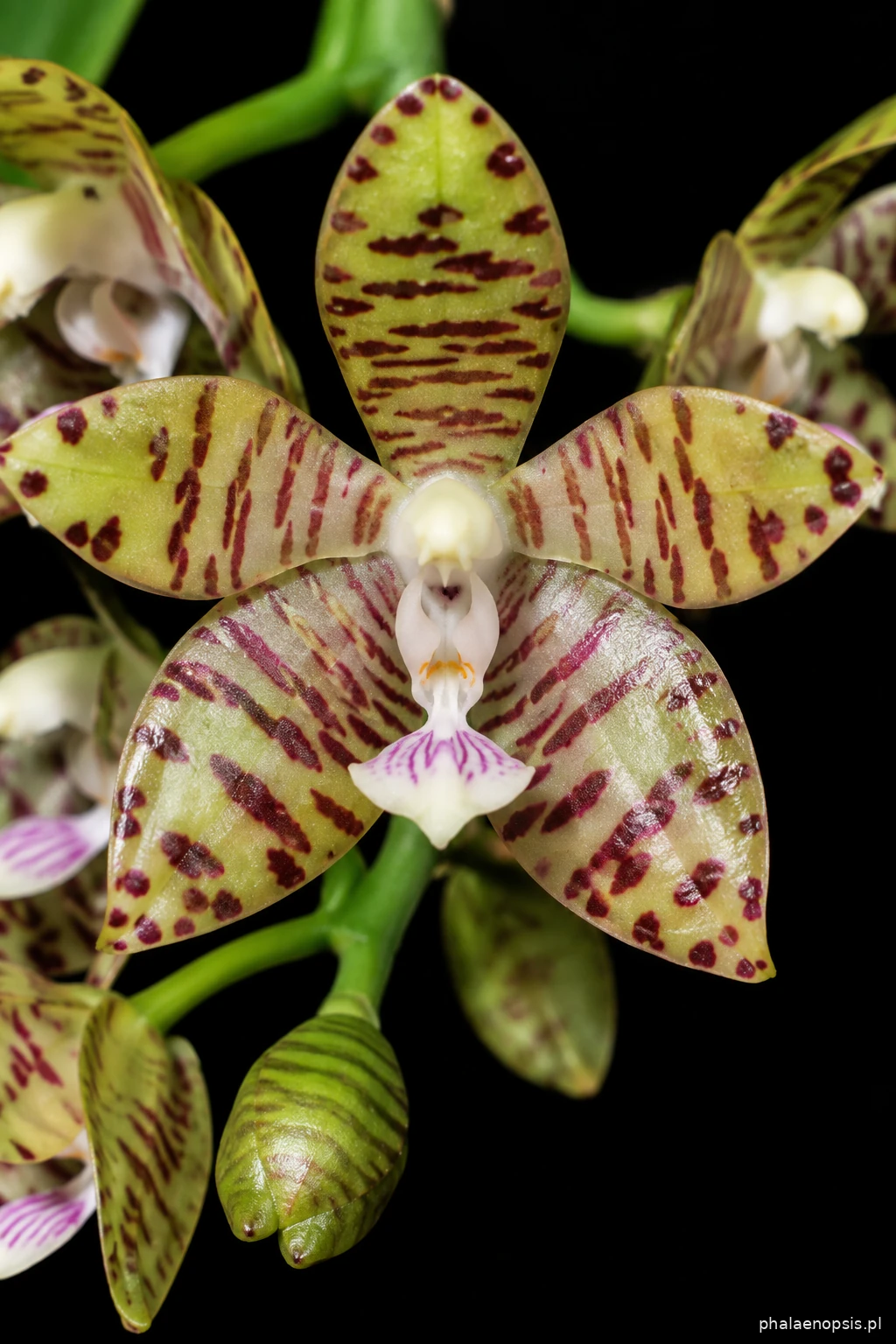
What the stereomicroscope saw
The description of a new species rarely rests on one spectacular detail. Metusala and Peter O’Byrne examined living plants, flowers preserved in alcohol, herbarium material and photographs. Dried flowers were softened in boiling water, while small structures of the lip and column were studied under a stereomicroscope. They were then compared with the most similar species: Phalaenopsis gigantea, Phalaenopsis doweryensis and Phalaenopsis rundumensis.
The differences began to form a coherent pattern.
Phalaenopsis kapuasensis has much narrower leaves than Phalaenopsis gigantea, smaller flowers and narrower perianth segments. Its flowers open successively, whereas in Phalaenopsis gigantea a larger number may open more synchronously. The most useful character, however, is found on the lip. The upper surface of its midlobe is covered with short, rather thick hairs. Phalaenopsis gigantea has none.
The other relatives have their own identifying features as well. Phalaenopsis doweryensis may have flowers of a similar size, but the margins of the midlobe of its lip bear characteristic finely fringed or tooth-like projections, and the surface is not hairy. Phalaenopsis rundumensis has larger flowers, triangular lateral lobes of the lip, and likewise lacks the characteristic hairs.
The authors also pointed out something particularly important: the shape of the lip midlobe itself is variable. This is true of both Phalaenopsis kapuasensis and Phalaenopsis gigantea, while the variability of Phalaenopsis rundumensis remains poorly understood. A single character, torn from its context, can therefore send an identification badly off course. Botany, as usual, has no intention of making our lives easier merely because it would be convenient.
A family with problems
Phalaenopsis kapuasensis, Phalaenopsis gigantea, Phalaenopsis doweryensis and Phalaenopsis rundumensis form a small group of closely similar moth orchids associated with Borneo. The problem is that we still know surprisingly little about their natural variation.
Phalaenopsis gigantea was described in 1909 from material collected during Nieuwenhuis’s 1896–1897 expedition and later cultivated at the Bogor Botanic Gardens. Phalaenopsis doweryensis was described in 2001 from plants cultivated in the United States that were said to have originated in Sabah. Phalaenopsis rundumensis was described ten years later from the Rundum area of Sabah, where it occurred in hill forest at elevations of about 600–800 metres.
Each of these species therefore contributes a little information to the family album, and a few blank spaces as well.
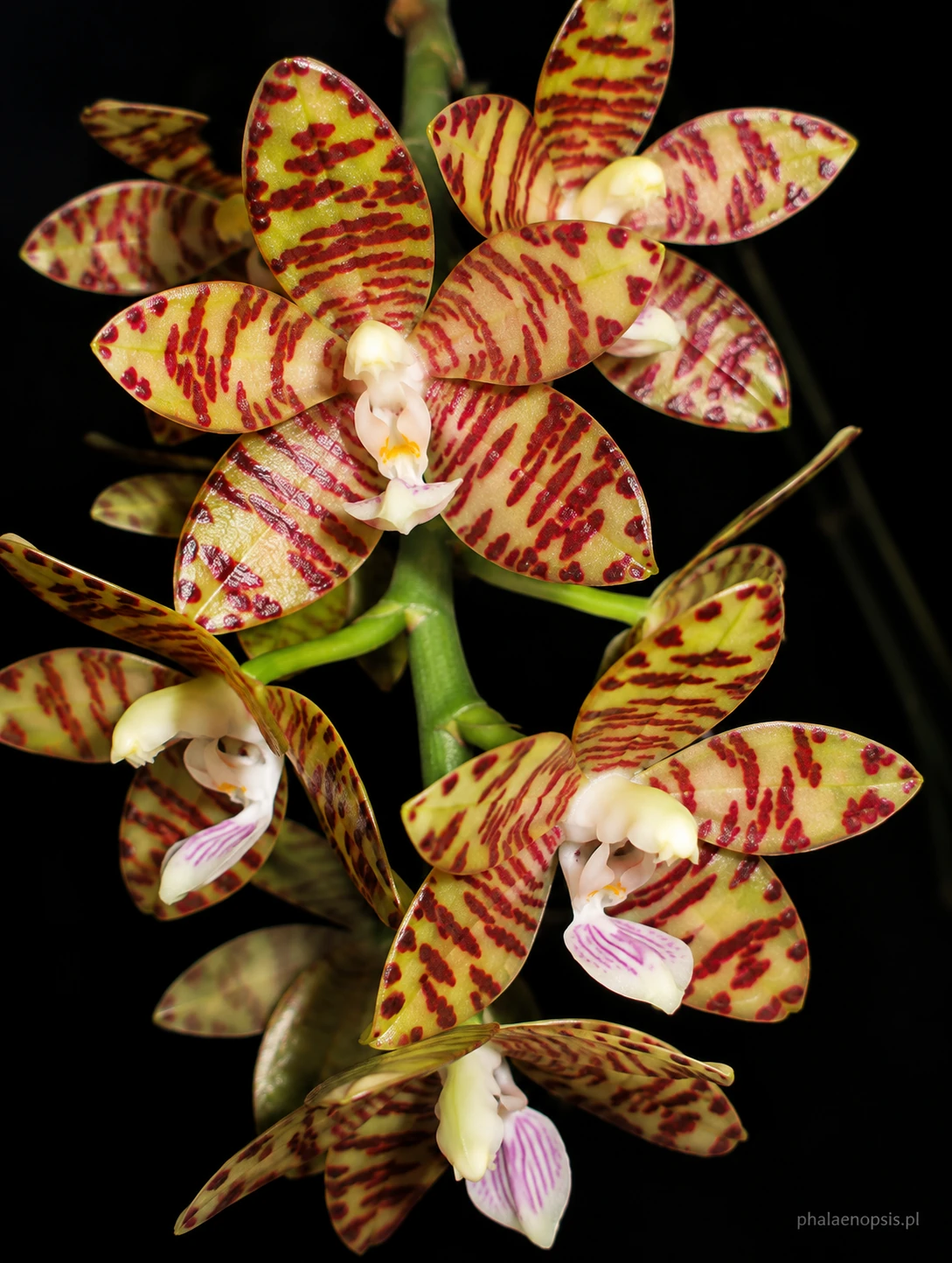
Metusala and O’Byrne wrote plainly: “We are still far from understanding the taxa in this complex”. I also found no published molecular analysis directly testing the relationships between Phalaenopsis kapuasensis and the three species to which it has been most closely compared. We therefore have a well-supported morphological description, but not the final chapter of the story.
In 2023, the American Orchid Society’s Species Identification Task Force confirmed the identification of one examined specimen as Phalaenopsis kapuasensis, citing, among other characters, the distinctive hairs on the lip and the proportions of the perianth segments. This is a valuable verification of a particular plant, not a molecular verdict that closes the discussion about the boundaries of the entire complex.
Not as small as its flower suggests
The flowers of Phalaenopsis kapuasensis are about 26–30 mm across. Beside the large flowers of modern hybrids, they can seem almost modest. The plant itself, however, is decidedly not.
It is an epiphyte with a pendulous habit. The short stem reaches about 4–5 cm and usually carries three to six thick, waxy leaves. These may be 22–48 cm long and 5–10 cm wide. In nature, then, this is not a tiny green rosette decorated with a dainty flower, but a substantial plant whose long leaves hang from its support, with inflorescences emerging from beneath them.
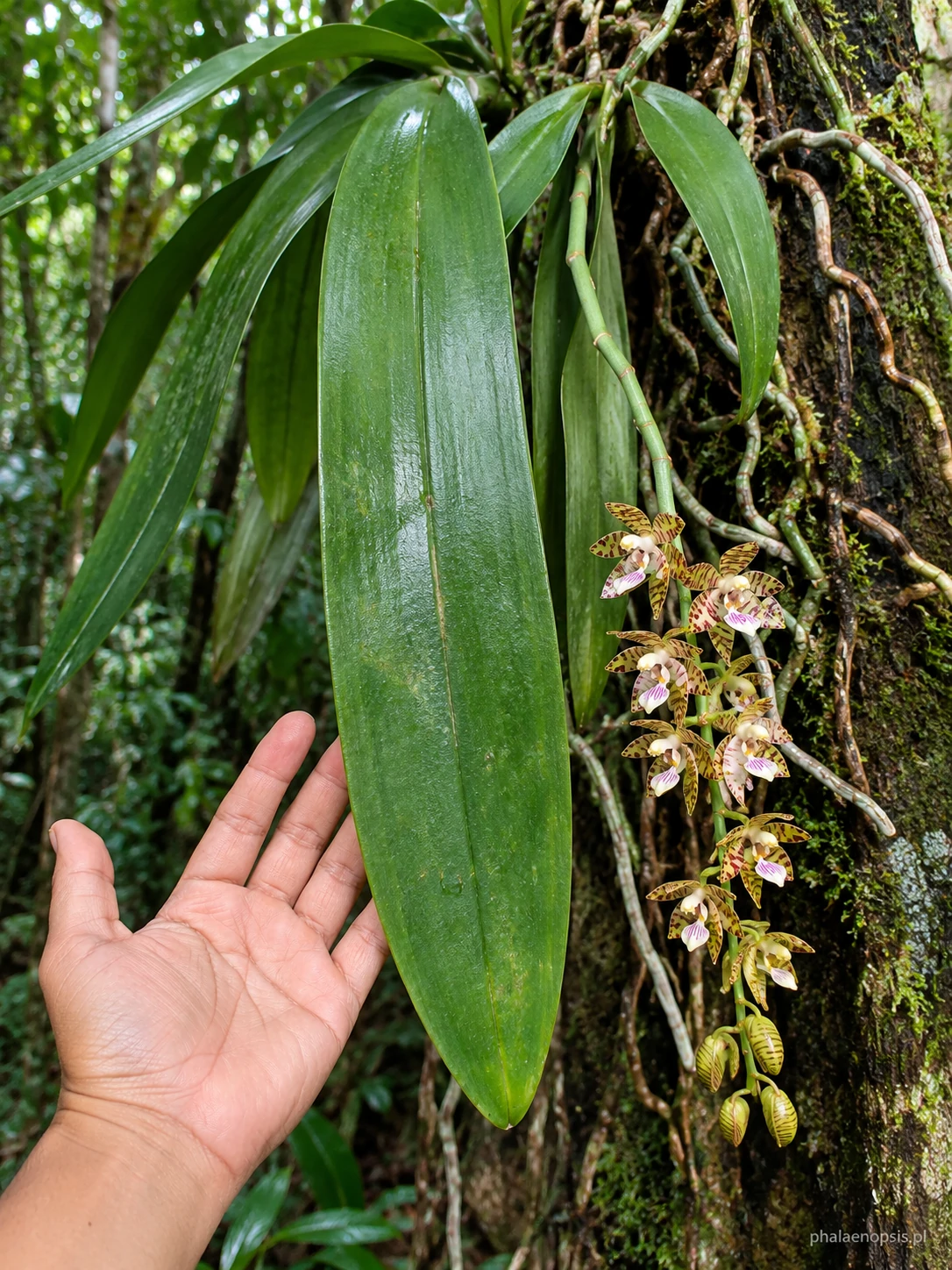
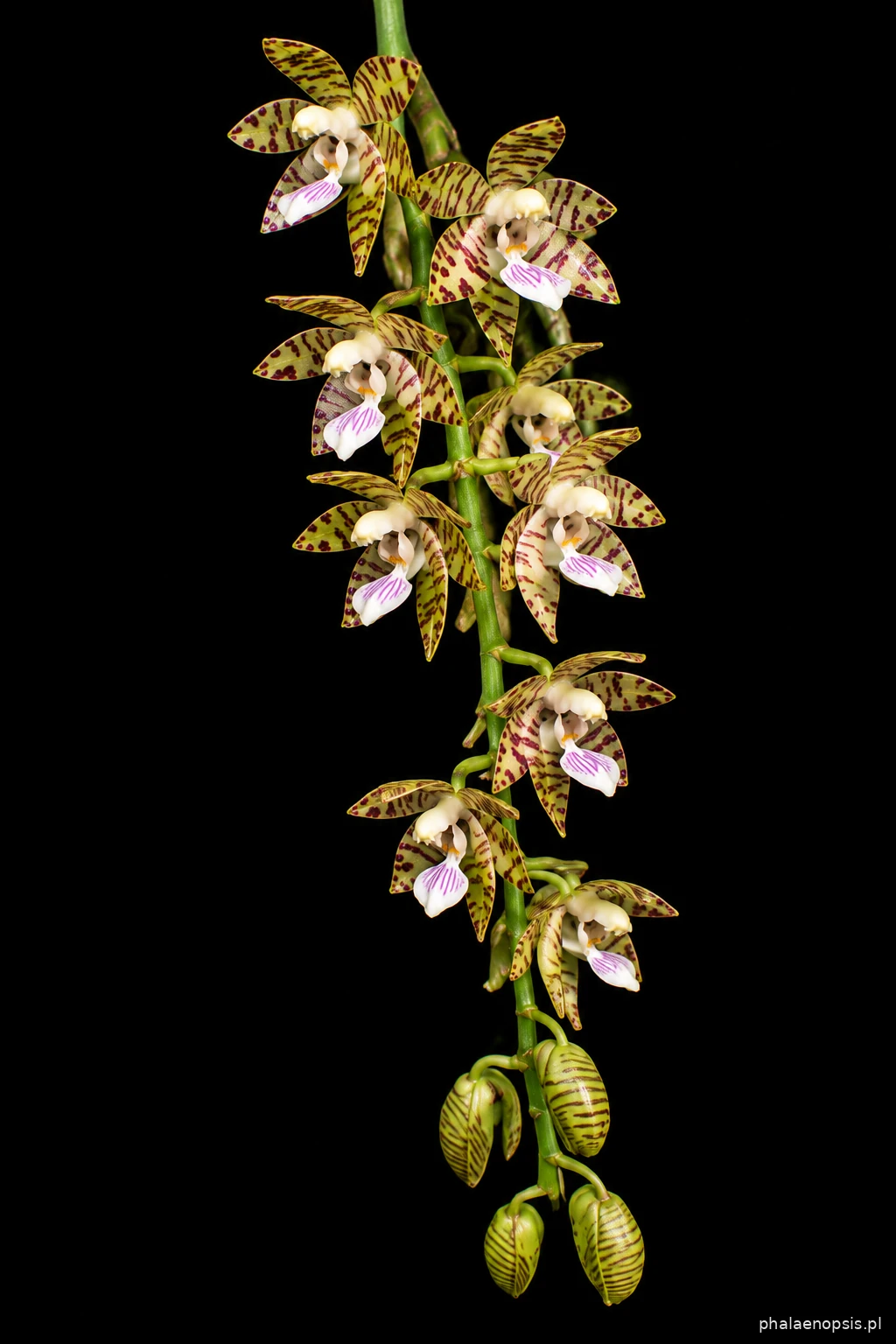
The inflorescences are pendulous too, about 10–34 cm long, and may sometimes produce one or two short branches. A single inflorescence can carry more than thirty flowers, although they do not all open at once. The authors of the protologue usually observed between two and ten flowers open at the same time.
Where the map ends
According to the species description, Phalaenopsis kapuasensis comes from lowland forest in western Kalimantan and occurs at elevations of about 50–200 metres. It was named after Kapuas Hulu Regency. The authors deliberately withheld the exact locality where the plants had been found.
This was not an omission. It was protection.
For an orchid with a poorly known distribution, precise coordinates can become not only scientific information but also a set of directions for collectors. The map therefore stops sooner than a curious reader might wish. We know that the species comes from western Kalimantan. We are not told exactly at which tree one should get out of the car and turn into the forest.
Plants of the World Online at Kew currently accepts Phalaenopsis kapuasensis as a distinct species occurring on Borneo, in western Kalimantan, in the wet tropical biome.
In 2018, the name Phalaenopsis kapuasensis f. flava was also published. Kew currently treats it as a synonym of Phalaenopsis kapuasensis. There is a certain elegance to this: the plant entered our story as a “yellow gigantea”, and a few years later its yellow form was given a separate name of its own, which ultimately did not survive either.
Taxonomy apparently likes a punchline.
Save the plant, lose its history
The most interesting paradox of Phalaenopsis kapuasensis, however, does not fit under a stereomicroscope. The species came to scientific attention because plants were taken from the forest into private collections and the trade. The same mechanism that provided botanists with material can simultaneously destroy the information needed to understand it.
Metusala and O’Byrne noted that many newly collected plants belonging to this group end up not in botanic gardens and herbaria, but in nurseries and private collections. Along with the plant, the exact locality, habitat description, population size, information about neighbouring plants and the entire ecological context are often lost.
It is therefore possible to save a living specimen while losing part of its history.
The authors also wrote that wild populations were being systematically removed and sold for private profit. This is particularly troubling in a group whose species boundaries and natural variation are still poorly understood. A plant stripped of its provenance becomes a much poorer scientific record.
How many are left?
That is precisely what we do not know.
In the available sources, I found no published estimate of the size of the wild population of Phalaenopsis kapuasensis. I also found no formal assessment of the species on the IUCN Red List. The absence of such data does not mean that the species is safe. Above all, it means that the data are absent.
In Kew’s Automated Extinction Risk Predictions system, the species received a predicted category of “threatened” in 2024, with high model confidence. This is, however, the result of automated risk modelling, not a formal IUCN assessment, and the two should not be treated as equivalent.
Like other orchids covered by the relevant regulations, Phalaenopsis is also subject to CITES rules governing international trade. The fact that the genus is included in Appendix II is not, however, an assessment of the threat level of any particular species. CITES regulates trade. It does not count plants in the forest.
New only to us
On 25 September 2017, Destario Metusala and Peter O’Byrne published the name Phalaenopsis kapuasensis. The holotype, designated RIO 9005, was deposited in Herbarium Bogoriense.
In everyday language, we would say that a new species had been discovered. Biologically, however, that is a slightly misleading phrase. The plant did not come into existence in 2017. It did not suddenly appear in the forest when a botanist wrote a diagnosis and gave it a name. It had been growing there already, probably for a very long time. People had collected it, photographed it, cultivated it and even sold it as something else.
Only our knowledge was new.
The story of Phalaenopsis kapuasensis therefore reminds us of one of the most fascinating things about biology. Not every undiscovered plant is hiding from people somewhere in an inaccessible forest. Sometimes we are looking straight at it and still do not know what we are looking at.
Photographs: Reza Wibawa and Anas Sarully, used with the authors’ permission. Prepared for publication by phalaenopsis.pl.
Sources
- Metusala D., O’Byrne P. (2017). Phalaenopsis kapuasensis (Orchidaceae), a new species from Kalimantan, Indonesian Borneo. Pro-Life 4(3): 386–391. DOI: 10.33541/pro-life.v4i3.434.
- Royal Botanic Gardens, Kew. Plants of the World Online: Phalaenopsis kapuasensis. Plants of the World Online.
- American Orchid Society, Species Identification Task Force (2023). Phalaenopsis kapuasensis. SITF Finding.
- Bachman S.P. et al. (2024). Automated extinction-risk predictions for the world’s flowering plants. New Phytologist. Project information: Royal Botanic Gardens, Kew.
- Royal Botanic Gardens, Kew (2022). CITES Appendix II Orchid Checklist. Kew / CITES Orchid Checklist.