For much of the twentieth century, the perfect moth orchid was supposed to look as though someone had designed it with a compass, a ruler, and the unshakeable conviction that white was the last word in colour. Its flowers had to be large, round, flat, long-lasting, and flawless. The petals were to overlap without leaving any awkward gaps, the flower spike had to be suitable for cutting, and the whole thing had to look good on the show bench and even better in a vase.
For decades, breeders patiently improved on nature. Nature, as we know, rarely reads the judging rules, but this time it was almost persuaded. The result was a succession of magnificent white Phalaenopsis with flowers so perfectly symmetrical that you began to suspect the moon ought to make more of an effort.
And yet, on the fringes of this orderly world, other plants were growing. Their flowers were smaller, star-shaped or waxy, sometimes spotted, striped, or drenched in colour. Some were fragrant. Others kept opening new flowers on the same spike, one or two at a time, long after the stately white hybrids had finished their performance. They belonged to species that had spent years losing out to the prevailing ideal of flower form.
During the 1960s, breeding that explored these possibilities began to gather momentum. For the purposes of this story, we shall call it a rebellion against the idea that beauty could take only one acceptable form.1
Novelty Phalaenopsis is a term with loose boundaries. It covers hybrids prized for unusual colours and patterns, often accompanied by fragrance, a waxy texture, or sequential flowering. Many descend from warmth-loving species placed in the subgenus Polychilos. It is not, however, a formal botanical category, nor a group with a single, precisely defined ancestry.2
This article opens a series on Novelty Phalaenopsis breeding. We begin with the birth of the idea itself. In the articles that follow, we will explore the major breeding traditions: the people behind them, their parent lines, their favourite species, and the traits that reveal their influence.
A revolution ahead of its time
The earliest threads of this story lead much further back. By the late nineteenth century, European breeders were already crossing white moth orchids with colourful species. In 1887, Veitch registered Harriettiae, a hybrid of Phalaenopsis amabilis and Phalaenopsis violacea. Eight years later came Luedde-violacea, the offspring of Phalaenopsis lueddemanniana and Phalaenopsis violacea.3
Both crosses sound surprisingly modern. Their pedigrees contain the very species that novelty breeders would turn to many decades later: plants with rich colours, bold markings, waxy textures, and fragrance. The genetic ingredients of the rebellion were already on the table in the Victorian era.
That does not mean a novelty movement existed at the time. A single cross may be a dazzling experiment, but a breeding direction only begins to take shape when there are further generations, deliberate selection, and desirable traits that can be passed on. Those Victorian crosses hinted at possibilities that would take many more decades of work to explore fully.
Even deciding which came first requires care. Harriettiae is sometimes described as the first artificially produced Phalaenopsis hybrid, but the history of earlier attempts, first flowering, and subsequent registration cannot be reduced to a single date. What matters more to our story is that breeders recognised the potential of colourful species early on, even though those species remained outside the mainstream for many years.5, 6
Seeds finer than dust
One reason was entirely practical. Orchid seeds have almost no food reserves. In the wild, germination depends on an encounter with a suitable fungus, which supplies nutrients to the developing embryo. For a nineteenth-century breeder, sowing orchid seed therefore meant leaving a substantial part of the enterprise to chance. And chance, though an inventive colleague, has a dreadful work ethic.
The breakthrough came in 1922, when the American plant physiologist Lewis Knudson published a method for germinating orchid seeds asymbiotically on an artificial nutrient medium. Breeders could now raise larger numbers of seedlings and select among their offspring much more deliberately.4
Knudson’s method did not create novelty breeding. It did, however, give future breeders a tool without which selection over successive generations would have remained far slower, more expensive, and less predictable.
The white empire: from vase to pot
Technology was only part of the answer. Throughout the first half of the twentieth century, breeders had a very clear goal. It was not a small, fragrant flower the colour of a ripe mango, decorated with whatever spots its ancestors happened to fancy.
Phalaenopsis were bred primarily for cut flowers. Growers wanted long, strong spikes bearing large, evenly shaped, long-lasting blooms. White and pale pink lines fitted the brief beautifully. Each new generation was meant to be larger, fuller, and rounder. Species with smaller, star-shaped, or heavily patterned flowers might contribute remarkable colours, but they also brought traits then regarded as flaws: narrow petals, gaps between the segments, small flowers, and less imposing flower spikes.
This is a crucial point in our story. The wild species had not spent decades waiting to be discovered. They were known. Their potential was recognised, too. They simply did not fit the accepted definition of perfection.
In the 1960s, the shift towards Phalaenopsis as pot plants gave breeders room to explore.6
In a vase, a long spike and an immediate impression were what mattered. In a pot, qualities that had previously been overshadowed could come into their own: compact growth, flowers opening in succession, the ability to extend an existing spike, fragrance, unusual texture, and variation in the markings. A small flower no longer had to pass for a disappointing large one. It could be exactly what someone wanted.
Meanwhile, methods of clonal orchid propagation were developing. These made it possible to reproduce outstanding individual plants while retaining their characteristics. Crossing and selection still began with seeds, but clonal propagation made the best results easier to share. An exceptional plant no longer had to remain a solitary stroke of luck tucked away in its breeder’s greenhouse.5, 6
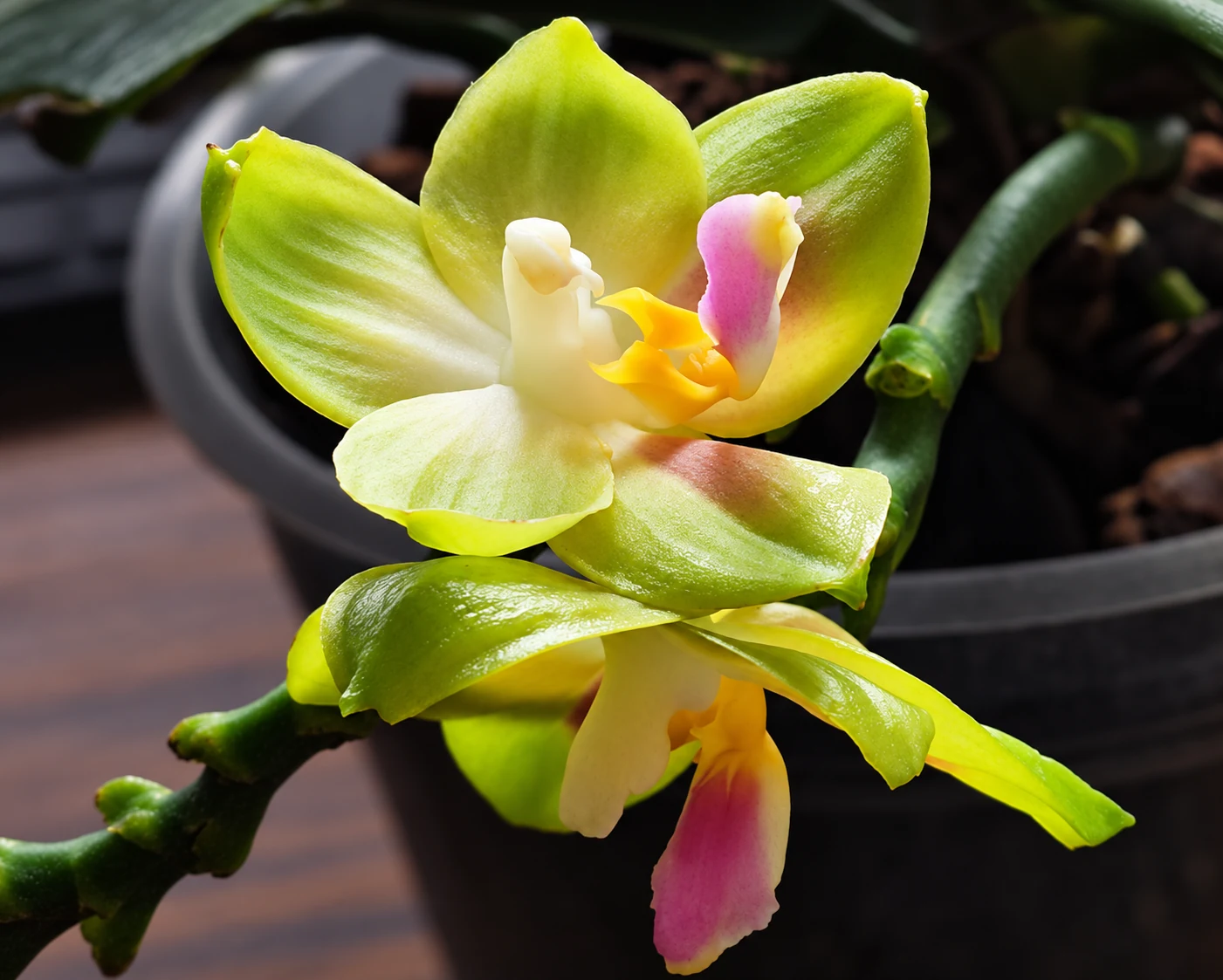 Phalaenopsis Joy Spring Canary ‘Yaphon’ — photograph by Marzenna Kielan.
The chromosome trap
Chromosomal compatibility between the parents could also get in the way. Crossing two promising plants was no guarantee that their offspring could be used in further breeding.
Many Phalaenopsis species are diploid: they have two sets of chromosomes. Among the advanced large-flowered lines, however, there were tetraploid plants, with four sets. Crossing the two could produce triploid offspring, with three sets. Such a plant might flower beautifully, yet uneven chromosome segregation during the formation of reproductive cells could reduce its fertility or leave it sterile. A breeder could arrive at an extraordinary flower only to discover that using it as a parent would be harder than expected.6, 8
Fertility depended on the particular parental combination, and ploidy did not account for every breeding difficulty. Later, spontaneously occurring unreduced gametes and artificial chromosome doubling proved useful, among other approaches, in restoring fertility to valuable hybrids.7
This mechanism helps explain some of the difficulties encountered when breeding further generations of hybrids. Without data on the plants concerned, however, it cannot be used to explain what became of the earliest nineteenth-century crosses.
The rebellion’s chronicler
Hugo Freed was among the breeders who systematically explored new possibilities in Phalaenopsis and wrote about them in orchid journals. His publications trace an interest in striped flowers, Phalaenopsis violacea, and new directions in hybridisation. He knew the white empire from the inside, too: in 1968, he also published “Breeding White Phalaenopsis” in Orchid Digest.9
An important parent in his programme was Phalaenopsis violacea ‘Country Acres’. A note published in the Australian Orchid Review in 1976 records that the Freeds’ nursery made forty crosses using this plant between 1964 and 1975. By the time the note appeared, offspring from nineteen of those crosses had flowered; six crosses had produced ten plants that earned twelve awards between them. This was a breeding programme, well beyond a single lucky result.10
Among the important plants was the clone Show Girl ‘Bonsall’. The Show Girl grex itself—the group of offspring from the cross Doris × Lipstick—was registered in 1964.3 Crossing Show Girl ‘Bonsall’ with Phalaenopsis violacea ‘Country Acres’ produced Renee Freed ‘Bonsall’. In 1970, this clone received the highest class of AOS award for flower quality, FCC/AOS, with a score of 91.7 points. At judging, the plant carried five flowers and two buds. The archived description singled out its colour and markings, but also the size and texture of its flowers—a revealing meeting of new possibilities and established standards of quality.11
Other plants were adding to this new breeding vocabulary. Tuffy, the offspring of Lowana Goldlip and Phalaenopsis amboinensis, brought a yellow line together with a species bearing waxy, patterned flowers.11 Long-known species and their selected clones were becoming parents of further hybrids. They were living ingredients of new breeding, with much more to offer than historical interest.
When reading these pedigrees, we need to bear changes in nomenclature in mind. Historical species names are retained here as they appear in the sources. Some plants formerly described as Phalaenopsis violacea, particularly its Bornean form, are now classified as Phalaenopsis bellina. That does not, however, mean we can reassign the identity of every historical clone or parent without checking it individually.12
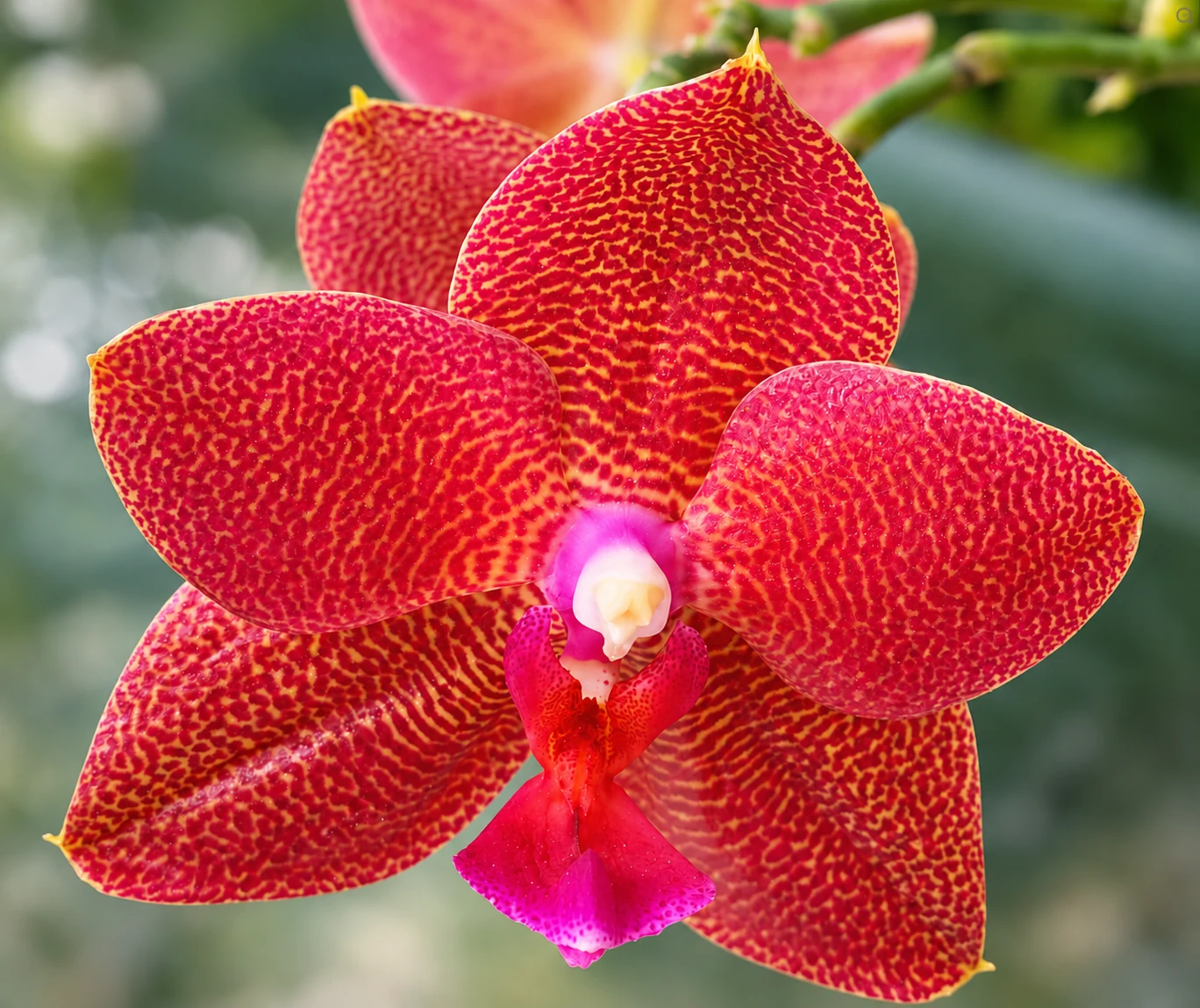 Phalaenopsis LD Sun Dragon ‘Red Leopard’ — photograph by Marzenna Kielan.
A carefully managed rebellion
Novelty Phalaenopsis did not represent a wholesale rejection of standard breeding. Quite the opposite: their breeders often wanted the best of both worlds. They sought to combine the colour, markings, fragrance, and waxy texture of wild species with the size, flatness, and full form of refined hybrids.
It was, then, a rather particular sort of revolution. The wild species were invited into the drawing room, then asked to button their jackets all the way up. A spotted flower was welcome to rebel, provided it did so with a round, flat face and a respectable judging score.1
That paradox became a driving force behind the whole movement. In many breeding programmes, standard lines helped increase the size and fullness of flowers in species-derived offspring. Without the species, standard Phalaenopsis would have continued circling ever more polished versions of the same ideal. Bringing the two worlds together was not always easy, but it was precisely this meeting that produced new combinations of colour, pattern, and form: yellows, oranges, reddish shades, spots and stripes, fragrant flowers, and blooms whose appearance changed with temperature or age.
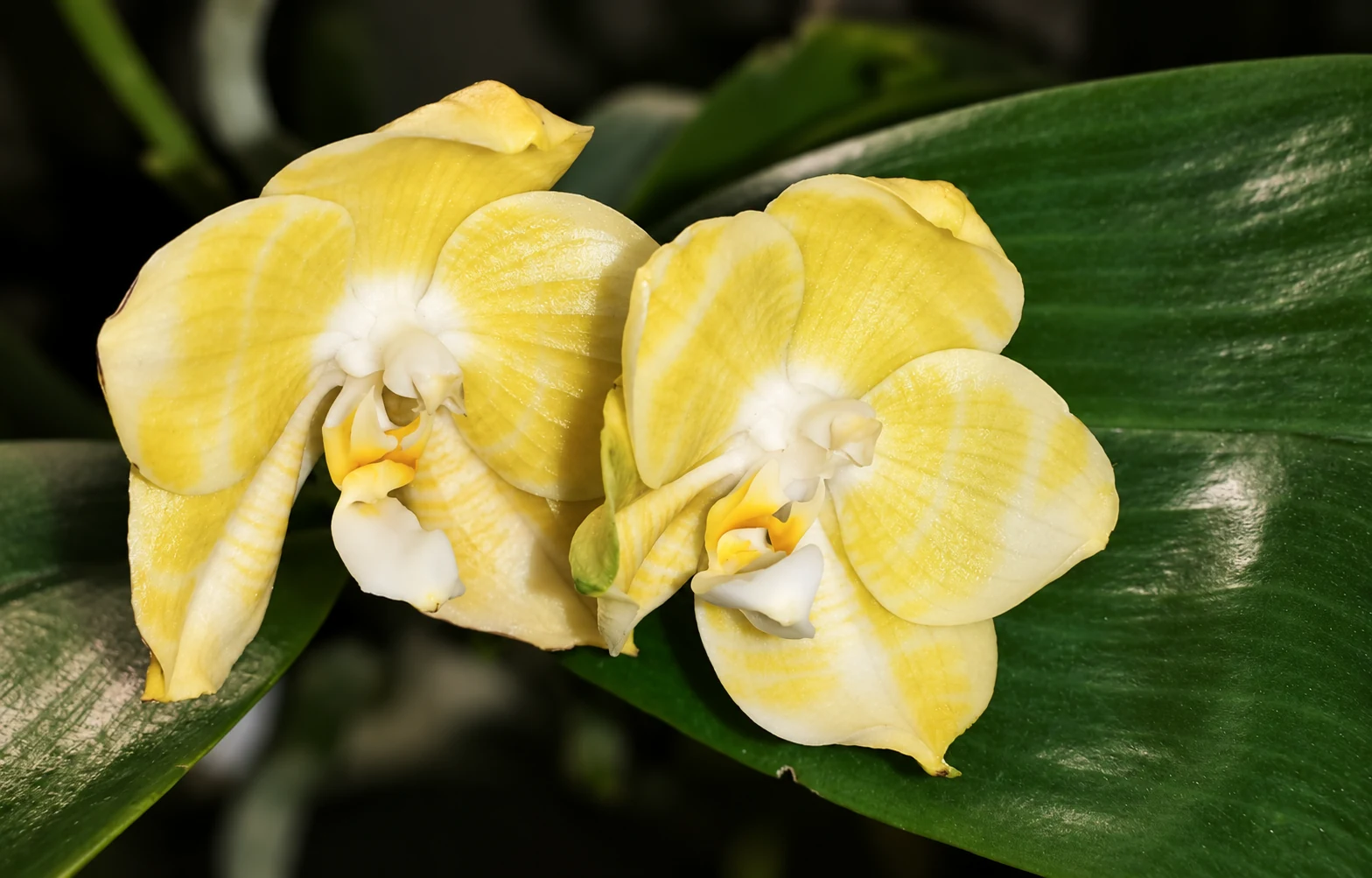 Phalaenopsis Mituo Golden Tiger ‘Yellow Dragon’ — photograph by Marzenna Kielan.
1973: two stories, one genus
The year 1973 offers a wonderful snapshot of two breeding ideals existing side by side. That year, the American Orchid Society Bulletin published Lewis and Varina Vaughn’s “An Account of Moth Orchids: The Ascendancy of White Phalaenopsis”.13 In the same year, Orchid Digest carried Hugo Freed’s “Breeding Novelty Phalaenopsis”. The word “novelty” was therefore already appearing in the title of a publication devoted to breeding. That fact alone does not establish who used it first.9
We can picture the white empire on the podium, surrounded by huge, perfectly round flowers. The audience applauds, the judges are pleased, and the story seems complete. Meanwhile, backstage, Phalaenopsis violacea is filling the air with fragrance, Phalaenopsis amboinensis is bringing spots and crossbars, and breeders are finding out what the next generations might make of them.
Both worlds were already under the same roof.
The revolution’s legacy
In 1980–1981, Hugo Freed published his series “Novelty Phalaenopsis Species and Their Hybrids” in the American Orchid Society Bulletin. Among the plants he discussed were Phalaenopsis amboinensis, Bornean forms of Phalaenopsis violacea, Phalaenopsis fasciata, and Phalaenopsis lueddemanniana. By the following decade, the movement’s species roots and hybrid offspring were receiving more extensive attention.14
The old paradox remained. Today’s breeders still try to preserve the wildness of colour and pattern while improving flower form, size, flower count, and ease of cultivation. Each generation pushes the boundary a little further, without resolving the tension between the species and the show-bench ideal. That is why the story is still unfolding.
Novelty Phalaenopsis were not born in a single greenhouse or a single year. The first meetings of their ancestral genes took place in the Victorian era. The tools developed through the first half of the twentieth century, and new directions in breeding gathered strength during the 1960s.
Gradually, breeders discovered that what counted as imperfection under the old rules could be the beginning of an entirely new kind of beauty. Narrow petals, spots, and small flowers ceased to be merely flaws to breed out. They became reasons to make the next cross.
And then the rebellion bloomed.
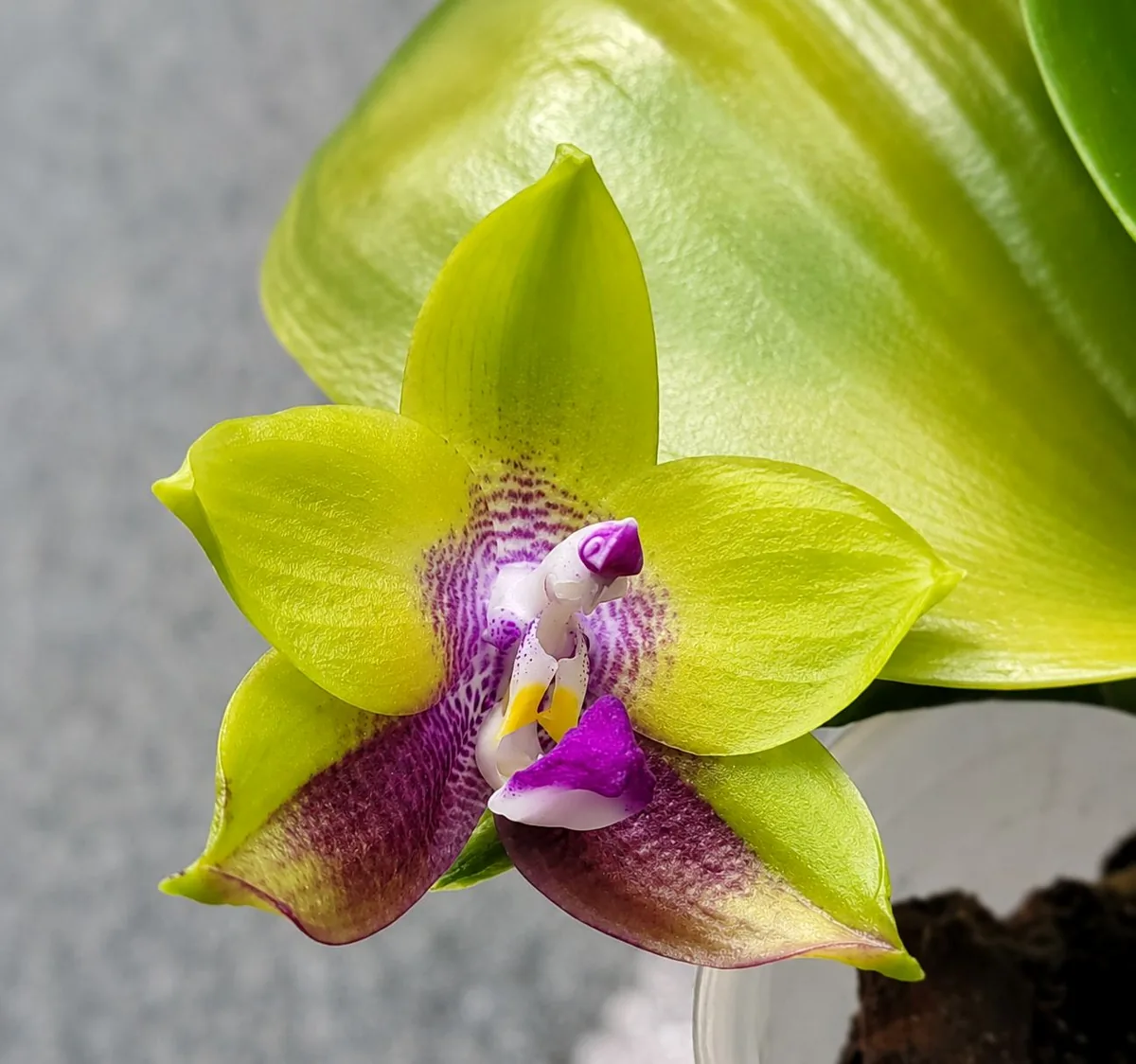 Phalaenopsis Mituo Prince ‘Ching Min’ — photograph by Marzenna Kielan.
Sources and bibliography — expand
For older publications, we distinguish between access to the text itself and bibliographic confirmation in an index or a later article. Links checked in the Polish edition on 8 October 2026.
- Batchelor, Stephen R. (1983). “Beginner’s Series 21 — Phalaenopsis, Part 2”. American Orchid Society Bulletin, January 1983. Text provided by the AOS. Covers the expansion of the hybrid colour palette from the 1960s, the influence of species on their offspring, and judging criteria for novelty hybrids. The online version includes later editorial notes on species identification.
- McHatton, Ron (2025). “Why Will It Not Bloom, Part 2: Phalaenopsis”. Orchids, June 2025. Text on the AOS website. A contemporary account of the novelty group, its species background, and its flowering habits.
- Royal Horticultural Society. International Orchid Register. Grex records: Harriettiae — Veitch, 1887, amabilis × violacea; Luedde-violacea — Veitch, 1895, lueddemanniana × violacea; Show Girl — Freed, 1964, Doris × Lipstick. The register documents names, parents, and the year attributed to each cross; it is not a register of individual clones. Historical dates should not automatically be treated as dates of pollination or first flowering.
- Knudson, Lewis (1922). “Nonsymbiotic Germination of Orchid Seeds”. Botanical Gazette 73(1): 1–25. DOI: 10.1086/332956. The original publication on seed germination without a fungal partner, under sterile conditions and with a suitable sugar source.
- Arditti, Joseph (1984). “An history of orchid hybridization, seed germination and tissue culture”. Botanical Journal of the Linnean Society 89(4): 359–381. DOI: 10.1111/j.1095-8339.1984.tb02567.x. A historical account of hybridisation, seed germination, and the development of tissue culture. Access to the full article may require a subscription.
- Griesbach, Robert J. (2002). “Development of Phalaenopsis Orchids for the Mass-Market”. In: Janick, J.; Whipkey, A. (eds), Trends in New Crops and New Uses. ASHS Press, Alexandria, Virginia, pp. 458–465. Full reproduction of the chapter — PDF. Especially pp. 459–462: developments in seed propagation, breeding for cut flowers, fertility barriers, and the transition to the pot-plant market. The link leads to a copy of the original chapter hosted outside the publisher’s website.
- Bolaños-Villegas, Pablo; Chen, Fure-Chyi (2022). “Advances and Perspectives for Polyploidy Breeding in Orchids”. Plants 11(11): 1421. DOI: 10.3390/plants11111421; record and abstract in PubMed; full text in PubMed Central. A review of meiosis, unreduced gametes, and the use of polyploidy in orchid breeding.
- “Cytogenetic Study and Pollen Viability of Phalaenopsis Queen Beer ‘Mantefon’” (2023). Plants 12(15): 2828. DOI: 10.3390/plants12152828; full text in PubMed Central. A cytogenetic study of a particular triploid hybrid. It documents meiotic abnormalities and pollen sterility; it does not establish that all triploid Phalaenopsis are sterile.
- Freed, Hugo. Publications in Orchid Digest. “Breeding White Phalaenopsis” (1968), 32(6); “Breeding Novelty Phalaenopsis” (1973), 37(1). Publisher’s index, arranged by title — PDF, p. 16. The index confirms authorship, titles, volumes, and issue numbers. It does not provide the full articles or establish who first used the word “novelty”.
- “Potentiality of a Species Plant” (1976). Australian Orchid Review 41(4), December 1976, p. 195; unsigned note. Digitised volume in the Internet Archive; full OCR text. The source for historical figures concerning ‘Country Acres’: forty crosses in 1964–1975, flowering offspring from nineteen crosses, and ten awarded plants from six crosses, with twelve awards in total. The note’s title can be searched in the OCR version.
- American Orchid Society. Award records from Long Beach, 23 February 1970. Transcriptions and photographs provided by the South Coast Orchid Society. Renee Freed ‘Bonsall’: award no. 19700332, FCC/AOS, 91.7 points, five flowers and two buds; description published in the American Orchid Society Bulletin 39(10): 922 and Awards Quarterly 1(4): 98. The same page documents Tuffy ‘Bonsall’, no. 19700336, and its parents: Lowana Goldlip × amboinensis.
- Royal Horticultural Society (2004). International Orchid Register supplement, July–September 2004. “Registrar’s Notes: Notes on previously refused registrations in Phalaenopsis group”, pp. 18–19. RHS document — PDF. Explains the historical treatment of P. bellina within P. violacea and the complications in hybrid registration arising from changes in species identification.
- Vaughn, Lewis; Vaughn, Varina (1973). “An Account of Moth Orchids: The Ascendancy of White Phalaenopsis”. American Orchid Society Bulletin 42: 231–237. AOS information about the journal archive. Bibliographic details are also confirmed in the references of the original study “Colchicine-induced polyploidy in phalaenopsis orchids”. The Vaughns’ full text was not used for detailed analysis; this article refers to its documented title and publication year. Access to the AOS archive requires membership.
- Freed, Hugo (1980–1981). “Novelty Phalaenopsis Species and Their Hybrids” — selected articles from the series. American Orchid Society Bulletin: “Phalaenopsis amboinensis” (1980), 49(5), beginning on p. 468; “An Up-date on Breeding with the Borneo-type Phalaenopsis violacea” (1980), 49(8), beginning on p. 843; “The Fabulous Phalaenopsis fasciata” (1980), 49(10), beginning on p. 1099; “The Versatile Phalaenopsis lueddemanniana”, parts 1 and 2 (1981), 50, beginning on pp. 1077 and 1325. Details of these publications and references to their content appear in the bibliography and text of Batchelor’s article on the AOS website. Confirmed opening pages are given; full volumes are available in the AOS archive.
Text and photographs: Marzenna Kielan