The Invisible Army. Part IV. The Living Shield
Over the first three parts, we met hunters, parasitoid wasps, predatory mites, ladybirds and nematodes. Each exploits a different weakness in a pest, and each belongs to a larger web of relationships. Yet the most important question remains: what can this extraordinary menagerie truly offer at home, among a dozen or several dozen Phalaenopsis?
The longer we observe the natural enemies of pests, the harder it becomes to see nature as a simple story of good and bad characters. A thrips has its hunters, but the hunter, too, is subject to environmental pressure, competition and other organisms. A ladybird may devour mealybugs, but first it must find enough of them. A parasitoid wasp can use its host’s body to raise its offspring, provided it finds the right species. Even a tiny predatory mite which, from our perspective, looks like the perfect special-operations soldier remains an animal dependent on temperature, humidity and the availability of food.
These relationships reveal the importance of biodiversity particularly clearly. No species exists in isolation. Each belongs to a web in which organisms restrain one another, compete, hunt, flee, reproduce and disappear. Balance does not mean silence. On the contrary, it is the outcome of countless small clashes that we usually never even notice.
It is tempting to conclude that, since nature has its own hunters, all we need to do is bring them in. For the grower, this is where the most interesting part begins.
When the army needs radar
The best moment to respond rarely looks alarming. There are no broad silvery patches on the leaves yet, the buds are not falling and nothing is conspicuously strolling across the flowers. Sometimes the only signal is a tiny dash on a blue sticky trap, or something that darted between the petals and vanished a moment later.
In biological control, such moments are especially valuable. A natural enemy does not usually act like a spray designed to reduce a large population sharply in a short time. It must find prey, survive and sometimes reproduce quickly enough. The fewer pests there are at the outset, the better the chance that the predator can keep pace with them.
Monitoring is therefore not merely about checking whether a problem already exists. A sticky trap reveals the presence of flying insects; a hand lens lets us inspect what appears to the naked eye as nothing more than a suspicious speck; and regular examination of the plants supplies the most valuable information of all: whether the situation is changing.
One thrips found this week and one found a fortnight later tell a very different story from one, then five, then a dozen. In the second case, someone has evidently decided that our Phalaenopsis make quite a good place to live.
The scout’s mission
Before sending anyone into battle, it is worth knowing whom we are actually facing. In biological control, a mistake can be particularly unforgiving because many natural enemies are highly selective.
A predator does not recognise a category called “something small and nasty on an orchid”. The thrips predatory mite (Neoseiulus cucumeris) mainly seeks the youngest thrips larvae. The glasshouse predatory mite (Phytoseiulus persimilis) specialises in spider mites. A parasitoid wasp may pass a mealybug by if it is not a suitable host for its offspring.
A silvery streak on a petal is therefore a clue, not the culprit’s signature. A white tuft still needs to be examined. With spider mites, it is worth looking not only for the mites themselves but also for eggs and fine webbing. A flower can be gently tapped over a pale sheet of paper to see whether anything falls out.
Here a home collection has an advantage no vast glasshouse can offer. We can pick up every plant, inspect it closely, move it away from the others and return to it a few days later. With several thousand specimens, no one has that luxury.
Before the fire takes hold
The thrips predatory mite shows perfectly why timing matters. It copes most easily with the youngest thrips larvae. Older larvae are more difficult prey, and it will usually not overcome an adult.
If we release predatory mites only when numerous older larvae and adult thrips are already walking over the flowers, we are setting them a task for which their biology simply has not equipped them. That is why this species is best introduced early; its ability to use supplementary food sources and the availability of breeding sachets also allow it to serve as a preventive patrol.
The Swirski predatory mite works in much the same way. When adult thrips are already walking over the flowers, it can still intercept newly emerging young larvae, but it should not be treated as a complete, stand-alone answer to the whole infestation. Visible insects must be removed, the plants watched closely and, if pest numbers continue to rise, the tactics changed before another generation has time to develop.
Not all predatory mites follow the same rule. The glasshouse predatory mite, an excellent spider-mite hunter, is much more closely tied to its prey. It makes most sense once spider mites have already been detected. When food is scarce, the predator begins to disperse and its population quickly loses its reason to remain.
In a home collection, this does not mean maintaining a permanent army on every windowsill. Far more important are careful observation of new plants, quarantine, sticky traps where they are genuinely useful and a quick response to the first signals.
Paradoxically, the greatest success of biological control may be entirely undramatic. A few larvae disappear, the population does not grow, and the owner of the collection never reaches the point of searching the internet at two in the morning for “the strongest treatment for thrips”.
Covering every position
Thrips complicate matters because each stage of life changes not only their appearance but also their whereabouts. The egg may remain hidden inside plant tissue, the larvae feed on leaves and in flowers, and in many important species the later stages move down towards the growing medium. The adult then acquires wings as well.
This is why a single natural enemy is not always enough. The thrips predatory mite intercepts young larvae. The Swirski predatory mite (Amblyseius swirskii) works similarly, thrives particularly well in warmth and can also use pollen when prey is scarce. Minute pirate bugs (Orius) can attack larger stages and adults, while the soil-dwelling predatory mite (Stratiolaelaps scimitus) intercepts thrips stages that descend into the growing medium to transform. On its own, however, it will not control a thrips population and should be regarded as support for measures acting above the medium.
Combining such allies makes excellent sense in a glasshouse. At home, however, we must ask an additional question: do we really have a battlefield that requires so many units?
With a dozen or so plants, we can still do part of the work ourselves. A lone mealybug can be removed, a suspicious moth orchid isolated, its leaf bases inspected closely, and the plant checked over the following days for newly emerged young. Not every skirmish calls for the cavalry.
A demanding warrior
It is easy to forget that a living product is quite literally alive. A predatory mite is not an active substance spread across a leaf. It must obtain water and food, pass through successive stages of development and, if it is to maintain a population, reproduce. Temperatures and humidity levels that seem perfectly ordinary to us can decide everything for an organism half a millimetre long.
The choice of a spider-mite hunter is a good example. The glasshouse predatory mite is an extraordinarily effective specialist once prey is sufficiently abundant. The Californian predatory mite (Neoseiulus californicus) follows a different strategy. It tolerates high temperatures and lower humidity better, can work at lower spider-mite densities and is sometimes introduced earlier, before their population becomes large. In a warm, relatively dry home, this difference may matter greatly.
The environmental requirements are even clearer in insect-killing nematodes such as Steinernema feltiae. They need adequate moisture to work effectively, and after application the growing medium should remain moist for a time.
Phalaenopsis, meanwhile, very often grows in coarse, airy bark that gradually dries after watering. We can therefore suppose that this medium will not always provide nematodes with conditions as favourable as the more evenly moist media used in many glasshouse crops. We do not, however, have grounds to present this as a rule confirmed by studies conducted specifically on Phalaenopsis.
That is precisely why it makes no sense to alter the watering regime solely to create ideal conditions for a beneficial organism. The moth orchid’s roots are still the host here, not furnishings in the mercenaries’ quarters.
With living organisms, the directions for use are no longer an addendum in small print. They become part of the method itself.
A silent explosion
One of the more ingenious tools in biological control is a small sachet containing predatory mites. From the outside it does not look especially impressive. It hangs among the leaves and, for a long time, apparently nothing happens.
Inside, however, a miniature breeding colony is at work. It contains predatory mites, a carrier material and feeder mites that allow the predators to reproduce. Successive individuals gradually leave the sachet and move onto the plant. In systems containing the thrips predatory mite, this can continue for several weeks. We buy something resembling a piece of paper, while inside it a small biological system is producing fresh patrols.
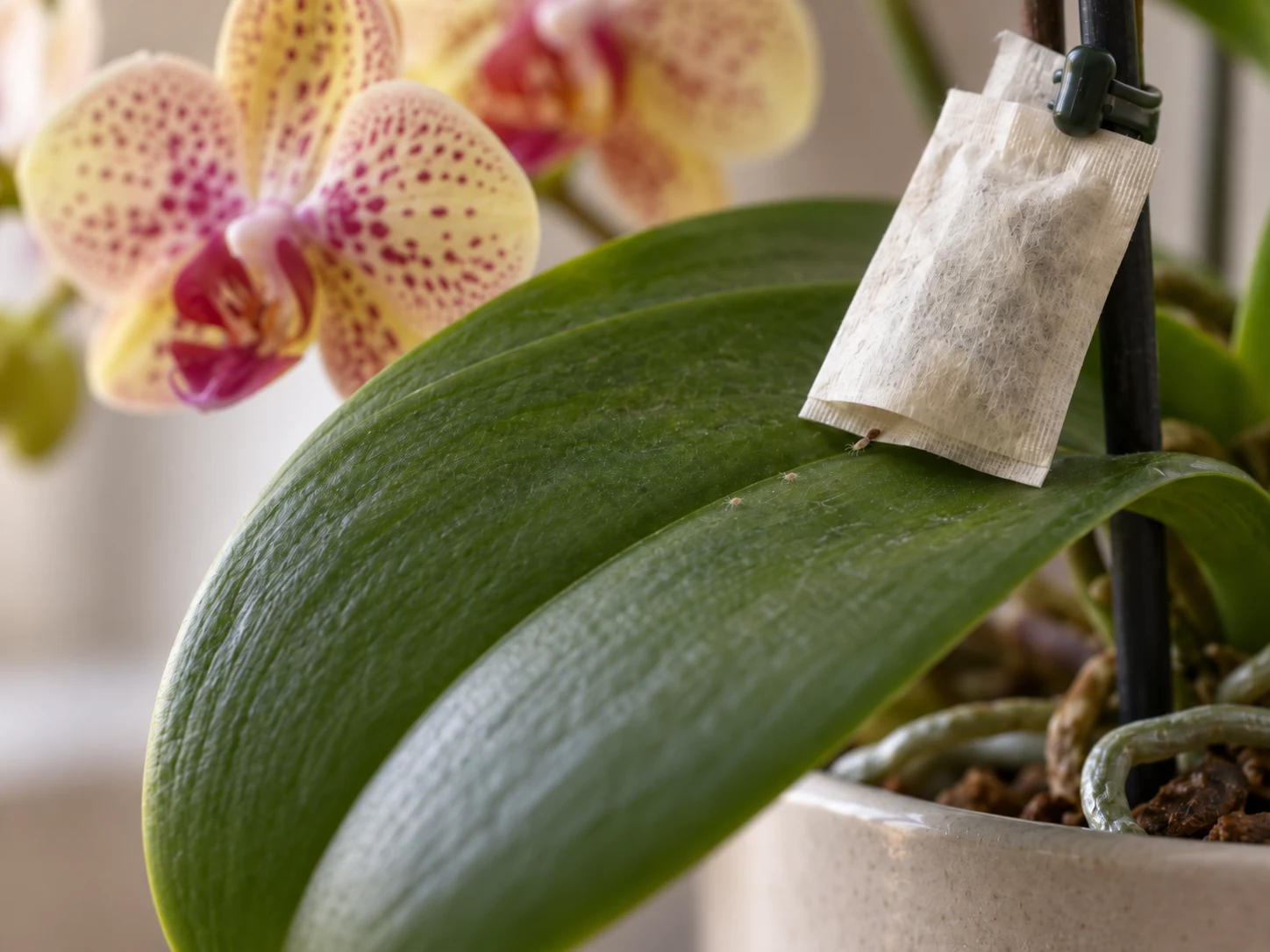
This is precisely what makes the sachet so interesting at home. Instead of releasing the entire group of predators in one day and hoping for a rapid result, we receive successive batches over a period of time. If they find suitable conditions and prey on the plant, they begin to search it.
That is, of course, provided the owner does not decide they know better than the manufacturer and tear the sachet open to “help them get out faster”. Sachets have a prepared exit hole and should hang somewhere protected from direct sunlight. Biology rarely accelerates simply because a person grows impatient.
A sachet does not, however, provide protection indefinitely. If it is to serve as a continuing patrol, it must be replaced after the period of activity declared by the manufacturer has ended. This does not mean that sachets should hang all year round in every collection. Preventive use makes sense where the risk is real: after bringing in new plants, following an earlier infestation, during conditions favourable to thrips, or in a dense collection to which the pest can easily return. Where no such risk exists, quarantine, monitoring and regular plant inspections remain the foundation.
A trap for your own army
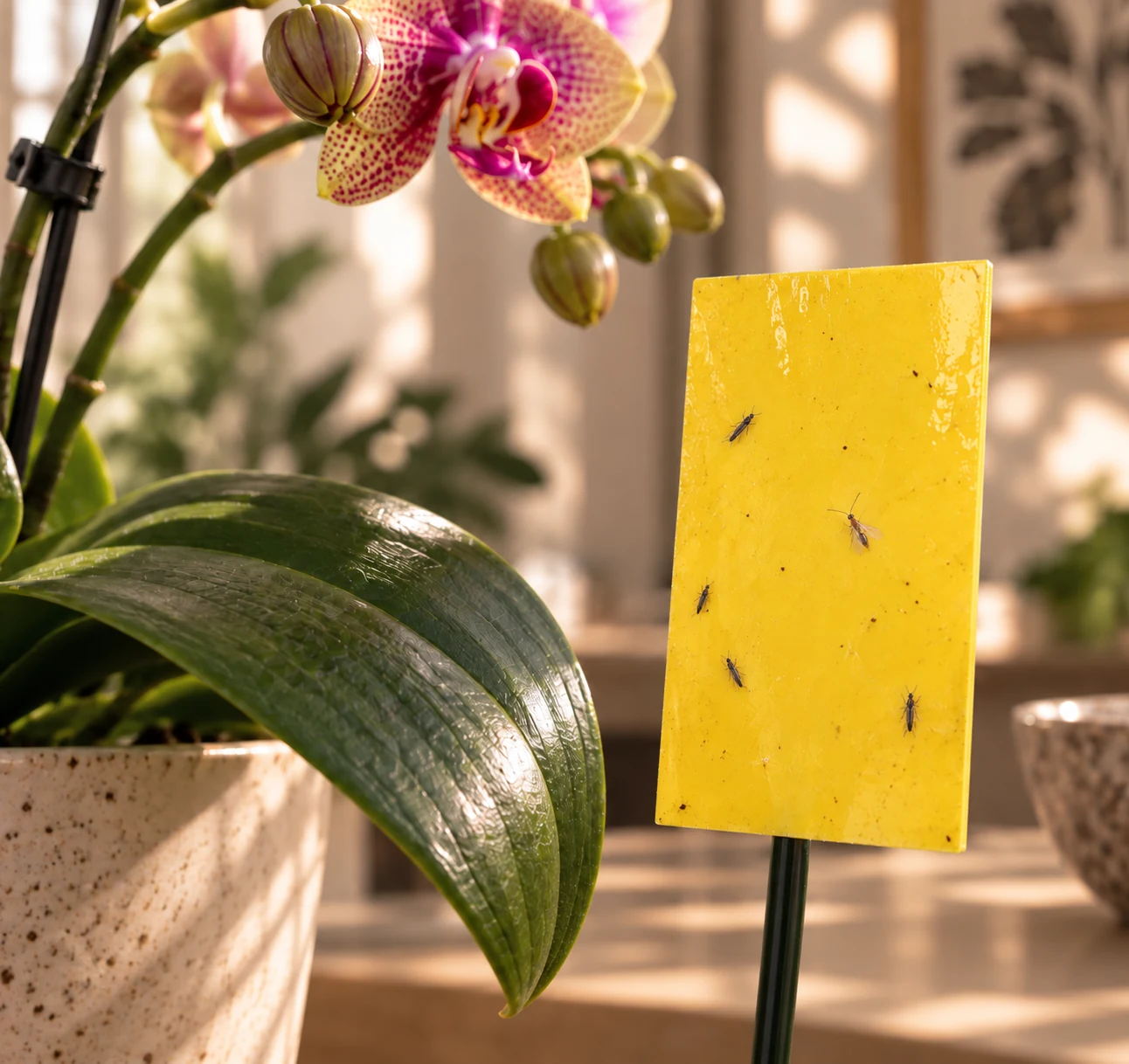
Sticky traps have one fundamental flaw: they do not know who is on our side. To the adhesive, a thrips and a beneficial wasp are simply organisms that have become stuck. This is of little consequence for predatory mites moving over plant surfaces. The situation changes when flying organisms are introduced into the collection.
Then even the placement of sticky traps becomes part of the strategy. It is a small detail, but it illustrates perfectly the difference between a genuine system and simply dropping a few biological products into a shopping basket. Every element begins to affect the others. We may therefore have an excellent sticky trap, an excellent parasitoid wasp and a disastrous plan for making the two work together.
Friendly fire
It is even easier to destroy our own allies with a product intended to help the plant. Some products kill beneficial organisms directly. Others may reduce their fertility, disrupt development or make it harder for them to locate prey. Even if a predator survives treatment, that does not mean it emerges with all its abilities intact.
Particularly treacherous is the belief that anything “natural” must, by definition, be safe for other natural organisms. Direct spraying with horticultural oil can, for example, harm the thrips predatory mite.
Here biological control meets a principle already familiar from fertilisation. Natural does not automatically mean better, just as mineral does not automatically mean worse. What matters is the mechanism, the conditions and the aim. Plant protection works in exactly the same way.
Where is the battlefield?
Having met all these organisms, we can finally ask the question for which this fourth part was written: whom is it really worth inviting into the home? Fascinating though minute pirate bugs, ladybirds, parasitoid wasps, predatory mites and nematodes may be, not every superb hunter will be an equally good resident of a room containing a dozen or several dozen Phalaenopsis.
Predatory mites seem the most natural allies for a home collection. They are tiny, do not fly around the room and move over plant surfaces — exactly where their prey is found.
Two species are particularly interesting against thrips. The thrips predatory mite works well as an early patrol, while the Swirski predatory mite is more comfortable at higher temperatures and can also be supplied in sachets. They are not entirely interchangeable, however, so conditions in the collection should determine the choice.
Against spider mites, too, we have a choice. The glasshouse predatory mite is a rapid and highly specialised response once the pest has appeared. The Californian predatory mite tolerates warmer, drier conditions better and can persist longer when prey is scarce, which may make it easier to use in some home collections.
Organisms that work in the growing medium require greater caution. Soil-dwelling predatory mites or nematodes may provide valuable support, but only when the environment in the pot genuinely suits them. It makes no sense to worsen conditions for the roots merely to create an excellent home for a beneficial organism.
And then there are the ruthless mercenaries. Minute pirate bugs can follow thrips into flowers and attack even adults. The mealybug destroyer (Cryptolaemus montrouzieri) can wreak genuine carnage in a mealybug colony. Parasitoid wasps can be astonishingly precise in locating their hosts. They are effective, fascinating and superbly equipped for their work.
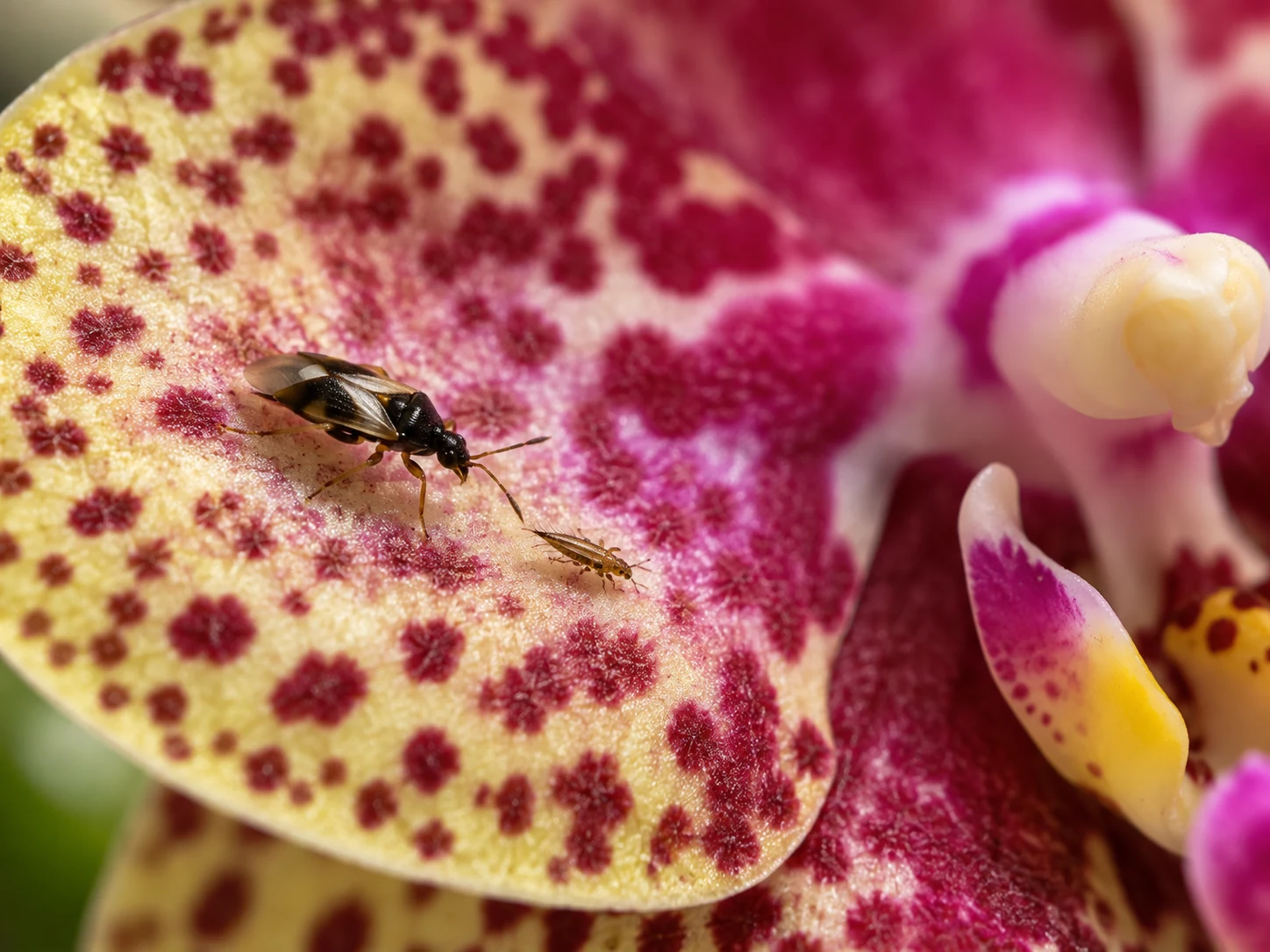
The trouble is that many of them need a real battlefield. In a glasshouse, conservatory or large enclosed grow tent, they have hundreds of plants, more stable conditions and a much better chance of finding further prey. In a room containing a dozen moth orchids, they may quickly discover that our collection ends behind the shelving but the world does not. An adult minute pirate bug or ladybird has wings and no obligation to remain where it was released.
This does not make them inferior allies. They simply require the right scale. In a large collection they can be excellent mercenaries. In a minor windowsill skirmish, they may be an army summoned for a problem that could be solved far more simply.
The living shield
Here we reach the most important lesson of the entire invisible army. Biological control is not a religion, and chemical plant protection is not capitulation. Sometimes it is enough to remove a few pests mechanically and watch the plant. Sometimes it is worth hanging a sachet of predatory mites before a thrips population has time to develop. In a larger collection, we can employ predators for whom a handful of plants would be too small a world.
There are also times when the situation is already too advanced for natural enemies to respond quickly enough. A carefully chosen plant-protection product may then be the best tool. Not because biology has failed, but because we are choosing a method better suited to the situation.
In Poland, this also means choosing a product authorised for the intended use and applying it in accordance with the current label. The Polish Ministry of Agriculture and Rural Development maintains and updates the register of authorised plant-protection products.
We have choices, and that is what is most valuable. We can combine observation, isolation of new plants, mechanical pest removal, beneficial organisms and, when genuinely necessary, plant-protection products. Each tool has its place, and each can be used badly.
After four parts of “The Invisible Army”, we are left with more than a gallery of extraordinary creatures. We are left with an awareness that behind every thrips, spider mite or mealybug lies an entire world of relationships that we usually cannot see. We can make use of it, but first we must understand it.
Not every hunter belongs on a windowsill. Not every skirmish requires mercenaries. Not every problem must be solved without chemicals. A good grower does not choose a method because it sounds more natural, modern or impressive. They choose it because they understand the opponent, know the conditions in their collection and know what to expect from the tool they reach for.
Then the invisible army ceases to be merely a fascinating world of tiny predators. It becomes part of a consciously managed system for protecting the collection.
A home guide to the invisible army
Not every natural enemy of pests needs a glasshouse, but not every one will be at home on a windowsill. The smaller the collection, the more important simplicity becomes: an ally should have somewhere to live, be able to find suitable prey and not require conditions we cannot provide without harming the Phalaenopsis.
| Ally | A dozen moth orchids in a room | Larger collection / shelving | Grow tent / conservatory | What is worth knowing |
|---|---|---|---|---|
| Thrips predatory mite Neoseiulus cucumeris |
worth considering | worth considering | worth considering | A very practical early patrol against young thrips. It does not fly and is also available in breeding sachets. |
| Swirski predatory mite Amblyseius swirskii |
worth considering in warmer conditions | worth considering | worth considering | Hunts young thrips, performs well in warmth and can also feed on pollen. |
| Californian predatory mite Neoseiulus californicus |
worth considering when spider mites are a risk or present in low numbers | worth considering | worth considering | Tolerates warmth and lower humidity better than some other predatory mites; it can work when prey is scarce. |
| Glasshouse predatory mite Phytoseiulus persimilis |
worth considering once spider mites are detected | worth considering | worth considering | A highly effective specialist. It needs spider mites, however, and is not the best candidate for permanent prevention on a pest-free plant. |
| Soil-dwelling predatory mite Stratiolaelaps scimitus |
in certain conditions | in certain conditions | often worthwhile | May intercept thrips pupae and other small organisms in the growing medium. Its usefulness depends on conditions in the pot. |
| Insect-killing nematodes Steinernema feltiae |
in certain conditions | in certain conditions | worth considering in suitable conditions | They need moisture. Do not alter the medium at the expense of the moth orchid’s roots merely to accommodate them. |
| Minute pirate bugs Orius |
generally not | in certain conditions | worth considering | Excellent thrips hunters, including larger stages and adults. They are mobile, however, and may disperse. |
| Mealybug destroyer Cryptolaemus montrouzieri |
usually unnecessary | for a larger colony | worth considering for the right problem | It needs enough mealybugs. A few individuals on one moth orchid do not call for a special-operations unit. |
| Parasitoid wasps | generally not | only after reliable pest identification | can be highly effective | Their specialisation is both an advantage and a limitation. We must know whether the pest is the right host for the particular wasp species. |
When should you change tactics?
If the pest has built a large population, conditions do not favour its natural enemies or we need to curb the infestation quickly, a well-chosen plant-protection product may be the more sensible option. This is neither surrender to chemicals nor a failure of biological control. It is simply the use of a different tool when that tool fits the situation better.
The most sensible protection strategy does not choose between “natural” and “chemical” as though they were rival teams. It draws on observation, quarantine, mechanical methods, beneficial organisms and, when necessary, plant-protection products. What matters is not the method’s label, but whether it has been chosen consciously for the opponent and the conditions.
Series: The Invisible Army
- Part I. Who Guards the Orchids?
- Part II. Hunters on the Web
- Part III. War under Cover
- Part IV. The Living Shield — you are here
Text: Marzenna Kielan, phalaenopsis.pl
Expand sources and methodological notes
- Cornell Integrated Pest Management. Neoseiulus cucumeris – Predatory Mite. Cornell IPM.
- Koppert. Thripex Plus – Neoseiulus cucumeris. Koppert.
- Koppert. Swirski-Mite LD – Amblyseius swirskii. Koppert.
- Cornell Integrated Pest Management. Phytoseiulus persimilis – Predatory Mite. Cornell IPM.
- Cornell Integrated Pest Management. Neoseiulus californicus – Predatory Mite. Cornell IPM.
- Koppert. Spical / Neoseiulus californicus. Koppert.
- Cornell Integrated Pest Management. Steinernema feltiae, Beneficial Nematode. Cornell IPM.
- VKM. Assessment of Stratiolaelaps scimitus for biological control. VKM.
- Cornell Integrated Pest Management. Minute Pirate Bug and Insidious Flower Bug Biocontrol Agent Factsheet. Cornell IPM.
- University of Connecticut Integrated Pest Management. Biological Control of Mealybugs. UConn IPM.
- Polish Ministry of Agriculture and Rural Development. Register of Plant Protection Products. gov.pl.
- European Commission. Invertebrate biological control agents against plant pests. European Commission.
- EPPO. PM 6 Standards on the safe use of biological control. EPPO.
Methodological note. Most data on the effectiveness of beneficial organisms come from laboratories, glasshouses and crops other than home Phalaenopsis collections. This article distinguishes well-established knowledge of species biology from the cautious application of those principles to domestic conditions. When using living organisms or plant-protection products, always check the instructions for the specific product, the current label, authorisation for the intended use and compatibility with products used previously.