For years, one of the most trusted pieces of advice on getting moth orchids to flower sounded almost like a recipe: give the plant warm days, cooler nights and a difference of a few degrees between the two. A flower spike should then appear on cue, as though the orchid came with a thermometer in its leaves and an instruction manual tucked underneath. We believed the rule because it usually worked. Science, however, has an awkward habit of unpicking the seams of the obvious.
Not everything consigned to the dustbin was foolish. Sometimes it was simply the best answer that could be drawn from the observations available at the time. The world changes, and knowledge changes with it. Ideas that once shaped the way we cared for moth orchids can now be examined more closely. Was it really the difference between day and night temperatures that mattered?
Observations
As autumn arrived, the days grew cooler, the nights cooler still, and moth orchids began to produce flower spikes. The connection seemed obvious. Since the gap between day and night temperatures increased with the arrival of autumn, that difference was credited with triggering flowering.
The reasoning made sense, but it bundled together several changes taking place at once. Night temperatures fell, but daytime temperatures fell as well. Light levels, day length and the plant’s entire environment were changing too. The observation showed that cooler conditions encouraged spike formation. It did not reveal which part of that cooling mattered most.
Answers
In 2006, Matthew G. Blanchard and Erik S. Runkle published an experiment designed to separate the effects of day and night temperature. They grew two clones of hybrid Phalaenopsis at constant temperatures of 14, 17, 20, 23, 26 and 29°C, as well as under several day/night regimes, including 20/14, 23/17 and 29/17°C.
The result was striking. After twenty weeks, at least 80 per cent of the plants in both clones had produced a visible flower spike at constant temperatures of 14, 17, 20 or 23°C. In other words, spikes appeared even when day and night temperatures were exactly the same.
The 29/17°C treatment was more revealing still. The nights were cool and the day–night difference was enormous, yet not a single plant began to flower during the experiment. The warm days effectively cancelled out the cool nights. Statistical analysis found a significant effect of daytime temperature, while the effect of night temperature was not significant.
Evidence
This is where we should slow the story down before one oversimplification gives way to another. The study did not prove that night temperature never matters in any Phalaenopsis. It involved two clones of popular hybrids, not the whole of this remarkably diverse genus. Its findings do not justify treating every botanical species in exactly the same way, particularly those originating at different elevations or in very different climatic zones.
What it demonstrated was more precise: in the plants tested, a daily temperature fluctuation was not an essential signal for flowering to begin. The orchids could initiate spikes at a constant temperature, while a very warm day inhibited the process even when the night was distinctly cooler. Later work on flowering control in greenhouse production turned this mechanism into a practical tool. Plants are kept warm while vegetative growth is required, then flowering is encouraged by cooling the entire above-ground part of the plant, during the day as well as at night.
More recent research has not wrapped the matter up in a single tidy verdict. A 2024 study involving four cultivars and comparisons with earlier datasets suggests that, across a wider range of plants, inflorescence formation may be influenced by day and night temperatures together, as well as by the duration of cool conditions. This does not reinstate the old requirement for a particular day–night temperature gap. It does remind us that a result obtained from two clones should not be applied to an entire genus without qualification.
The Windowsill
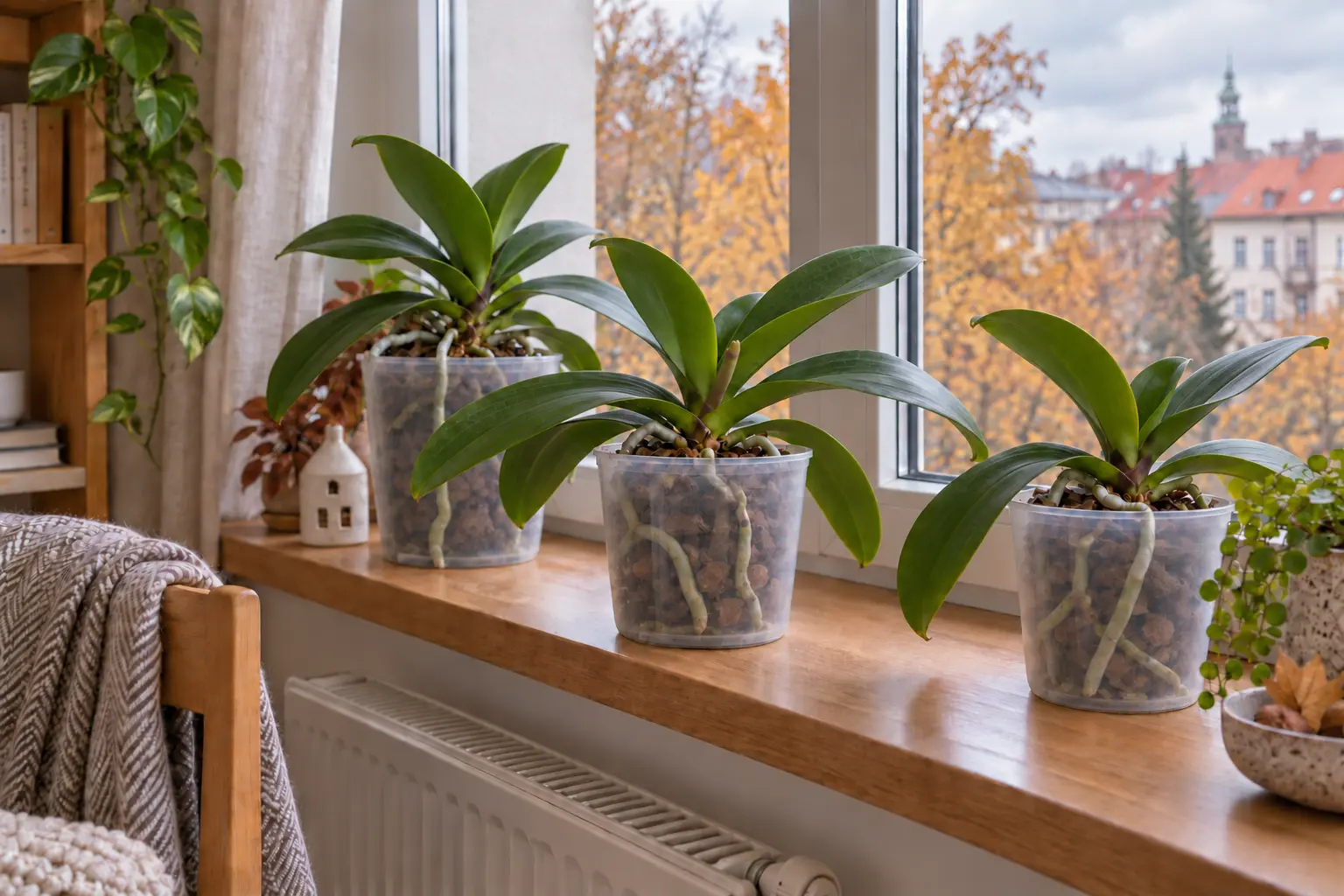
There is no need to move a moth orchid every evening, exile it to a cold corridor or chase a magical five-degree temperature drop. If the whole growing area becomes moderately cooler in autumn, during the day as well as at night, that may provide enough of a cue for many standard hybrids. Ordinary household conditions, where temperatures gradually fall as summer ends, often do the job without any help from us.
That does not mean every spell of cooler weather guarantees a spike. The plant must be mature and healthy, with sound roots, enough light and sufficient energy in reserve. Genetics matters too. Temperature is an important signal, but it is not a single button marked “flower”.
Cooler nights may still be part of successful cultivation, and there is no reason to fight them. They simply cease to be a compulsory ritual. The old advice often worked because the days were becoming cooler along with the nights. A sound observation was once given an explanation that was too narrow.
Ready for Retirement
This is how horticultural knowledge changes. First someone notices a pattern. Others pass it on as a rule. Eventually, an experiment separates the mechanism that truly matters from the circumstances that merely accompanied it. There is no need to mock the old advice. It helped plants flower and gave growers a method that worked.
Today we can put it more precisely: in the hybrid Phalaenopsis tested, a cooler night was not required to initiate a spike when the daytime temperature was suitable. That is one of the loveliest things about science. It does not take our experience away. It simply helps us understand why it sometimes worked.
References and sources +References and sources −
- Blanchard, M.G., Runkle, E.S. (2006). Temperature during the day, but not during the night, controls flowering of Phalaenopsis orchids. Journal of Experimental Botany, 57(15), 4043–4049. https://doi.org/10.1093/jxb/erl176
- Newton, L.A., Runkle, E.S. (2009). High-temperature inhibition of flowering of Phalaenopsis and Doritaenopsis orchids. HortScience, 44(5), 1271–1276. article page
- Paradiso, R., Maggio, A., De Pascale, S. (2012). Moderate variations of day/night temperatures affect flower induction and inflorescence development in Phalaenopsis. Scientia Horticulturae, 139, 102–107. https://doi.org/10.1016/j.scienta.2012.03.007
- Chen, J., Chen, C. (2024). The effect of temperature on the inflorescence formation model for Phalaenopsis. Plants, 13(9), 1280. https://doi.org/10.3390/plants13091280
Text by Marzenna Kielan