We walk into a garden centre and stop in front of the fertiliser shelf.
On the left are the mineral fertilisers: precise, businesslike, armed with tables, percentages and chemical symbols. They look as though they have come straight from a laboratory and might ask us to sign the test report at any moment.
On the right are the natural, organic, biological and humic products. The bottles are usually dark, the labels green, the roots magnificent, and somewhere nearby there is almost invariably an earthworm. Sometimes merely symbolic, but always remarkably industrious.
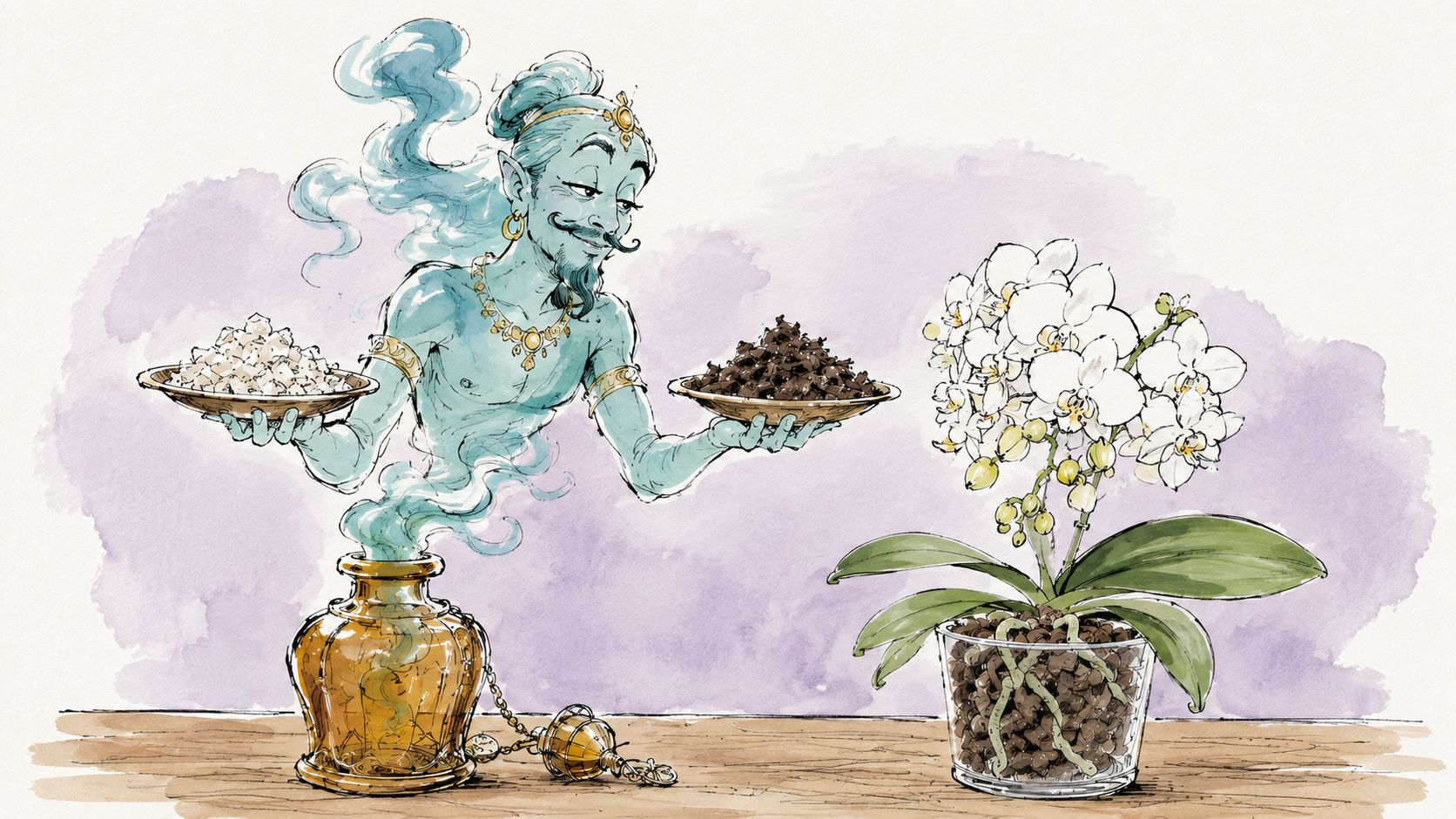
They all promise more or less the same thing: healthy roots, firm leaves, vigorous growth and flowering so abundant that the orchid will no longer fit in the frame. You begin to suspect that you are not standing in front of a fertiliser shelf at all, but before a row of enchanted bottles.
All you have to do is choose one, unscrew the cap and make a wish.
Our first wish is:
“Genie, feed my orchid.”
It seems modest enough. We are not asking for a palace, a flying carpet or even seven new flower spikes by Sunday. We simply want to feed a plant.
And yet this is exactly where things begin to get complicated.
Some people insist that mineral fertiliser is best: clean, precisely described and predictable. Others choose organic fertiliser because, after all, no one runs through a forest carrying a watering can full of NPK. Still others decide to reconcile the two camps and add a little of everything to the water, producing a mixture that makes even the genie put down his turban, reach for his safety goggles and request a chemical analysis.
Before we take sides, it might be wise to consult the party most directly concerned.
Or, more precisely, to look at its roots.
The orchid does not read the label
Phalaenopsis needs nitrogen, phosphorus, potassium, calcium, magnesium and sulphur. In smaller quantities, it also requires elements including iron, manganese, zinc, copper, boron and molybdenum.
It is not enough for these elements simply to be somewhere nearby. They must be present in the right chemical form, dissolved in water and available for uptake by the roots.
A root cannot tell whether a nitrate ion arrived in an elegant mineral fertiliser, came from decomposed plant remains or emerged from a bottle decorated with a green leaf and an exceptionally cheerful earthworm.
It has no ideological loyalties. It does not divide nutrients into natural, artificial, ecological and suspicious. It absorbs what is present in the solution, in a suitable form, and capable of being transported through root cells.
The origin of an ion may be irrelevant to the root, but the composition of the solution as a whole certainly is not. The difference does not lie in one element being a noble child of nature and another a chemical intruder. What matters is:
– the form in which a nutrient is supplied,
– how much of it is supplied,
– how quickly it becomes available,
– which other substances accompany it,
– how the fertiliser affects the pH and salinity of the solution,
– whether its composition is known and consistent.
In short, the orchid does not read the label, but it feels the consequences very clearly.
Mineral fertiliser: we know what is being served for dinner
Mineral fertiliser contains nutrients mainly in the form of water-soluble salts. Once the solution has been prepared, a substantial proportion of them is available to the plant almost immediately.
This is its greatest advantage. Within the limits of the manufacturer’s declaration, at least, we know how much nitrogen, phosphorus and potassium it contains. Better-formulated products also provide calcium, magnesium, sulphur and trace elements. We can choose the concentration, measure the conductivity of the solution and prepare roughly the same mixture at the next watering.
Dinner is not described merely as “something nutritious”. We are given the menu.
Predictability has another side, however. Because dissolved salts are readily available, it is equally easy to provide too much of them. The salinity of the solution and the growing medium then rises, and instead of quietly enjoying the feast, the roots begin struggling to take up water.
A Phalaenopsis growing in coarse bark does not have a large mass of soil around its roots to retain, dilute or buffer part of the excess. It has a pot, a few handfuls of growing medium and an owner with the best of intentions. And good intentions, especially when measured by an estimated capful, can reach a surprisingly high concentration.
For plants in the genus Phalaenopsis, “less, but regularly” makes far more sense than fertilising with all the splendour of a sultan’s banquet.
We should also remember that a single element may occur in several forms, each behaving somewhat differently. Nitrogen is the best example.
Nitrogen and its three disguises
In fertilisers, nitrogen most commonly occurs in three forms:
– nitrate,
– ammonium,
– amide, chiefly in the form of urea.
For years, growers repeated the claim that orchids cultivated in bark could not use urea because microorganisms first had to break it down. It sounded plausible, particularly because bark in a pot bears little resemblance to a teeming layer of humus.
Apparently, however, Phalaenopsis had not heard the theory.
Research has shown that its roots can absorb nitrogen in nitrate and ammonium forms, as well as urea. At least some urea can therefore be taken up directly, without waiting for microorganisms to oblige by converting it into another form.
The proportions of the different forms still matter. Reviews of research on Phalaenopsis indicate that an excessively high share of ammonium nitrogen can hinder the uptake of certain cations, including calcium and magnesium. Where ammonium predominated, researchers also observed reduced growth, chlorosis and root damage. The plants’ response depended on the growing medium, the fertiliser concentration and the length of time for which it was applied.
There is no need to declare ammonium nitrogen a villain and throw it out of the house. It is a valuable nitrogen source until it begins to dominate. The proportions, concentration and response of the individual plant are what count.
Organic fertiliser: the pantry is full, but the door is locked
Organic fertilisers are made from materials of plant or animal origin. They contain a variety of organic compounds, together with a certain quantity of mineral nutrients that become available to the plant once the product has been diluted.
Some of the nourishment stored in them is not immediately accessible. Complex compounds must first be broken down into simpler forms, chiefly through the activity of microorganisms. Only then can the roots make use of them.
The pantry may be full, but not everything has been set on the table.
The speed of this process depends on temperature, moisture, aeration, pH and microbial activity. Garden soil is home to an enormous and extraordinarily diverse community of bacteria, fungi and other organisms. Some decompose, others transform, and still others use the products left by their predecessors. The whole arrangement resembles a vast company in which nobody has ever seen the organisational chart, yet most of the departments somehow manage to work together.
Conditions inside a pot filled with coarse bark are much less stable. Microorganisms are certainly present, but their living conditions change constantly. The medium is moist, then soon dries out, and the next watering washes away some of the dissolved substances.
An organic fertiliser used in bark may therefore act less predictably than a mineral one. It is harder to determine when particular nutrients will be released and how much of each will reach the plant at any given moment.
Organic fertiliser can nevertheless be a useful addition. It supplies nutrients and dissolved organic compounds. Some of these may affect root development, microbial activity or the availability of particular elements.
It does not automatically become more complete, gentler or safer simply because it was made from a natural raw material.
Nettles are entirely natural too, yet sitting in a patch of them is rarely recommended as a beauty treatment.
Nature can overdo things as well
The composition of organic fertilisers may be less consistent than that of well-defined mineral products. It depends on the raw material, the way it was processed and, in some cases, even the individual batch.
A product may contain very little of one essential element, a disproportionate amount of another, or fail to provide complete nutrition altogether. A green leaf on the label is not a laboratory analysis, although it is undoubtedly prettier.
A useful warning comes from an experiment conducted on the orchid Laelia purpurata. This was not a plant of the genus Phalaenopsis, so the results cannot be transferred directly to our orchids. The study does, however, reveal something important about fertilisers themselves.
In this experiment, combining mineral and organic fertilisation produced more dry matter than using either one alone. It might seem that the researchers had discovered the perfect marriage: mineral precision met natural abundance, and the happy couple would live happily ever after.
Unfortunately, boron interfered with the relationship.
One of the organic fertilisers contained a great deal of it. The plants developed toxicity symptoms, showed reduced growth and produced necrotic tips on older leaves. The romance ended before anyone had time to order the wedding cake.
The lesson is important: a fertiliser’s origin does not guarantee a suitable composition. Boron at an excessive concentration damages a plant regardless of which fertiliser supplied it.
The root does not ask for the culprit’s pedigree.
So, Genie, what should we choose?
If we are looking for a basic fertiliser that will regularly provide Phalaenopsis with the necessary mineral nutrients, a well-formulated mineral fertiliser is the more predictable choice. We know its declared composition, can dilute it accurately, control the concentration and observe the plant’s response.
An organic fertiliser can serve as an addition, but it requires exactly the same degree of judgement. We need to check its composition, intended use and recommended dose. The word “bio” does not grant a product immunity from chemistry. Everything in the bottle is still made of chemical substances, even if the label shows it running barefoot through a meadow.
The two approaches can also be combined sensibly. This does not mean adding a full dose of mineral fertiliser, a full dose of organic fertiliser and then throwing in something else “for the roots”, because if we are going to perform magic, we might as well do it in style.
The plant does not receive several independent servings of goodness. It receives everything at once, and the final concentration of the solution is the sum of everything we poured into the watering can.
And, as usual, the roots are left to settle the bill.
For Phalaenopsis grown at home, the safest approach remains a simple one:
– use a well-formulated mineral fertiliser as the predictable basis of nutrition,
– treat an organic product as a possible supplement rather than a mysterious replacement for the entire menu,
– use low concentrations,
– flush the growing medium periodically with clean water,
– watch the roots, leaves and rate of growth,
– do not try to have every wish granted in a single watering.
We may therefore consider our first wish granted, although the genie has proved rather less romantic than the bottle suggested.
Phalaenopsis needs the right mineral nutrients, supplied in suitable forms, proportions and concentrations. A natural fertiliser is not inherently better than a mineral one, and mineral fertiliser is not artificial fast food for plants. Both can be useful, both can be misused, and neither relieves us of the need to think and read the label.
We can put the cork back in the first bottle.
But there is still a second wish:
“Genie, do more than feed my orchid. Make it grow stronger.”
And that is when vermicompost extract, humic acids and a dark liquid that appears to contain all the secrets of fertile soil enter the scene.
Does it really hold something more than plant food, or do some of its supposed powers come chiefly from the label?
The genie smiles mysteriously.
We shall find out in Part II.
Part I. Feed My Orchid — you are here
Sources
- Wang and Chang (2017), Effects of Nitrogen and the Various Forms of Nitrogen on Phalaenopsis Orchid—A Review.
- Trépanier, Lamy and Dansereau (2009), Phalaenopsis Can Absorb Urea Directly Through Their Roots.
- Rodrigues et al. (2010), Orchid Growth and Nutrition in Response to Mineral and Organic Fertilizers.
© 2026 Marzenna Kielan. All rights reserved. Illustrations created by the author with the assistance of AI.