On the underside of a Phalaenopsis leaf, only a few threads can be seen, as fine as scratches on glass. Beneath them, a chase is under way that the naked eye can barely follow. One mite drains the contents of the plant’s cells; another follows in its tracks. The adult pest and the adult hunter both have eight legs, and either would fit on the head of a pin. That is precisely why the owner of a collection can make a mistake before the battle has even begun. A silvered leaf and a red speck are clues, not a verdict. Nor does a label promising a predator ‘for mites’ settle the matter: every predatory mite has its own hunting preferences. Before releasing the hunters, we must examine the scene.
A Silvered Leaf and Four Suspects

The story usually begins innocently enough. A leaf loses its shine. Pale pinpricks, a silvery streak or a brown patch appear. The owner frowns and searches for ‘white spots on an orchid’. Five minutes later, spider mites, thrips, a fungus and a virus are all under suspicion; after ten, burning the plant along with the windowsill begins to seem reasonable. Steady. To begin with, all we need is white paper, a strong light, a 10–20× hand lens and a phone. Inspect the undersides of leaves, the veins and leaf bases, flower spikes and the recesses beneath dry scales. Then hold the plant over the paper and tap a leaf gently. Photograph whatever falls in the greatest magnification you can manage. This will not make us acarologists — specialists in mites — but it can help us distinguish four fundamentally different situations. A home inspection can usually identify the likely group of culprit, though not always the exact species. Flat mites in particular tend to keep their surnames beyond the reach of a windowsill laboratory.
Suspect One: the Two-Spotted Spider Mite
The most characteristic clue is delicate webbing. It need not engulf the entire plant at once. A small colony may produce no more than a few threads beneath a leaf, especially near the veins and in places where the mites congregate. One stray thread on a flower is not enough to convict a spider mite; an ordinary spider may have left it. Under a hand lens, adult spider mites look like tiny oval dots, usually pale green or yellowish and often marked by two darker patches at the sides. Some females may be orange or reddish. Their spherical, almost transparent eggs are generally found beneath the leaf. Mobile stages are about half a millimetre long; the eggs measure roughly 0.14 mm. The two-spotted spider mite (Tetranychus urticae) pierces individual cells and sucks out their contents. Each emptied cell becomes a pale dot. In time, the dots merge into bleached or dull areas which, when the damage is severe, may turn silvery or brown.
Suspect Two: a Flat Mite
A flat mite is smaller, flatter and much less mobile. It may be reddish or orange and favours sheltered places: leaf bases, hollows and the spaces beneath dry scales. It can leave pinprick discolouration, dull or roughened patches, corky marks and brown, sunken lesions. Flat mites do not spin webs. That is an important clue, although not a conclusive one: a young spider-mite colony may not yet have produced visible webbing either. One flat mite found on Phalaenopsis is Tenuipalpus pacificus, known in English-language literature as the Phalaenopsis mite. It has also been recorded in Poland: in 2012 it was described on Phalaenopsis hybrids imported from China. This was a detection in imported plant material, not proof that the species had become permanently established in the country.
Suspect Three: Thrips
A thrips has six legs and an elongated body. An adult resembles a fine dash; the larvae are paler. When a flower or leaf is disturbed, it often scurries away. Its feeding can also leave silvered marks, but these are more often streaks, scratches and irregular scars. Tiny black specks of excrement may lie nearby. Flowers may show discolouration and withered edges, while buds can be damaged. Silvering accompanied by slender insects and black specks points towards thrips. Our two hunters are not the right tools for controlling an infestation. The Californian predatory mite may occasionally eat small thrips larvae, but this is not its principal role and a control programme should not rely upon it.
Suspect Four: Nobody
A damaged leaf need not mean an active infestation. Sun scorch, abrasion, oedema, old feeding damage and an injury sustained in transit can remain visible long after the event. A dead or emptied cell will not turn green again. If repeated inspections reveal no eggs, webbing, moving pests or fresh damage, we may simply be looking at old scars. Releasing predatory mites against the memory of a spider mite would be touching, but not especially effective.
Two Hunters, Two Temperaments
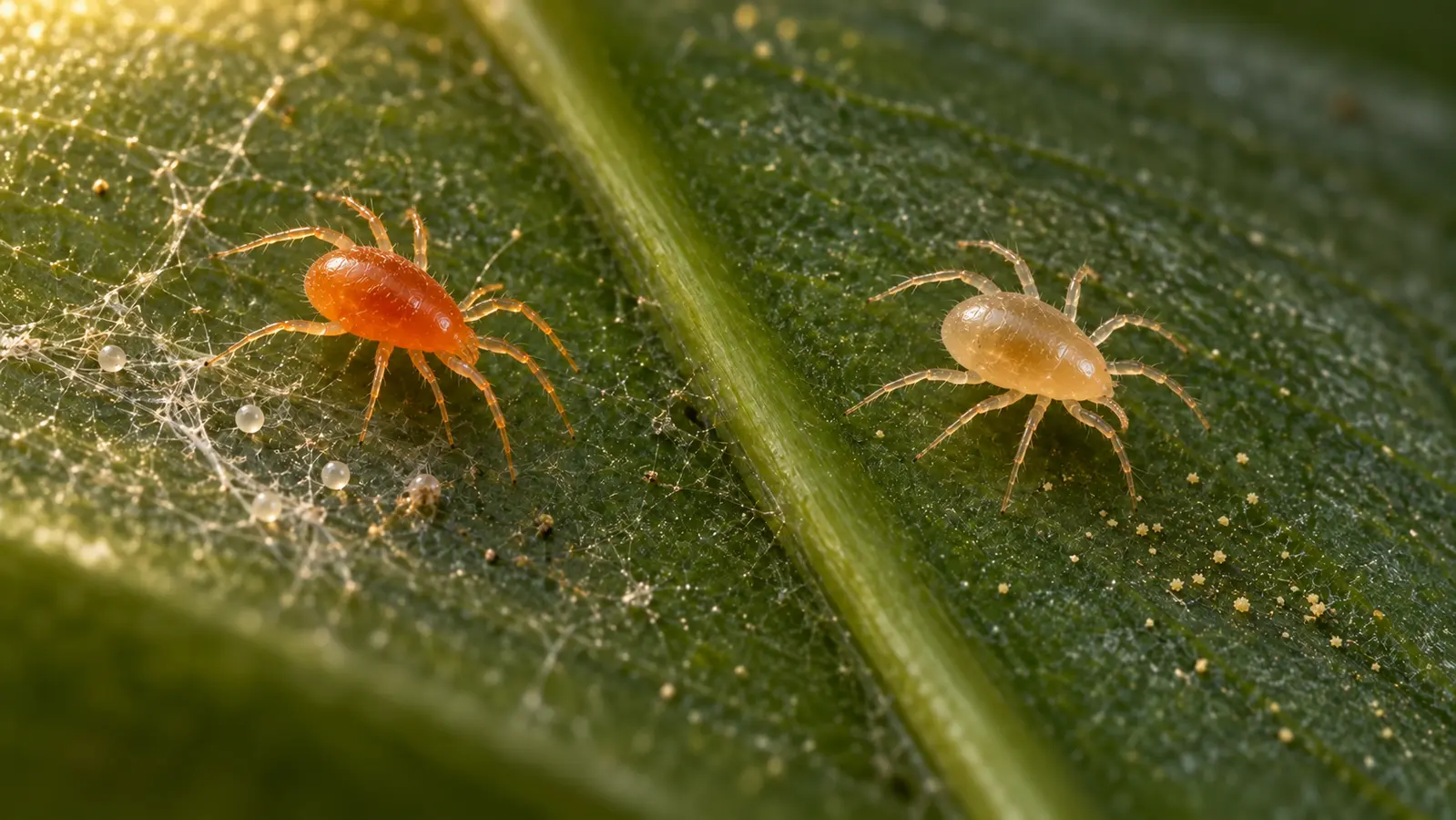
Let us suppose that we have found webbing, spherical eggs and mobile mites with dark patches. The two-spotted spider mite is now our chief suspect. We can choose a hunter.
The Sprinter: the Specialist Predatory Mite (Phytoseiulus persimilis)
It is orange-red, pear-shaped and noticeably faster than its prey. To spider mites, the web is a refuge; to this hunter, it has become a road. It can negotiate the threads, locate the colony and attack every stage: eggs, larvae, nymphs and adults. In favourable conditions, an adult female may consume as many as five adult spider mites a day, or about twenty eggs or young stages. The specialisation of Phytoseiulus persimilis gives it an advantage during an active infestation of web-spinning spider mites, but makes it a poor guard for a clean plant. When the correct prey runs out, the predator disperses, starves and disappears. This is an intervention force, dispatched to a confirmed spider-mite outbreak.
The Patroller: the Californian Predatory Mite (Neoseiulus californicus)
The Californian predatory mite hunts more sedately, but copes better with a shortage of prey, higher temperatures and drier air. It chiefly selects spider-mite eggs and young stages; when these are scarce, it can also survive on other tiny prey and pollen. This makes it suitable for very early intervention and for patrolling a collection in which spider mites have a habit of returning. That does not mean one sachet will give the orchids lifelong protection. Phalaenopsis do not provide an endless abundance of pollen, a home is not a sealed glasshouse, and the predatory mite has signed no contract of employment.
Which Hunter Should We Release?
If a distinct spider-mite colony is already present, with eggs and webbing, choose the sprinter: the specialist predatory mite Phytoseiulus persimilis. If we have found only one or two spider mites, the problem tends to recur, or the home is warmer and drier, the patroller — the Californian predatory mite (Neoseiulus californicus) — may be more useful. No webbing, combined with very slow, flattened mites around the leaf bases, points instead towards flat mites. Do not buy either of these predators blindly. There is not enough evidence to promise that they will control Tenuipalpus pacificus in a home collection. Silvery streaks, black specks and elongated insects suggest thrips, another job for which our two hunters are ill suited. If we find nothing alive, isolate the plant and repeat the inspection every few days. Buying a predator is no substitute for a diagnosis.
An Army Delivered to Your Door
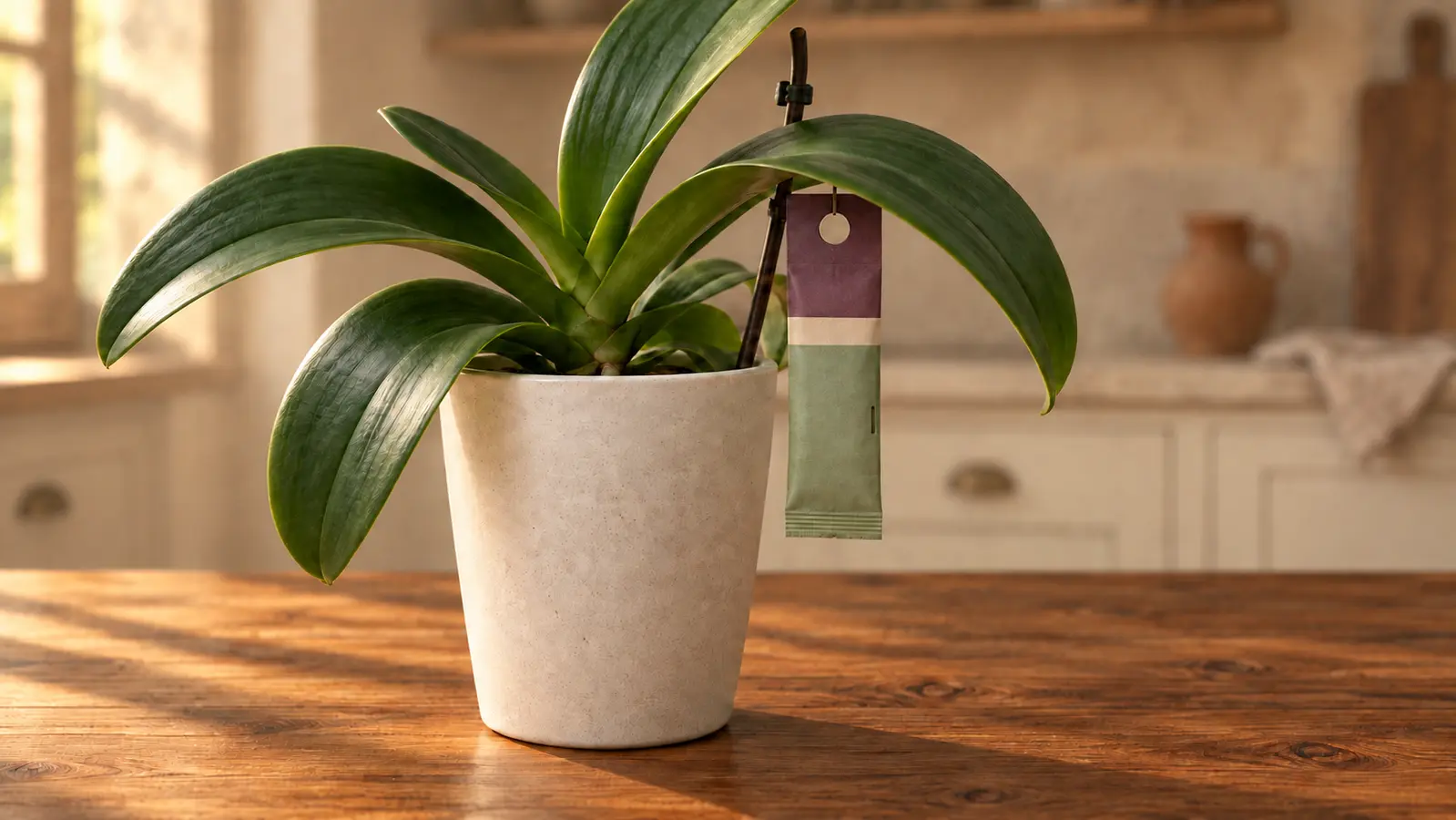
Both hunters are sold in Poland, although the pack size deserves as much attention as the species name. The Californian predatory mite (Neoseiulus californicus) is available, among other forms, in sachets that retail sellers may offer in smaller sets than the manufacturer’s full pack. For somebody with a dozen or several dozen plants, such a set can be put to use without first building a glasshouse behind the house. We checked availability in September 2026; it is worth checking again later, because the trade in living organisms changes with the season. The specialist Phytoseiulus persimilis more often arrives in a bottle containing about 2,000 individuals, sold under names including Spidex. That is a great many for one plant, but not necessarily too many for several infested specimens and their closest neighbours in a collection of thirty.
A large bottle makes a joint purchase with another collector tempting. The manufacturer, however, provides no instructions for dividing and transporting its contents a second time. If the seller cannot supply a smaller quantity, it is wiser to ask how the product should be handled than to move the mites into some improvised container. When searching for a product, use both the English or local common name and the scientific name. ‘Predatory mites for spider mites’ may describe several different creatures; Neoseiulus californicus or Phytoseiulus persimilis leaves far less room for an expensive mistake.
The parcel contains living animals, so it cannot be treated like a preparation that will wait patiently in a cupboard. Check the dispatch day, transport conditions and the instructions for storage and release. A parcel locker is convenient, but leaving the package there for hours during a heatwave or a frost may end the campaign before the army reaches a leaf. Use the predators immediately whenever possible. If the instructions permit brief storage, provide the stated temperature, darkness and ventilation. Do not automatically put them in an ordinary refrigerator. Requirements vary by product: for Spical Ulti-Mite, for example, the manufacturer permits storage for one or two days at 12–14°C.
Prices, pack sizes and availability change, which is why we explain how to find the right organism instead of listing offers that would soon be obsolete. It is also worth distinguishing two methods of release. A bottle allows a measured number of predators to be distributed rapidly over the leaves. A sachet is a miniature breeding colony from which successive generations emerge over several weeks. Do not cut it open or hang it in full sun; hold it by the card strip so that the contents are not crushed.
A Campaign across Thirty Plants
First, move the suspect plant aside and note which specimens its leaves have touched. For spider mites, that contact is bridge enough to the next plant. Once spider mites have been confirmed and the predators distributed, the arrangement can change: infested plants and their inspected neighbours may be placed so that the hunters can travel from leaf to leaf. Do not expect them to march across half the room unaided.
Next, photograph the damaged areas. The pictures will later reveal whether fresh marks are appearing, because the old leaf will not regain its former appearance after treatment. Predatory mites may eat those responsible, but they cannot repair emptied cells. Before ordering, check what the collection has been sprayed with, and when. Residues of some acaricides, insecticides, oils and contact products also kill beneficial mites. There is no single safe interval that applies to every chemical. Tell the supplier the name of the product and, ideally, its active ingredient.
On arrival, release the mites according to the instructions for that particular product. Products differ in the number of individuals, their carrier material and the method of application. Do not mechanically scale a rate intended for a hectare of cucumbers down to a windowsill. What matters most is placing predators close to the outbreaks and carefully inspecting plants that have touched the infested specimen.
At first, inspect the same leaf undersides every three or four days, and continue monitoring for several weeks. Look for living pests, eggs, fresh webbing and new pale feeding punctures. Look for the predatory mites too; they usually move conspicuously faster than spider mites. A single release may not be enough. Bottled products can require repeat introductions, whereas sachets release mites gradually over a longer period. Take the timing of any repeat release from the instructions for the specific product.
Humidity without Creating a Swamp
Phytoseiulus persimilis fares poorly in very dry air. Its eggs and young stages are particularly vulnerable. Neoseiulus californicus tolerates dryness better, although it is hardly a desert creature. Greater tolerance is not indifference: according to the manufacturer’s documentation, its performance also declines below roughly 60% relative humidity.
There is no need, however, to turn the entire home into a glasshouse. A sensor at the far side of the room does not describe the microclimate beneath a leaf with any precision. The rise in humidity at night, the plant’s hydration and the absence of a hot draught also matter. A humidifier may help, but it should not soak the flowers or leave water in the crowns. Any increase in humidity must be accompanied by air movement. Saving the predators at the cost of a rotting orchid would be a victory rather difficult to celebrate.
How Do We Know They Have Won?
A damaged leaf will not recover its former appearance, so the old marks cannot tell us whether the campaign has succeeded. What matters is the absence of new pale dots and fresh strands of webbing, a falling number of living spider mites and healthy new leaf growth. Rather than staring at the same scar each day in expectation of a miracle, compare photographs of the same areas.
If the pest population continues to rise, check whether the predators arrived alive and reached the right leaves, whether pesticide residues harmed them and whether the air was too dry. It is also worth returning to the most important question: was the enemy really a spider mite? Biological control is a race between two populations. The predator must reproduce and hunt faster than the pest can damage the plant. We can assist with suitable temperature, humidity and placement on the leaves. We cannot persuade it to eat a creature it does not recognise as food. Beneath the leaf, the pursuit continues beyond our sight, and the webbing does not stop a specialised hunter. The owner is left with the most difficult task of all: identifying the enemy and choosing a predator genuinely capable of defeating it.
In the Next Part
In Part III, we shall leave the world of eight-legged pests and venture into flowers occupied by thrips, beneath the waxy covering of mealybugs and under the shields of scale insects. There we shall meet predatory bugs, lacewings, ladybirds and tiny parasitoid wasps that have adopted a particularly unsettling way of life: they lay their eggs inside other insects.
Sources and methodological notesExpand +Collapse −
- University of California Statewide IPM Program. Phytoseiulus Predatory Mites.
- University of California Statewide IPM Program. Neoseiulus Predatory Mites.
- University of California Statewide IPM Program. Spider Mites: Pest Management Guidelines.
- University of California Statewide IPM Program. Thrips.
- Łabanowski, G., Soika, G. (2012). False spider mites as pests on orchids (Phalaenopsis hybrids) in Poland. Biological Letters 48(2), 167–175.
- Denmark, H.A. Phalaenopsis Mite, Tenuipalpus pacificus Baker. University of Florida IFAS Extension.
- University of Florida IFAS Extension. Orchid Insect and Mite Pests in South Florida.
- Messelink, G.J., Leman, A. (2020). Are low humidity levels a limiting factor for spider mite control by phytoseiid predators under fluctuating climatic conditions?. Wageningen University & Research.
- Sulek, N. et al. (2023). Prey consumption capacity and functional response of Phytoseiulus persimilis to Tetranychus urticae. Acarologia.
- Cornell Integrated Pest Management. Neoseiulus californicus: predatory mite.
- Koppert Poland. Spidex: Phytoseiulus persimilis. Product directions for use and storage.
- Koppert Poland. Spical Ulti-Mite: Neoseiulus californicus. Product directions for use and storage.
- Koszyk Rolnika. Spidex 2000: Phytoseiulus persimilis. An example of a pack available from a Polish retail seller in September 2026; availability and price may change.
Most studies of predatory-mite efficacy have been conducted in laboratories and glasshouses, on plants other than Phalaenopsis. This article distinguishes well-established knowledge of the species’ biology from the cautious application of biological-control principles to a home collection.